












- ANALIZA
- WIADOMOŚCI
The migration crisis in Ceuta as a tool of hybrid warfare?

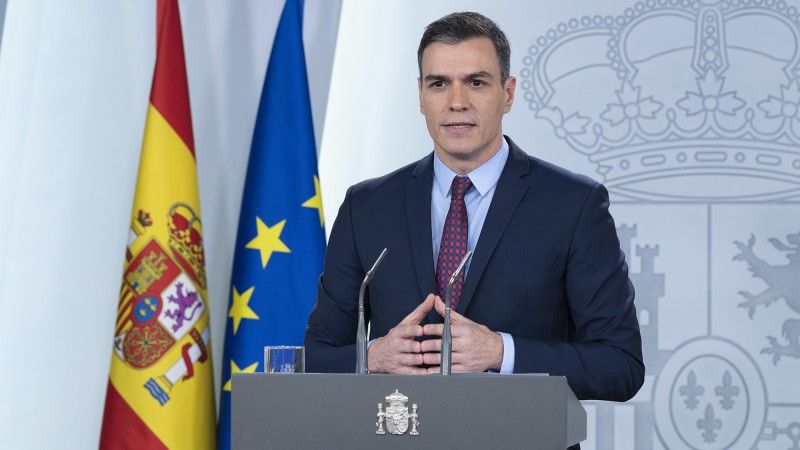
Photo. Government of Spain
At the end of July, tens of thousands of people illegally crossed the border between Morocco and Spanish territory in North Africa. How is the sudden migration crisis affecting relations between EU states, and are we witnessing a case of hybrid warfare?
The cause of the sudden influx of migrants into Ceuta may lie on Morocco’s side, as the country claims rights to control over the Spanish enclaves of Ceuta and Melilla. The incident occurred on a Moroccan national holiday, during a visit by King Mohammed VI to a nearby city. The King does not recognise Spanish control over the North African territories. Could the sudden indifference of Moroccan border guards toward tens of thousands of people illegally crossing the border have been a political provocation?
The migration crisis in Ceuta
On July 30, around 72,000 people illegally crossed from Morocco into Ceuta, Spain’s autonomous territory in North Africa. This is one of the most serious migration incidents in recent times. Most of those who arrived left Ceuta just a few hours later, but several thousand migrants remain in the Spanish enclave. Residents of Ceuta took to the streets, protesting and demanding the immediate expulsion of the migrants, citing security concerns. Tensions in the city rose after a military vehicle carrying four soldiers was attacked and pelted with stones by a group of about 70 migrants.
Given the situation, police and military presence in Ceuta was increased. Mass deportations are contrary to international law and to rulings by the Spanish judiciary. The Spanish government also does not want to transport the migrants to mainland Europe, fearing opposition from both domestic political rivals and some EU member states. Spain intends to review each remaining migrant’s asylum application individually and has requested assistance from Frontex and the European Commission. This is not the first time the authorities have loosened controls on the Moroccan border, allowing a wave of migrants into Ceuta. In May 2021, around 9,000 people illegally entered Spanish territory in North Africa after Moroccan police abandoned their duties and suspended border checks. The motive cited for that decision was Morocco’s dissatisfaction with Spain’s actions regarding Western Sahara.
Western Sahara was a Spanish colony until 1975, when Spain decided to hand over control of it to Morocco and Mauritania. Morocco now treats Western Sahara as part of its own territory, despite the declaration of independence by the Polisario Front, a political-military organisation opposing Moroccan rule in Western Sahara. The 2021 border crisis in Ceuta occurred shortly after Polisario Front leader Brahim Ghali was granted permission to receive medical treatment in Spain. Five years later, does control over Western Sahara remain the real motive behind Morocco’s actions?

What is really behind the crisis?
In the second half of July, Pedro Sánchez paid a visit to Algeria, a country in conflict with Morocco over the status of Western Sahara. It was his first visit to the country since 2022, when Spain abandoned its neutrality on Western Sahara and backed Morocco’s claims to the territory, a move that displeased Algeria’s authorities at the time. This year’s warming of relations may not have pleased Morocco’s leadership and could have been perceived as a challenge to its regional position. Morocco has officially attributed the sudden wave of migration to disinformation on social media. But is that a sufficient explanation for why Moroccan border services allowed thousands of people to cross the border illegally?
Morocco is a close ally of the United States and Israel. In 2020, Morocco normalised relations with Israel, and in exchange the US recognised its control over Western Sahara. Military cooperation between the two countries has been deepening recently. In August, American and Moroccan forces conducted joint long-range missile tests on Moroccan territory. Meanwhile, diplomatic relations between the US and Spain have recently been going through a crisis. Spain is the only NATO member state to have openly rejected increasing defence spending to 5% of GDP at the alliance’s latest summit. A few months earlier, the Spanish government also refused to grant the US access to its military bases and airspace for an operation against Iran.
Given the tense Spanish-American relationship, and with such an influential ally on its side, Moroccan authorities may have seized the opportunity to assert their position and show Europe what could be in store if it fails to cooperate with Morocco. Last week, Morocco also renewed its territorial claims to the Spanish enclaves of Ceuta and Melilla, citing historical and geographical rights to these territories, another move aimed at asserting its influence in the region.

Divisions within Spain
This year’s crisis on the Moroccan border triggered a wave of criticism from both EU member states and the Spanish opposition. Particularly sharp discontent came from Italy. Giorgia Meloni described the events in Ceuta as proof that uncontrolled migration poses a serious threat to European borders. Italy temporarily reinstated border checks with Spain, and the Spanish government responded in kind. Leaders of 22 EU member states sent a letter to EU institutions expressing their dissatisfaction and concern over the situation in Ceuta, demanding a meeting of interior ministers to develop a further strategy. Also drawing criticism was the Sánchez government’s June decision to legalise the residency status of half a million migrants who could prove they had lived in Spain for at least five months, a move that stands out against the backdrop of other EU states currently tightening their migration policies. Will the events of recent months change Spain’s approach to migration management?
So far, nothing suggests that Spain intends to take concrete action against Morocco’s conduct. Sánchez emphasises that there is no evidence Morocco is responsible for the sudden mass influx of migrants into Ceuta. The Spanish opposition disagrees, claiming there are indications the government knew in advance about Morocco’s planned moves at the border. A report submitted to Spain’s National Court by the National Center for Immigration and Borders also points to the involvement of Moroccan authorities in the events of late July. The report argues that migration was used as a smokescreen to encourage, promote, and direct the mass influx of people toward the Ceuta border, citing as evidence the fact that most of the migrants’ profiles did not match a genuine intention to remain in Spain. The report also links this year’s events to those of 2021. If the information it contains is confirmed, Spain will need to change the nature of its cooperation with Morocco and develop effective strategies for securing the borders of its autonomous territories.
Public discontent is becoming increasingly visible. Thousands of people across the country are taking to the streets to express their disappointment with the decisions of Pedro Sánchez’s government and to demand his resignation. Given this situation, the Spanish government should demonstrate concrete actions and strategies for the future. Sánchez explains the Spanish authorities’ decision to allow the mass border crossing into Ceuta on humanitarian grounds, stressing that a more aggressive approach could have led to tragedy. However, Spaniards concerned about their safety amid the uncontrolled influx of migrants see the government’s stance as failing to ensure their security. Amid growing discontent, Sánchez’s chances of re-election in next year’s elections are shrinking. It is increasingly likely that Spain will follow the well-trodden European path sharply to the right.

What's next for Spain?
Voices are openly suggesting that Morocco is waging a hybrid war against Spain. Given that the main goal of hybrid actions is to destabilise a state by deepening its internal divisions, the situation on the Moroccan border fits this pattern. The recent events in Ceuta have exposed weaknesses not only in the Spanish government but across the entire Union. Member states did not hesitate to openly criticise the actions of Pedro Sánchez’s government and raised the possibility of suspending Schengen rules with respect to Spain. The situation in Ceuta shows how easily panic can spread among member states, leading them to abandon action based on the EU principle of solidarity. The effects of the 2015 migration crisis are still being felt, and in the face of threats to border security, national interests speak louder than the search for cooperation-based solutions. The EU should pay closer attention to the risk of its neighbours using migration as a bargaining chip.
Social unrest related to security and border protection, combined with increasingly bold provocative moves by Morocco, suggests that Spain should seriously reconsider increasing the share of its GDP spent on defence. Morocco is behaving like an ally in whom Spain should place only limited trust, particularly given its territorial claims. Pedro Sánchez, aligned with the social-democratic political current, opposed spending 5% of GDP on defence, arguing that it was necessary to cut costs elsewhere in order to preserve social benefits and the ecological transition. On today’s European political scene, dominated by right-wing and centre-right currents, this stance clearly stands out.
Amid security-related crises, Sánchez’s narrative could end up benefiting parties such as the centre-right Partido Popular or the more conservative Vox. If Morocco continues to use migration as a tool of hybrid warfare against Spain and grows increasingly bold in asserting its claims over the Spanish enclaves and Western Sahara, an increase in military engagement in Ceuta and Melilla will become necessary. Faced with a crisis that Spain is experiencing as a result of “its own decisions,” EU member states show little willingness to put the principle of solidarity into practice. Spain’s approach to defence spending, which diverges from that of most European countries, is leaving it isolated within the EU. In this context, a takeover of power by the right and a shift in the current political narrative toward a more “European” one seem highly likely.


