












- ANALIZA
- WIADOMOŚCI
- WAŻNE
Intelligence warned, the government slept: Anatomy of Spain’s debacle in Ceuta

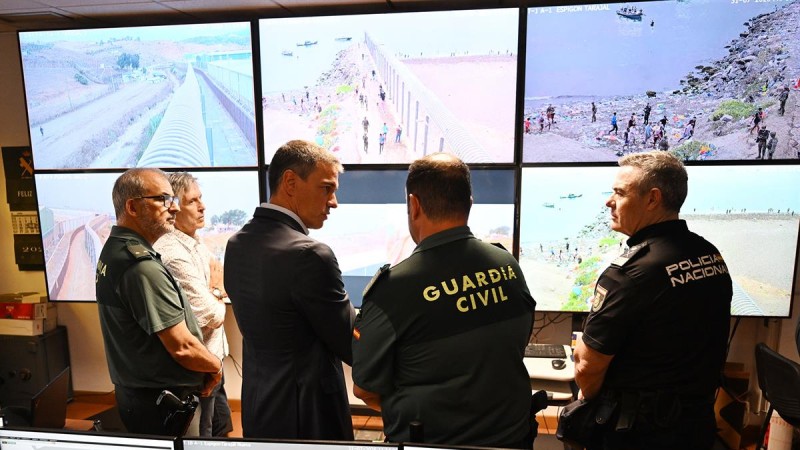
Photo. Borja Puig de la Bellacasa/Oficjalna strona internetowa rządu Hiszpanii (lamoncloa.gob.es)
The assault on Ceuta did not strike Spain like a bolt from the blue. For days, the number of attempted crossings had been rising, the Guardia Civil had been submitting alarming data, local authorities were warning that they were losing control, and (according to military and civilian sources) Madrid had received warnings of a possible coordinated operation during Morocco’s Throne Day celebrations. The government was not deprived of information. It was paralysed by its own inertia, its political caution toward Rabat, and its inability to make a decision before the border effectively ceased to exist.
The most serious charge against Pedro Sánchez’s government is not that the intelligence services failed to predict the exact number of migrants or the precise hour at which the assault would begin. It is that the administration received a succession of signals indicating a mounting threat, yet none of them prompted an adequate response.
According to findings reported by Euronews, El Pueblo de Ceuta, and other media outlets, military and civilian sources had allegedly warned the authorities that Morocco might deliberately relax its border controls during Throne Day, celebrated on 30 July. It has not been disclosed, however, whether the information originated with the CNI, the Armed Forces Intelligence Centre (CIFAS), or the intelligence structures of the Guardia Civil or National Police.
In practical terms, this meant that thousands of migrants could be used as an instrument of pressure against Spain. Developments on the Moroccan side should have triggered an alarm: an increased number of buses transporting people to Fnideq, a growing concentration of young men near the border, and a sharp rise in attempted maritime crossings.
Preparations of this kind are not organised within a few hours. Thousands of people do not suddenly appear in a border area solely as a result of a spontaneous impulse. Even if some of those involved travelled there independently, the sheer scale of the mobilisation should have been treated as an operational indicator of the highest importance. Madrid, however, waited. It waited for the forecast to become a crisis, and for the crisis to become a catastrophe.

Guardia Civil's data was self-explanatory
The government did not even need to rely on classified intelligence reports. It had official Guardia Civil data showing that pressure on the border was increasing at a rate that could not reasonably be dismissed as an ordinary seasonal fluctuation.
As El País reported, approximately 500 attempts to reach Ceuta and Melilla by sea were recorded between 29 June and 12 July. Over the following two weeks, that figure rose to approximately 1,300. In the space of less than a fortnight, activity along the routes leading to the Spanish enclaves had therefore more than doubled.
That is precisely what early warning is about. It is not about predicting the future, but about identifying changes in tempo, scale, and modus operandi. When the number of attempted crossings rises sharply, reception centres are overcrowded, migrants remain on the streets, and local authorities publicly appeal for assistance, a responsible state does not wait for the final assault. It increases staffing levels, prepares reserves, reinforces maritime security, and places military forces on alert.
The Spanish government failed to do so in time. Interior Minister Fernando Grande-Marlaska was familiar with the Guardia Civil reports. He knew that the number of attempted crossings was rising. He also knew that Ceuta’s migrant reception system was approaching the limits of its capacity. He did not need a report stamped “the assault will take place tomorrow” to understand that the situation was approaching a tipping point.
Ceuta sounded the alarm, Madrid looked elsewhere
Juan Jesús Vivas, President of the Autonomous City of Ceuta, publicly warned that the city was losing its capacity to receive additional arrivals. He spoke of overcrowded centres, people sleeping on the streets, and a growing security threat.
One day before the crisis reached its peak, the situation was already the subject of public debate. On the morning of 30 July, media outlets reported that approximately 1,500 people had reached Ceuta within a week. This was yet another indication that the situation no longer involved isolated attempts to cross the border, but a mounting wave.
Madrid still did not treat Ceuta as an area facing an imminent security crisis. According to accounts cited by El País, the government’s attention was being consumed at the time by wildfires in other parts of the country. Ceuta was reportedly outside the central authorities’ primary field of concern.
This explanation does not mitigate the government’s responsibility. On the contrary, it compounds it. A state cannot suspend the protection of one border because a separate crisis is unfolding in another region. Administrative structures, security services, and procedures exist precisely so that multiple threats can be managed simultaneously.
If warnings from Ceuta were downgraded because the government was dealing with wildfires, this demonstrates not an absence of information, but a loss of the capacity to manage several dimensions of national security at the same time.

Playing with definitions
Once the border had been breached, the government began arguing that it had not received information predicting precisely such a course of events. Grande-Marlaska maintained that the National Intelligence Centre had not submitted a report forecasting that tens of thousands of migrants would enter en masse on a specific day. The government’s delegate in Ceuta, Miguel Ángel Pérez Triano, likewise denied having received a warning concerning an influx on such a massive scale.
This is a convenient defence, but not a credible one. The government equated an intelligence warning with a document that would have had to specify the exact date, time, location, and number of participants. In other words, the administration expected not a risk assessment, but a prophecy.
Security services almost never possess a complete scenario of a future event. They provide fragmentary information: increased activity, unusual movements, changes in the other side’s behaviour, concentrations of people, preparations for transportation, and the growing vulnerability of the border. The role of political leaders is to connect these elements and make a decision before it is too late.
Madrid is now attempting to persuade the public that the absence of a report predicting the arrival of precisely tens of thousands of migrants means that there was no warning. This is a manipulation of definitions. The warnings existed. What was missing was a decision.
Armed Forces awaiting political orders
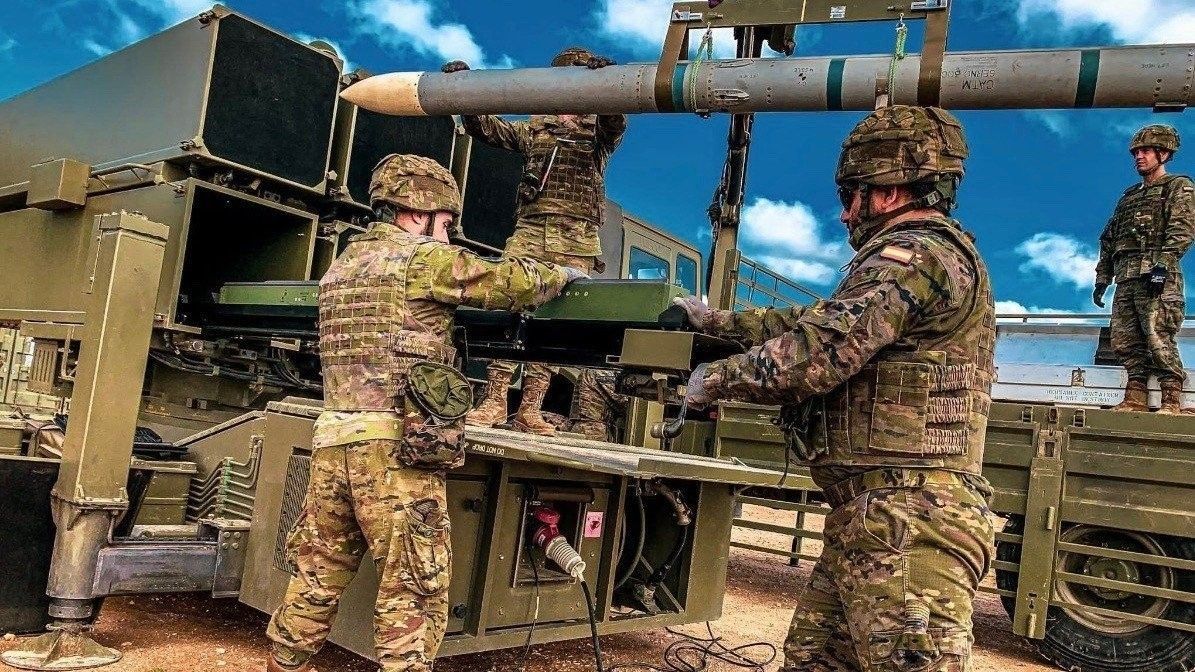
Spain had military units stationed in Ceuta and Melilla that could have been placed on alert in advance. There was no need to organise a major deployment operation from the mainland. It would have been sufficient to prepare troops to support the border services, deploy additional patrols, and secure the most vulnerable sectors. Such measures, however, required a political order. That order never came.
When thousands of people moved toward the border crossing and the breakwaters, Guardia Civil officers and police personnel were no longer able simultaneously to protect the border, rescue people from drowning, assist the injured, and control the influx. The state lost the ability to register, screen, and detain every person entering its territory. Only then did the government begin deploying additional forces. Military personnel, larger police contingents, maritime patrols, and barriers arrived after the border had already been breached. This was not a defence plan, but a hurried attempt to contain the consequences of earlier neglect.
The government behaved like a guard who ignores noises at the door and, once the crowd has forced its way inside, begins checking where the keys are kept.
Morocco: A political blind spot
A second source of the government’s inaction may have been its reluctance to openly question cooperation with Rabat. Although Prime Minister Sánchez spoke of a violation of Spain’s territorial integrity, he simultaneously emphasised the country’s good cooperation with the Moroccan authorities. The official narrative directed attention toward smugglers and information disseminated through social media.
This messaging was convenient for Madrid because it allowed the government to avoid asking whether an influx on such a scale could have occurred without at least the temporary passivity of the Moroccan security services.
According to some accounts, Moroccan officers did not attempt to stop the crowd for a period of time. Reports also emerged that individuals linked to Moroccan intelligence were among the migrants and were observing the Spanish response.
The scenario of using migration as an instrument of pressure should not, however, have come as a surprise to Spain. In 2021, Madrid experienced a similar crisis after Morocco relaxed its border controls.
Following those events, Spain announced that it would establish an effective early-warning system and a comprehensive protection plan for Ceuta and Melilla. Five years later, it became apparent that warnings were still circulating between institutions, while decisions were being made only after the crisis was already being broadcast on camera.
The information was there. The state was not
The dispute over whether the CNI produced a single detailed report obscures the essence of the matter. A state does not operate on the basis of one document, but on the overall situational picture. And that picture was sufficiently clear.
There was a sharp rise in the number of attempted crossings. Reception centres were over capacity. Ceuta’s authorities issued public appeals. There were reports of people concentrating on the Moroccan side. There were reports of buses travelling toward the border area. There were warnings from military and civilian sources. Finally, there was the experience of the 2021 crisis.
Each of these indicators, considered separately, might have been deemed insufficient. Taken together, they formed a picture of an explosion in preparation. Either the government failed to recognise that picture, or it concluded that the political cost of acting early would be greater than the risk of remaining passive. In either case, responsibility rests with Madrid.
It was not only the intelligence services that failed. The administration failed because it was unable to convert information into a decision. Coordination between the security services, local authorities, and central government failed. Political leaders failed because they preferred to sustain the narrative of successful cooperation with Morocco rather than prepare for the worst-case scenario.
In the aftermath, one may debate whether the assault was spontaneous, tolerated, or instigated. What cannot seriously be claimed is that Spain received no warnings.
Madrid saw the wave building, but pretended it was observing only individual drops. When the wave struck Ceuta, the government announced that no one had warned it of the approaching tide.


