- WIADOMOŚCI
Challenger 3 passes its first tests. Early results look promising

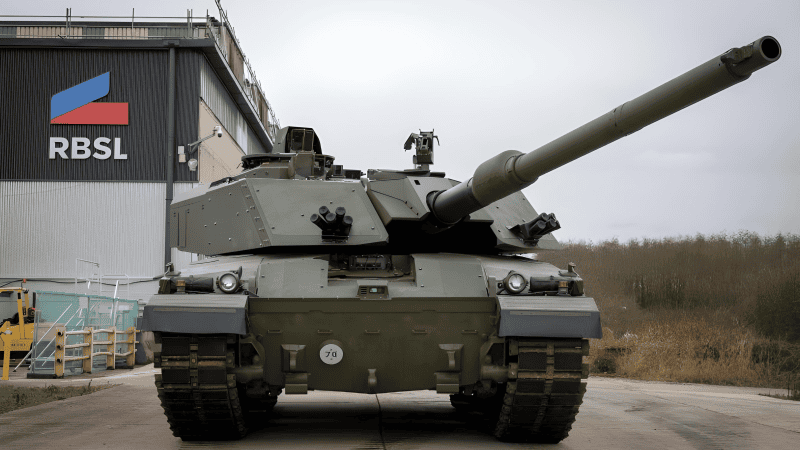
Photo. RBSL
In summer 2026, the first phase of testing the Challenger 3 tank prototypes came to an end. The next phase will be conducted over the winter of 2026–2027. All indications are that this could be the least problematic heavy equipment programme undertaken by the British Army.
As Christopher F. Foss of Shepard reports, the RBSL (Rheinmetall BAE Systems Land) consortium completed the first phase of RGT (Reliability Growth Trials) testing of the Challenger 3 tank prototypes in collaboration with the British Army in summer 2026. The second phase of these trials will continue over the winter of 2026–2027. So far, RBSL has built and handed over seven prototypes for testing, while the eighth is in the final assembly stage. Ultimately, all eight prototypes are to be brought up to production configuration. RBSL also reports that no major problems or surprises have been recorded during the 18 months of RGT testing to date. All firing trials with the main armament have also been completed. Importantly, no excessive vibration problems have been recorded during testing of the Challenger 3 prototypes.

Photo. RBSL
RBSL plans to begin the production upgrade of Challenger 2 main battle tanks to the Challenger 3 standard in 2028. Importantly, although the current plan is to upgrade 148 tanks for the British Army, the possibility of upgrading additional vehicles in the future has not been definitively ruled out. Oman is also interested in upgrading its Challenger 2 tanks to the Challenger 3 standard; it operates 38 Challenger 2s. Their operation is becoming increasingly costly and difficult, so upgrading them is advisable. Most importantly, this would involve replacing the 120 mm L30A1 rifled gun, which fires unusual three-piece ammunition, with a 120 mm smoothbore gun that fires standard NATO 120 × 570 mm unitary ammunition. Other components that have been out of production for decades and are in short supply in storage would also be replaced.

Photo. Sergeant Ben Beale - www.defenceimagery.mod.uk/OGL 3
Another interesting development concerns changes to the British Army’s organisational structure. The original plan was to retain two tank regiments (effectively tank battalions) with a Type 56 organisation, meaning that both regiments—the Royal Tank Regiment and the King’s Royal Hussars—would each have 56 tanks, for a total of 112 Challenger 3s. These plans have changed, and three tank regiments will remain in service: the Royal Tank Regiment, the King’s Royal Hussars and the Queen’s Royal Hussars. The difference is that instead of a Type 56 organisation, they will have a Type 44 organisation. They will therefore have a total of 132 Challenger 3 main battle tanks, while the remaining 16 will serve as a small wartime reserve and for training soldiers. This shows that upgrading a larger number of tanks would ultimately be desirable, but that will depend on the available budget.

Photo. Rheinmetall BAE Systems Land / X.com
Another important issue being raised is the upgrade and standardisation of CRARRV (Challenger Armoured Repair and Recovery Vehicle) armoured recovery vehicles, Trojan engineer tanks and Titan bridge-layers alongside the Challenger 3. This would involve fitting the same third-generation Hydrogas hydropneumatic suspension and the new HTT (Hydraulic Track Tensioners) system, as well as upgrading the powerpack under the HAAIP (Heavy Armour Automotive Improvement Programme). The upgrades would include engines of the same CV12-9A variant, an improved TN54E transmission, new air filters, a new powerpack cooling system and an intake manifold heater as part of an improved electric cold-start system.

Photo. British Army