


- ANALIZA
- WIADOMOŚCI
Russia is turning T-72s into armoured robots. The development of Shturm [ANALYSIS]

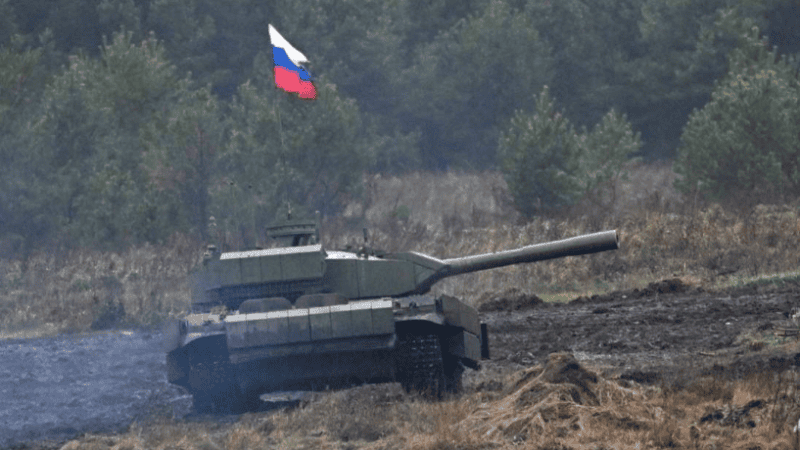
During the Tsentr 2026 exercise, the Russian Ground Forces officially presented several new armoured fighting vehicle developments. One of these is the TShRK Shturm.
The article explains:
- What is Russia’s TShRK Shturm family?
- What equipment and weapons do the individual vehicles carry?
- How might they operate together and be employed on the battlefield?
The TShRK (Тяжёлый Штурмовой Роботизированный Комплекс, or Heavy Robotic Assault System) Shturm is a new armoured fighting vehicle concept intended to complement more conventional, crewed armoured fighting vehicles. The TShRK Shturm comprises three vehicle types that probably form a platoon. All are most likely based on the chassis of the T-72 Ural/Ural-1 or T-72A tank. The platoon includes a crewed heavy armoured personnel carrier serving as a command vehicle, which houses the operators of the unmanned variants. These variants can be described as a tank or fire support vehicle and an unmanned counterpart to the BMPT tank support fighting vehicle (Боевая Машина Поддержки Танков).
Command vehicle
For self-defence, the command vehicle carries a remotely operated weapon station armed with a 12.7 mm 6P49 Kord heavy machine gun chambered for 12.7×108 mm ammunition. Its crew most likely consists of two or three soldiers: a driver, a commander, and possibly a weapon station operator, although the commander may also operate the weapon station. Inside, there are most likely four to six workstations for the unmanned fighting vehicle operators, with two workstations allocated to each vehicle. In theory, therefore, the platoon consists of a command vehicle and two or three fighting vehicles. Communications between the command vehicle and the unmanned fighting vehicles are assumed to be maintainable within a radius of up to 3 km.

Photo. Uralvagonzavod
The command vehicle itself appears to be fairly well armoured, with its ballistic protection optimised primarily against shaped-charge warheads. This is natural, considering that the vehicle is intended to remain somewhat to the rear and may be exposed primarily to attacks by, for example, small FPV drones carrying shaped-charge warheads. Unfortunately, more detailed information is unavailable, including on the powerplants of the vehicles developed as part of the TShRK Shturm system. Possible engines include the 780 hp V-46-6, the 840 hp V-84-1 or V-84MS, the 1,000 hp V-92S2, or the 1,130 hp V-92S2F. On paved roads, these vehicles can most likely reach 60–70 km/h, while their operating range is probably around 400–500 km.
Unmanned MBT/Fire support platform
The unmanned fighting vehicle that can be described as a tank or fire support vehicle is also based on the T-72, but its turret has been replaced. The new turret is smaller and welded from rolled armour plates. It lacks built-in composite armour modules protecting its front; explosive reactive armour modules provide protection instead. This again indicates that the vehicle’s armour protection is optimised against shaped-charge warheads. The hull front most likely retains its built-in composite armour, while explosive reactive armour modules cover the exterior of the hull front and sides.

Photo. Uralvagonzavod
The turret houses a 125 mm D-414 gun. This is a modified gun from the 2A46 family, which still fires standard Soviet 125 mm separate-loading ammunition. The principal modification involved shortening the barrel and fitting an additional protective jacket intended to shield it from damage caused by fragments or impacts, for example, in built-up areas. This clearly indicates that the vehicle is intended primarily for urban combat and engaging personnel rather than anti-tank missions. The gun is loaded by the standard electrically powered AZ-184 autoloader, whose ammunition magazine holds 22 projectile-and-propellant-charge sets.

Photo. Uralvagonzavod
A 7.62 mm 6P7K PKTM general-purpose machine gun, chambered for 7.62×54 mm ammunition, is mounted coaxially with the main gun. Its ammunition supply is unknown but probably amounts to around 2,000 rounds. Additionally, what are most likely two multi-tube launchers are mounted on the turret sides, probably carrying rocket-propelled munitions with thermobaric warheads. These may have been adapted directly from other weapons of this type, such as RPO or RShG shoulder-fired thermobaric launchers, or possibly from anti-tank guided missiles such as the Kornet system, using the 9M133F-1/F-2 thermobaric variants rather than a tandem shaped-charge warhead.
Unmanned MBT support fighting vehicle
The next variant uses the same chassis but has a different turret system housing its armament. The new turret is an unmanned, modified version of the system used on BMPT tank support fighting vehicles. Its main armament consists of two paired 30 mm 2A42 automatic cannons firing 30×165 mm ammunition. A 6P7K PKTM general-purpose machine gun is also mounted coaxially with the cannons. The ammunition supply should total around 850 rounds of 30×165 mm ammunition, with 425 rounds allocated to each cannon. One cannon is fed with 3UOF8 fragmentation-incendiary or 3UOR6 fragmentation ammunition, while the other is fed with 3UBR6 armour-piercing or 3UBR8 sabot armour-piercing ammunition.

Photo. Uralvagonzavod
The PKTM machine gun should have an ammunition supply of around 2,000 rounds of 7.62×54 mm ammunition. Launchers for thermobaric munitions, identical to those on the tank/fire support vehicle variant, are installed on the turret sides. Unfortunately, neither the number of these munitions carried nor their effective range is known. It should be assumed, however, that these are relatively short-range weapons suited to urban combat and engaging targets such as field fortifications at limited distances. The turret’s armour appears to have been reduced compared with its BMPT counterpart and relies mainly on homogeneous steel armour and explosive reactive armour modules.
See also 
Concluding notes
The TShRK Shturm is an interesting concept intended to complement crewed fighting vehicles. Heavy unmanned vehicles of this type can be used during the initial phase of operations aimed at breaching enemy defensive lines, drawing the enemy’s attention and fire. At the same time, they can return fire with their onboard weapons and therefore pose a real threat that cannot be ignored. The TShRK Shturm also provides an excellent example of certain inherent limitations of unmanned systems, including the short communications range between the vehicles and their command vehicle or command post, the significant risk of losing the connection, and the fact that neutralising the command vehicle disables the entire platoon. Reduced situational awareness compared with crewed vehicles is another limitation.
1/ Thread Yesterday was quite an eventful day. Russian Center-2026 joint exercise, brought a ton of new equipment showcases, some confirmations of standing claims, some interesting vehicles returning in the background, and some heated discussions, so let's talk a bit about em! https://t.co/xhmUhf8Qaq
— Volke (@Volke__) October 3, 2026
At the same time, systems such as the TShRK Shturm occupy a highly specialised niche within ground forces. They also offer a way to make effective use of older or obsolete armoured fighting vehicles that have exhausted their potential for modernisation and further development as crewed platforms but can be converted into unmanned vehicles. Their potential loss on the battlefield is less costly, while certain technical limitations, such as outdated armour that no longer provides adequate protection, are less of a problem. Since protection is optimised primarily against shaped-charge warheads, it can be reinforced relatively easily with explosive reactive armour. Time will tell how the TShRK Shturm concept develops.


