- ANALIZA
- WIADOMOŚCI
The economics of cheap drones [PART 1]

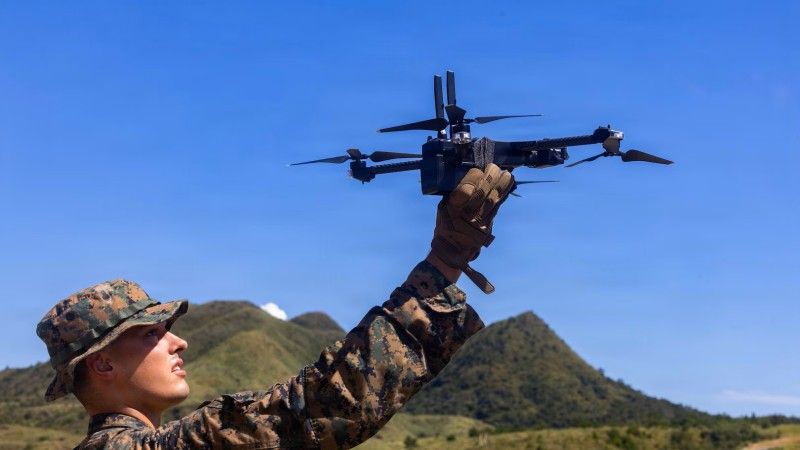
For many years, the development of the defence industry was based on a simple assumption: whoever could build the more advanced platform gained the advantage. This applied to aircraft, tanks, warships, and today also to unmanned aerial systems – from cheap FPV drones, through multirotors and loitering munitions, to larger reconnaissance and strike UAVs. In practice, however, the experience of recent years shows that, in the case of cheap drones, the logic of competition has fundamentally changed.
Paradoxically, the drone itself is increasingly less often the most valuable element of the entire system. What is more, this is apparently no longer any particularly secret knowledge, because today virtually everyone knows perfectly well how a drone works, what it is used for, and why it is worth having lots of them. A few videos, a few conferences, and, naturally, a touch of expert self-confidence are enough. In the age of drones, therefore, the greatest value is paradoxically not the drone itself.
The drone as a platform
The production of simple drones is becoming increasingly accessible. Frames, motors, flight controllers, cameras, and power systems can be purchased from many suppliers around the world. Technologies that just a few years ago were reserved for the largest manufacturers are becoming widely available. In other words, the drone increasingly resembles not a mysterious technological artefact accessible only to the chosen few, but rather a device that – with the right amount of money, off-the-shelf components, and confidence – can simply be assembled.
This means that the advantage resulting solely from hardware design is rapidly disappearing. Every successful solution can be copied in a relatively short time, and price competition becomes inevitable. You may have an excellent motor, a lightweight frame, and a camera with impressive specifications, but it is difficult to expect the mere presence of these components to provide a market advantage for decades to come. Especially since a competitor may already be ordering a very similar set, just with a different label.
As a result, the drone itself is beginning to resemble a personal computer, with its value stemming not from the casing or processor, but from the software and services that run on it. This is where the real difference begins – one that cannot be so easily shown in a manufacturer’s catalogue photograph.
Software can determine how a drone plans its route, avoids obstacles, recognises objects, transmits imagery, cooperates with other unmanned systems, or responds to changing conditions. There are also other services, such as analysing data collected by the entire fleet, software updates, mission management, integration with other systems, archiving material, operator training, or remote diagnostics. In other words, everything that cannot be impressively placed on a table during a customer presentation, but which may determine whether ten drones are actually a useful system or merely ten expensive flying objects.
For example, value may lie not in the camera itself, but in an algorithm capable of extracting an object of interest from the image. Not in the transmitter itself, but in a system capable of maintaining connectivity and managing data transmission. Not in a single drone, but in software that allows an operator to manage an entire fleet without having to conduct ten conversations, monitor ten screens, and worry ten times that something might freeze.
An even more interesting model is one in which the drone – regardless of whether it is airborne, surface-based, underwater, or ground-based – becomes part of a larger service. The user then does not have to purchase merely the device, but receives an entire package: hardware, software, cloud services, data analysis, updates, and support. In practice, this means moving from the “buy a drone” model to the “buy the capability to perform a specific task” model. And this is a fundamental change, because customers care less and less about how many propellers the device has and increasingly about whether, after the mission is completed, the system will deliver something more than footage of several hectares of farmland and a message saying: “file saved successfully.”
This is precisely why, in the future, an increasing share of the value may lie above the drone rather than inside it. Hardware will become increasingly standardised, interchangeable, and accessible, while the advantage will be provided by the digital layer – algorithms, data, integration, automation, and services. The drone will therefore become what the computer became long ago: not the end product, but a platform on which the actual business only begins.
And, of course, we should not make too much of a secret out of this. After all, we already know that the future belongs to software, data, and services. All that remains is to find someone who can make that software actually work, make the data genuinely valuable, and ensure that the service does not end with an invoice for a “next-generation autonomous platform.”

Software – the centre of the system
Software is increasingly what determines the effectiveness of modern unmanned systems. Its quality determines not only whether a drone can take off, fly, and return, but above all what it will do when reality stops conforming to the instruction manual. Software is responsible, among other things, for resilience to interference, operation under electronic warfare conditions, alternative navigation in the event of GPS signal loss, automatic flight-path planning, object identification and classification, object tracking, as well as the simultaneous cooperation of multiple drones in so-called swarms. On top of this comes integration with command-and-control systems, as well as the ability to rapidly update software and deploy new functions.
And it is precisely this last element that may prove particularly important. In a world where the operating environment changes faster than the procurement cycle of traditional weapons, the advantage may come not from what the manufacturer designed three years ago, but from what it is capable of changing in the system within a few weeks. A drone that performs one function today may receive a new recognition algorithm tomorrow, a modified navigation method, or the ability to cooperate with additional devices. Of course, provided that someone anticipated such a possibility beforehand, and the code was not written in a way that makes every update resemble open-heart surgery.
In practice, this means that two identical drones can represent completely different levels of combat capability solely because of the software they use. One may be a functioning flying device, while the other may be an element of an entire system capable of independently responding to changing conditions, cooperating with other platforms, and providing the operator with information instead of merely more hours of video footage. The hardware may look identical, but its actual capabilities will depend on what is stored in the device’s memory.
This, in turn, leads to a rather uncomfortable conclusion for the traditional defence industry. Increasingly, there is no need to build an entirely new drone to create a new capability. Sometimes all it takes is changing the code. Sounds trivial? In practice, precisely this apparent simplicity may be one of the most difficult elements of the entire system.
The best drone will not win – the best system will
In the traditional approach, a drone was treated as a standalone reconnaissance or strike asset. It was supposed to take off, find a target, and carry out the task. Preferably without obstacles or technical interruptions. Increasingly, however, it turns out that the drone itself is merely the final element of a much larger ecosystem, and its real value only begins when it can make use of information originating from the entire system.
Information about a target may today come from a satellite, a radar, an electronic intelligence system, another drone, or an operator located many kilometres away from the task area. The data is then fed into analytical systems, compared and interpreted, and subsequently passed on to the appropriate effector. Only at the very end does a specific unmanned vehicle, a loitering munition, or an entire group of drones appear. In other words, a drone no longer has to “know” everything itself. It is enough for it to “know how to listen” to the right sources, understand the information it receives, and make use of it. For a device that until recently was advertised primarily by the number of megapixels in its camera, that is quite a lot.
In such a model, the greatest value is therefore created not in the sensor itself or in the effector itself, but between them. This is where information from multiple sources has to be collected, its reliability assessed, combined into a single picture of the situation, a decision made, and that decision passed on to the appropriate executor. Sounds simple, just like: “we only need to integrate all the systems.” In practice, that very “only” can consume years of work, hundreds of meetings, and a substantial budget.
The advantage is therefore beginning to belong not to whoever has the most attractive-looking drone, but to whoever can make many different systems behave like a single organism. The sensor provides information, the software interprets it, the command-and-control system selects the appropriate response, and the effector carries out the task. In this arrangement, the drone becomes less of an independent hero and more of a very well-informed soldier carrying out orders.
This is a fundamental change in the way we think about unmanned systems. Value is no longer found solely in how far a drone can fly, how long it can remain airborne, or how good its camera is. Increasingly important is how quickly it can turn someone else’s information into concrete action and how efficiently it can cooperate with the rest of the system. Because ultimately, you can have the best sensor, the best effector, and the best drone, but if they cannot “talk” to one another, what remains is an impressive collection of very expensive devices that have even less in common with one another than the participants in an inter-ministerial conference.
Conclusions
The development of the cheap-drone market means that value is gradually shifting away from the flying platform itself toward software, data, and system integration. The drone is therefore ceasing to be the end product and increasingly becoming a carrier of a larger capability. In other words, what will matter less and less is how impressive the device looks in a photograph, and what will matter more and more is what it can do, whom it can cooperate with, and how quickly it can be taught something new.
A manufacturer that limits itself solely to building the drone will have to compete primarily on price. And competing on price in a market where similar components are becoming increasingly easy to purchase is hardly a sophisticated strategy. At some point, there will always be someone who can make a similar product more cheaply and more quickly.
A much more interesting position will be held by a manufacturer that builds its own ecosystem encompassing software, artificial intelligence, integration with command-and-control systems, updates, data analysis, and continuous product development. Such a system is considerably more difficult to copy than a frame with a motor and camera. You can buy similar hardware, but it is much harder to buy, as a package, years of experience, data from thousands of missions, proprietary algorithms, proven processes, and a team of people who know why the previous version did not work the way it was promised to.
The most important advantage will therefore become the ability to learn quickly. Every flight, every mission, and every failure can provide information that makes it possible to improve the next version of the system. A manufacturer capable of rapidly turning these experiences into new software, a modified configuration, or a new version of the hardware will, over time, build an advantage that cannot easily be caught up with by simply purchasing more motors and cameras.
Part 2 of the analysis will be released tomorrow.