












- OPINIA
- WIADOMOŚCI
A universal recipe for peace – the American way

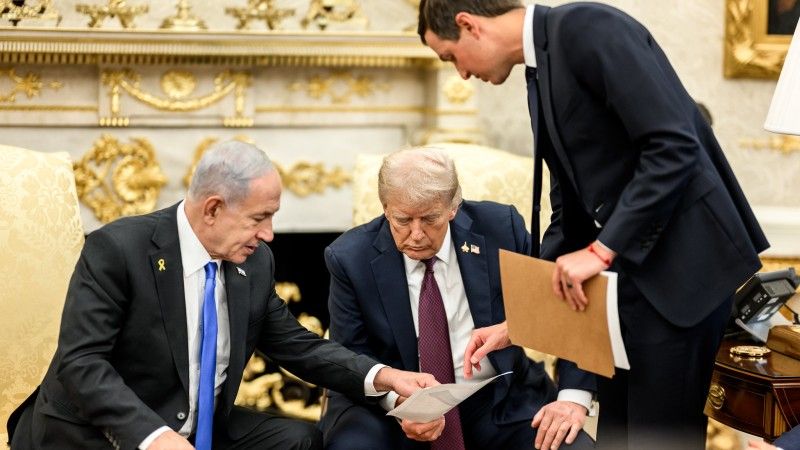
„The peace is contagious,” said Steve Witkoff during his 60 Minutes appearance alongside Jared Kushner – and everyone smiled. The two businessmen with extensive experience in the Gulf states were hailed for launching the peace process in the Middle East, brokering the deal between Israel and Hamas. Thanks to their personal ties to the American president, they became diplomatic powerhouses, responsible for helping untangle the most difficult conflicts.
In his second term, Donald Trump is more eager to designate his trusted men as special envoys (or even unofficial advisers) to handle international relations rather than relying on seasoned diplomats. Looking closely, one can easily notice frictions between Marco Rubio, the secretary of state, and other presidential confidants - as they often present a slightly different approach.
But for Donald Trump there is only one metric of success - how effective that approach proves to be. That’s why - after the biggest success of his second presidency in the Middle East - Trump wanted to follow the same path that had once provided his administration with the desired solution.
Comparing the Gaza peace plan - negotiated by Steve Witkoff and Jared Kushner - with the Ukraine plan - drafted, according to Bloomberg, by the very same figures along with Putin’s representative Kirill Dmitriev - shows a striking resemblance. The recipe for peace, once proven successful and praised around the world, emerged as a go-to template, ready to be implemented almost under any circumstances.
The main similarities? Both plans favored the stronger side of the conflict. Israel’s and Russia’s demands were presented as the preliminary conditions of the agreement - depending on which war we’re talking about. Siding with the more powerful party is an easy way to make the weaker one accept the proposed plan. After all, the weaker side of the conflict - at least nominally weaker - does not really have much room for negotiation if its opponent’s demands become the demands of the United States, the only country capable of bringing the conflict to an end without further bloodshed.
It’s more difficult to bring a superpower (or a regional power) to the negotiating table - whether it’s Israel or Russia. They can play for time, postponing negotiations until their demands are met. It is easier to demand more from the side over which one has greater influence. Sometimes that influence takes the form of refraining from action - whether it is holding Israel back, as in the war in the Gaza Strip, or the threat of such restraint in the context of supplying weapons and intelligence, as in the case of Ukraine. In such a universal peace plan, the United States does not have to do anything - it does not need to take proactive steps. It is enough for the American administration to refrain from certain actions - and that alone is sufficient to push the weaker side to act in the way the U.S. wants.
But here lies the main difference between the Gaza and Ukraine plans: American influence over Israel is much greater than over Russia. Benjamin Netanyahu - even if he sometimes seems to act in ways unacceptable to the U.S. - is far more predictable than Vladimir Putin. And Donald Trump’s influence over him is stronger. In Putin’s case, there are not many ways
in which the American administration can compel him to act in a certain way - even sanctions are not enough.
That is the main weakness of the initial proposition for Ukraine - it was not enforceable against Russia in the way it was enforceable against Israel in Gaza’s case.

But steering away from the pitfalls, there are many more similarities between the two plans. The most striking one is the lack of concrete steps toward achieving the goals of the non-dominant side. Palestinian statehood is a promise without a timeline, much like the security guarantees for Ukraine. The sole benefit for Ukraine was that the war was going to end - period.
Both plans carefully regulate only one side of the conflict. In Ukraine’s case, it is the carefully crafted wording regarding military restraints. In Gaza’s - it was about disarming Hamas.
There are not many enforceable restraints on the more powerful side of the conflict.
Donald Trump’s perspective is much broader than focusing only on the two directly involved parties. He is convinced that lasting peace requires rebuilding the entire region’s security architecture - sometimes from scratch. That’s why he invited Gulf and other Arab states as guarantors of the Gaza peace plan. In Ukraine’s case, the original plan rearranged NATO’s position in the region - implying that the alliance could no longer be regarded as purely anti-Russian.
The vision for the Middle East, brokered by Witkoff and Kushner, resembled the one for Eastern Europe: defining new spheres of influence. It corresponds well with the „America First” approach - as American interests are the most important factor determining whether the U.S. wants to maintain an active role in the region. The key criterion will be a cold-blooded calculation - whether it is simply in the United States« interest. When it comes to involvement in the Middle East, especially given its crucial relationship with Saudi Arabia, Washington’s answer is clear: this region lies at the heart of American strategic focus. In Ukraine’s case, however, the U.S. may be prepared to yield ground - whether to Russia or, at least in part, to the Europeans.
For Steve Witkoff, a businessman and developer, making deals is a piece of cake. A draft agreement that once worked can be reused many times. But international relations operate under different dynamics - there are not many things that can be easily assessed. Sometimes the crucial decisions are dictated by sentiment rather than calculations.
That’s why a one-size-fits-all template won’t work. Peace, war, borders for which people die every day - these are not spreadsheet categories where one can simply replace numbers to get the correct result.
Ukraine isn’t Gaza. Russia isn’t Israel. It is not determined whether the outcome will be similar or not at all. But serving the same solution to strikingly different problems could be regarded as ignorance. And in an interconnected world, one can pay dearly for ignorance. All things considered, it won’t be the United States that ends up paying for it.


