












- WIADOMOŚCI
- ANALIZA
Israel's recognition of the events of 1915 as the Armenian Genocide

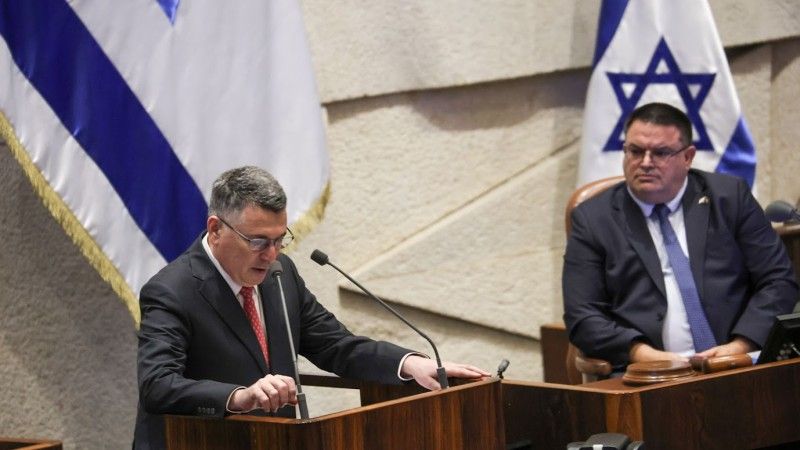
Photo. The Knesset (official website)
On Sunday, June 28, the Israeli government unanimously approved a resolution recognising the crimes committed against the Armenians during World War I as genocide. This decision can undoubtedly be considered groundbreaking, ending decades of diplomatic restraint. At the same time, it was a clear signal of the deepening conflict between Türkiye and Israel. However, it is worth noting that relations between the two countries had already deteriorated, specifically following the outbreak of the Gaza War, which was a direct consequence of the attacks perpetrated by the Palestinian Islamist movement Hamas on Israel in October 2023.
The Israeli government’s recent decision is being interpreted as a direct response to the sharp deterioration in relations with Türkiye at the state level, as well as to the aftermath of the intense rhetorical conflict between the leaders of both countries in the context of the Gaza War. Tel Aviv’s new policy subsequently sparked strong protests from Ankara and further raised serious concerns in Azerbaijan, a strategic partner of Israel. Regardless of whether this decision is based on applicable international law and historical evidence, it cannot be ignored that it is, above all, a tool used to exploit historical memory in the current geopolitical game, which, in turn, has the potential to permanently alter the balance of power in the Eastern Mediterranean.
Main reasons behind Israel’s recognition of the events of 1915 as the Armenian Genocide
Israel’s decision to recognise the events of 1915 as the Armenian Genocide appears to have been shaped by a combination of geopolitical considerations and the country’s evolving foreign policy priorities.
1. Open conflict with Türkiye and the desire for retaliation: By far the most important factor worth mentioning is the drastic deterioration of Israeli-Turkish relations following the outbreak of the Gaza War in October 2023. Turkish President Recep Tayyip Erdoğan has become one of the harshest critics of Israeli military operations in the Middle East, accusing Tel Aviv of genocide against Palestinians and repeatedly comparing Israeli policymakers to Nazis. Furthermore, Türkiye has suspended most trade with Israel and become one of Hamas’s most vocal diplomatic supporters, despite the relatively high level of cooperation between Ankara and Tel Aviv before the resumption of the Israeli-Palestinian conflict. In response to Türkiye’s increasingly confrontational rhetoric, the Israeli government appears to have used recognition as a tool of political pressure by addressing one of Ankara’s most sensitive historical issues.
2. Shifting Israel’s strategic paradigm: For decades, successive Israeli governments refused to formally recognise the 1915 genocide in order to protect their crucial diplomatic, military, and, above all, economic ties with Türkiye and Azerbaijan. Given that current relations with Ankara are already strained and unlikely to be restored anytime soon, Israel has concluded that it no longer has anything of value to protect at the expense of remaining silent about the historical truth that it itself recognises.
3. Declared moral obligation: The government’s official justification, promoted in particular by Foreign Minister Gideon Sa’ar, is primarily the “moral and historical obligation” of the Jewish state, which “understands the suffering of an oppressed people like no other.” The minister rejected claims that this was an act of revenge. According to Israeli officials, Türkiye’s dissemination of “hostile narratives” against Israel does not guarantee immunity from confrontation with the past.
See also 

4. Long-term domestic pressures: The government’s decision, although dictated by the current political situation, is based on the work of Israeli scholars, public figures, and politicians (primarily former left-wing politicians such as Zehava Galon and Yossi Sarid), who have been lobbying the Knesset since the early 1980s to recognise the crimes against the Armenians as genocide. They argued that, as a nation that survived the Holocaust, Israel has a special obligation to show solidarity with other victims.
5. Instrumental use of history and domestic political calculations: Finally, it cannot be ruled out that Israeli Foreign Minister Gideon Sa’ar also initiated this move for domestic political reasons, specifically to strengthen his position on the ruling Likud party’s electoral lists and demonstrate Israel’s internal unity. Radical critics of Benjamin Netanyahu’s government, on the other hand, argue that the recognition of the genocide is intended to serve as a smokescreen, diverting attention from allegations of war crimes against Palestinians and the ongoing proceedings before the International Criminal Court and the International Court of Justice in The Hague.
In summary, although demands for the recognition of the genocide had been systematically made by historians and left-wing politicians in Israel since the early 1980s, it was only the Gaza War, harsh Turkish rhetoric, and the fact that Israel had lost all the benefits of its strategic partnership with Ankara that opened the political window for the government to take this historic step.

Why did Israel avoid formal recognition for decades?
For decades, successive Israeli governments consistently avoided officially recognising the events of 1915 as the Armenian Genocide, driven by a complex set of geopolitical, historical, and diplomatic considerations.
The primary reason was undoubtedly the desire to maintain close military, economic, and intelligence ties with Türkiye and Azerbaijan. In the 1950s, facing hostility from Arab states, Israel deliberately built close ties with countries such as Türkiye to break its political isolation in the region. Meanwhile, Azerbaijan, a close ally of Ankara, eventually became Israel’s main oil supplier, a major recipient of Israeli weapons, and a key strategic partner, making its territory available for intelligence and operational purposes against Iran.
Equally important, for decades Israel maintained that the Armenian issue was an “internal dispute” between Türkiye and Armenia, to be resolved through historical research and the opening of archives rather than through political pronouncements. Even after Recep Tayyip Erdoğan came to power and gradually cooled relations, Israeli decision-makers preferred to avoid provoking Turkish nationalism and deliberately sidelined the issue, hoping to maintain relations based on pragmatic, mutually beneficial interests.
The belief in the “uniqueness of the Holocaust” also appears to have posed a significant psychological and political barrier. This phenomenon is referred to as “ethnic competition” surrounding the status of the Shoah (Hebrew for “catastrophe” or “destruction”) as a crime unique in human history. Israel traditionally avoids equating any other national crimes or tragedies with the extermination of European Jews.
Differences in the interpretation of historical facts also posed a problem. Israeli politicians often pointed to the historical differences between the Holocaust and the Armenian Genocide. They argued that in the Ottoman Empire, Armenian partisans (supported by Tsarist Russia) actively fought the authorities and demanded autonomy, which was the direct cause of the oppression of the Armenians, while Jews in Germany before World War II were loyal citizens striving for assimilation. Furthermore, they pointed out that the Ottoman authorities did not seek the global annihilation of the entire Armenian nation, as evidenced by the survival of a large Armenian community in Istanbul. However, this perception changed dramatically with the emergence of Turkish accusations that Israel itself was committing genocide.

Armenia’s reaction
It is worth noting Armenia’s ambivalent and reserved stance, driven by concerns that politicising the Armenian tragedy would harm the reconciliation process with its Turkish neighbour. This situation can therefore be described as a complex web of connections between morality, historical truth, and hard-line national security interests.
Armenian decision-makers are primarily concerned with protecting the peace process with Ankara. The Pashinyan administration is pursuing the “Real Armenia” doctrine, which entails a painful but strategically necessary reconciliation with Türkiye in order to open its borders and break its long-standing isolation. Israel’s sudden move carries the risk of triggering a wave of nationalist backlash in Türkiye, which could derail these extremely fragile and complex negotiations. Significantly, the Armenian Ministry of Foreign Affairs announced in 2024 that international recognition of the genocide is no longer a priority of Armenian foreign policy.
More importantly, there is also a visible reluctance to exploit history, especially by third countries not directly involved in these historical events. Armenian Prime Minister Nikol Pashinyan has openly described Israel’s actions as being motivated by the current Israeli-Turkish conflict. He emphasised that it is in the state’s interest not to participate in attempts to transform the Armenian Genocide into a “political weapon” aimed at Türkiye. Pashinyan also noted that even if Türkiye itself recognised the genocide, Armenia would not feel obligated to comment on it to avoid being drawn into political power plays.
This current reticence also stems from the very difficult bilateral relations between Yerevan and Tel Aviv. Armenia deeply resents Israel for ignoring its appeals for neutrality and supplying advanced weaponry to Azerbaijan. These weapons played a key role in the conflicts between 2020 and 2023, resulting in Armenia suffering severe territorial losses. Moreover, in 2024, Armenia faced sharp criticism in Israel when it officially recognised the sovereignty of the Palestinian State.
From a domestic perspective and in terms of internal interests, the Israeli government’s demonstrative move complicates the situation for Pashinyan, who has managed to retain power for another term. It therefore provides the domestic political opposition with a strong argument to accuse the prime minister of weakness and concessions to Türkiye, an accusation he has already faced during this year’s political campaigns.

Türkiye’s reaction to Israel’s decision
Türkiye’s reaction to the Israeli government’s decision was immediate and exceptionally harsh, paving the way for an escalation that went beyond the existing diplomatic disputes. The Turkish Foreign Ministry described Israel’s actions as a political attempt to conceal “its own crimes” and accusations of genocide in the Gaza Strip from the International Court of Justice. Turkish Foreign Minister Hakan Fidan, in turn, called Israel “a burden that humanity can no longer bear,” which the Israeli side interpreted as open incitement to the destruction of the Jewish state, thereby hoping to elicit a sympathetic international response. Israeli Foreign Minister Gideon Sa’ar himself condemned these remarks, calling them “textbook incitement to genocide.”
Israeli politicians, business representatives, and analysts also warned that Türkiye could respond to the Knesset’s decision with a range of specific retaliatory measures, including a transport blockade and a complete suspension of trade. The authorities in Ankara could close Turkish airspace to Israeli airlines and completely suspend bilateral trade. It is worth noting that Türkiye has already suspended most economic relations due to the war in the Gaza Strip.
It is also likely that Türkiye will launch a broad diplomatic offensive in international forums, including the International Court of Justice (where it has already joined South Africa in filing charges) and the International Criminal Court in The Hague. Turkish Foreign Minister Hakan Fidan has openly called for global sanctions against the Jewish state. Furthermore, analysts predict that Ankara may seek support in this dispute from Washington and Brussels, taking advantage of the July visit to Ankara by representatives of influential NATO countries.

Conclusions
In summary, the Israeli government’s decision drastically deepens the existing crisis in relations with Türkiye and opens a new, potentially dangerous chapter in their rivalry. It also has profound repercussions for the region, primarily by complicating relations with its ally Azerbaijan and placing Armenia in an extremely difficult situation.
Israel’s decision may be seen as illustrating the transactional nature of modern diplomacy. By treating its neighbours’ turbulent history as an asset or a risk to be exploited on the global chessboard, Israel may not only risk its pragmatic interests in the South Caucasus but also inadvertently undermine the prospects for lasting political stabilisation with Türkiye, which consistently strives to play an increasingly prominent role on the international stage.


