


- WIADOMOŚCI
- KOMENTARZ
Another clash in Polish-Ukrainian relations. Lviv councillor considered as persona non grata?

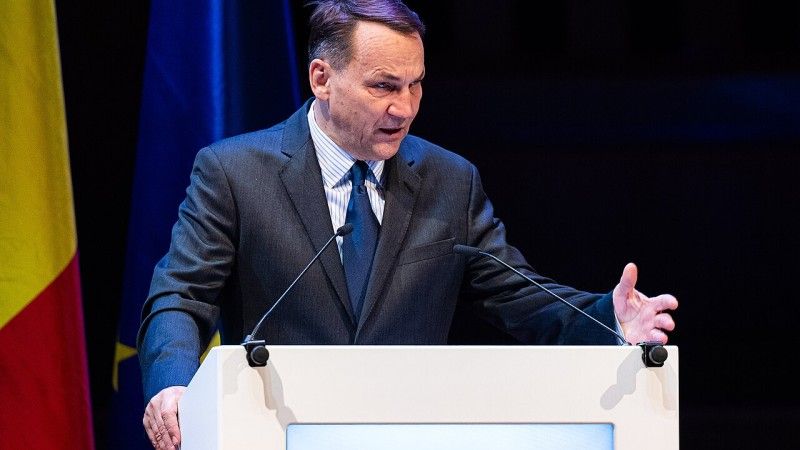
In response to the decision by the Lviv Regional Council to designate 2027 as the year of, among others, the Ukrainian Insurgent Army (UPA), the Polish Minister of Foreign Affairs, Radosław Sikorski, has announced the signing of a motion to include Lviv councillor Sviatoslav Sheremeta on the list of personae non gratae in Poland. The councillor is the author of the announced decision.
The decision specifically concerns the Lviv Regional Council’s declaration of 2027 as the year of the Ukrainian Insurgent Army (UPA), its commander Roman Shukhevych, and Oleh Olzhych, an activist of the Organisation of Ukrainian Nationalists (OUN). The aforementioned announcement has been widely echoed in Poland.
Among those reacting to the Ukrainians’ decision was Poland’s Foreign Minister Radosław Sikorski. “I have signed a request to enter S. Sheremeta—a councillor of the Lviv region, a re-enactor of the Waffen-SS Galizien, and the author of the idea to establish 2027 as the year of R. Shukhevych, the UPA commander who issued orders for the displacement and murder of Poles—onto the list of persons undesirable in the Republic of Poland,” the politician wrote on the X platform.
Podpisałem wniosek o wpisanie na listę osób niepożądanych w RP radnego obwodu lwowskiego S. Szeremeta, rekonstruktora Galizien Waffen-SS, autora pomysłu ustanowienia 2027 rokiem R.Szuchewycza, dowódcy UPA, który wydawał rozkazy wysiedlania i mordowania Polaków. https://t.co/pT0EdzgqKr
— Radosław Sikorski 🇵🇱🇪🇺 (@sikorskiradek) October 21, 2026
Sheremeta is a deputy to the Lviv Regional Council representing the European Solidarity party of former President Petro Poroshenko. This would not be the first time the politician has been banned from entering Poland. He first received a ban in 2017 in connection with Ukraine halting Polish search and exhumation works, as well as the construction of new memorials within its territory. Ukraine’s decision at the time was a reaction to the dismantling of a UPA monument at a cemetery in Hruszowice, in the Podkarpacie region, and previous acts of vandalism against Ukrainian sites of remembrance in Poland.
Will the decision be rescinded?
According to Deputy Foreign Minister Marcin Bosacki, the Polish side has received assurances from associates of Ukrainian President Volodymyr Zelenskyy that the Lviv Regional Council’s decision will not come into effect. “This is a provocative decision; we are taking the Ukrainian side at its word,” said Bosacki. “It is a good sign that late Tuesday evening, this resolution disappeared from the Lviv region’s website,” he added.

Reports from the Polish Press Agency (PAP), citing circles close to Lviv politics, suggest that Lviv councillors are unlikely to rescind the announced decision. “After all, the deputies will not revoke their decision independently, and there are no other mechanisms to do so. Unless through legal action, but that is unimaginable in our region,” said one anonymous source. Another anonymous source from Lviv stated that “the deputies were certainly aware that their decision regarding the year of Shukhevych and the UPA would cause dissatisfaction in Poland, but they practically declare a year of Shukhevych or Bandera every year. They announce a year dedicated to some figure or organisation, and then nothing happens. No events or functions. Someone is certainly making money from this.”
It is not ruled out that the announced decision may be a provocation inspired by Russia, aimed at further alienating Ukrainians from Poles. Rafał Leśkiewicz, spokesperson for the Polish President Karol Nawrocki, assessed on Wednesday that the Ukrainian services should investigate the background of the Lviv regional authorities’ decision. “This smacks of Russian provocation,” he stated.
Why is it an issue in the first place?
The issue of the UPA and the figure of Shukhevych, who was one of its leaders, remains one of the most contentious topics in Polish-Ukrainian relations. According to Polish and foreign historians, in July 1943, UPA units carried out coordinated attacks on approximately 150 settlements inhabited by Poles in Volhynia. This crime is often referred to as the Volhynian Genocide. Its perpetrators were members of the Stepan Bandera faction of the Organisation of Ukrainian Nationalists and the UPA, which was subordinate to it. Many historians and politicians on the Ukrainian side treat Volhynia as part of a broader Polish-Ukrainian conflict, for which both sides were allegedly responsible. It should be added here that on the Polish side, it is impossible to find a crime of a similar scale during that period.
The OUN and UPA are also perceived in Ukrainian historical policy as groups fighting for independence in opposition to the Soviet Union. The decision of the Lviv Regional Council is another episode of friction in Polish-Ukrainian relations related to the politics of memory and historical policy. At the end of May this year, Ukrainian President Volodymyr Zelenskyy named one of the military units after the “Heroes of the UPA”. This led to a heightening of tensions. In response, the President of the Institute of National Remembrance, Karol Nawrocki, decided to call for Zelenskyy to be stripped of the Order of the White Eagle.
 / Defence24.com


