












- WIADOMOŚCI
- ANALIZA
Gradually drawing closer: Indian Foreign Minister Jaishankar’s visit to Poland

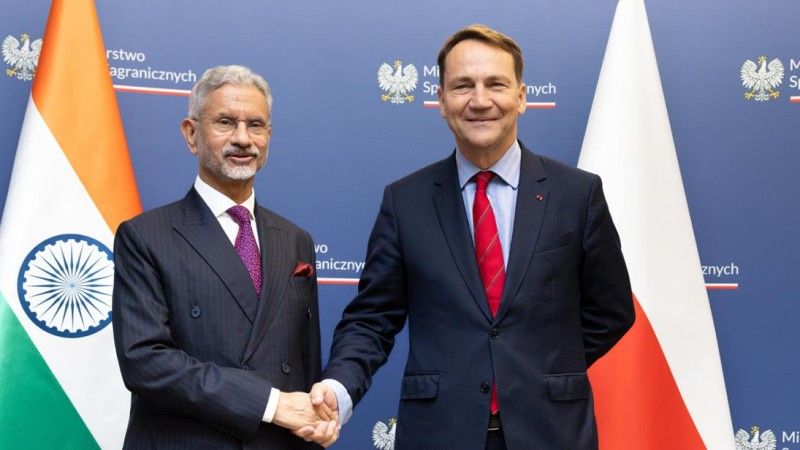
Photo. Polish Ministry of Foreign Affairs / https://www.gov.pl/web/diplomacy/meeting-between-top-diplomats-of-poland-and-india
This was S. Jaishankar’s second visit to Poland. He first came in 2019, ending a 32-year absence of an Indian foreign minister from Warsaw. The trip is a signal of rapprochement and of a more active foreign policy on both sides.
During his European tour, Jaishankar also visited Ukraine, where talks included prospects for a peace settlement. Combined with Prime Minister Narendra Modi’s recent dialogue with Vladimir Putin at the SCO summit in Bishkek – during which the Indian leader urged an end to the war – the visit is a typical Indian exercise in balancing. Gestures that are clearly welcome in the West will be offset by India’s hosting of the BRICS summit in New Delhi in mid-September.
Returning to the Polish visit: it was a classic preparatory trip ahead of Prime Minister Donald Tusk’s forthcoming visit to India. The two sides discussed issues likely to feature on the Polish government’s agenda. It will be the first such visit in more than 15 years. The last Polish prime minister to travel to India was Tusk himself, in 2010. The last Polish president to do so was Aleksander Kwaśniewski, who visited New Delhi in 1998. Bilateral contacts have clearly been too sparse and have not matched the actual state of relations.
Over the past decade, however, both countries have begun to revitalize their diplomacy on previously lower-priority tracks. Jaishankar’s 2019 visit to Poland was the first by an Indian foreign minister since 1987. A few weeks later, a direct Warsaw–Delhi air link was inaugurated. In 2022, Polish Foreign Minister Zbigniew Rau visited India; in 2024, Prime Minister Modi came to Poland – it was the first visit by an Indian prime minister to Warsaw since 1979.
Trade has grown in parallel, exceeding USD 6 billion last year. That remains below the potential. Russia’s aggression against Ukraine provided an impetus: Poland helped evacuate thousands of Indian students from the war zone. India recognized that Warsaw was playing an increasingly important role in Europe and beyond. A further catalyst has been U.S. President Donald Trump’s tariff policy, which has sharply accelerated work on an EU–India Free Trade Agreement, due to be signed by the end of 2026. The same policy has also spread awareness in Poland that India is a trading partner of considerable potential.

Both sides are therefore, in a sense, bound to expand cooperation across many fields. Jaishankar’s visit to Warsaw was intended to identify possible platforms for that cooperation. Official statements indicate that Poland and India intend to work together in new technologies, with particular emphasis on space, as well as in energy and digital technologies.
They also discussed the global situation, above all Russia’s aggression against Ukraine. Both sides agreed that the war must be brought to an end as quickly as possible. On the second day of his visit, Jaishankar paid tribute to the maharajas of Jamnagar and Kolhapur, who during the Second World War gave shelter to thousands of Poles. That unique history has bound the two nations together ever since.
Poland and India signed a strategic partnership in 2024. The EU–India FTA is due to be signed in a few months. Jaishankar’s visit to Warsaw and Tusk’s forthcoming trip to New Delhi are attempts to give substance to those agreements. After decades of limited interest, the two countries are gradually drawing closer.


