












- WIADOMOŚCI
- KOMENTARZ
India – Youth protests temporarily suspended: will reforms follow?

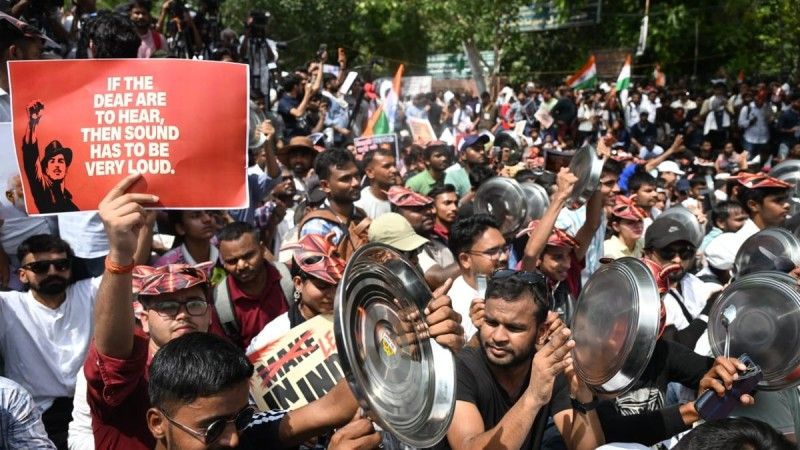
Photo. Pelph Hoters - Own work
In recent weeks, a wave of Gen Z protests swept across India. They have now been suspended. The key question remains: will higher education reform materialise?
Higher education constitutes one of the weakest – if not the weakest – elements of the entire state structure. There are few high-quality universities, and competition for places at those that exist is so intense that admission is nearly impossible. Private institutions are emerging, yet most of them still fall short of the highest standard, and, moreover, they come at a cost.
Young people in India place a very high value on education. They regard it as a pathway to financial success. They are also fully aware that securing a place on a good degree program within the country is almost impossible. Those who can afford it therefore seek opportunities to study abroad. This explains why exam-related fraud triggered such intense anger – not only among the young, but among entire families who invest heavily in their children’s education.
The current protest was triggered by the leakage of questions for one of the major national examinations. In a broader sense, however, it concerned corruption within the education system, and in the widest sense, the entire system of education itself. Everyone knows that the system is deeply flawed and requires profound reform. At present, the weakness of higher education stands as one of the greatest brakes on India’s development. In virtually no field of science do Indian institutions rank among the world leaders.
This problem cannot be resolved in a week, nor even in five years. So far, however, no coherent vision for reform is visible, and the situation demands bold measures comparable to those that once produced the Indian Institutes of Technology. To this day, the IIT system remains the strongest component of higher education and innovation in India. It was precisely the IITs that produced the chief executives of some of the world’s largest IT companies.

The government has promised reforms to the examination system – a necessary step, of course, but one that will not eliminate the fundamental defects. Those defects are clear: there are simply too few higher-education institutions of adequate quality, and a shortage of universities and research centers capable of competing on the global stage – institutions that can offer the most talented (of whom there is no shortage) genuine opportunities for professional development and for creating technology within India itself. Such developments are occurring, but far too slowly, and people are unwilling to wait while life slips away. Indian society is young and determined to fight for better living standards and better future prospects.
Therefore, unless fundamental reforms are launched, protests of this kind will recur. The frustration is immense, justified, and shared by society as a whole.


