- WIADOMOŚCI
- ANALIZA
- KOMENTARZ
Loud protest against Defence Ministry’s deal with Palantir: ‘Let’s learn the lesson from Pegasus’ [REPORT]

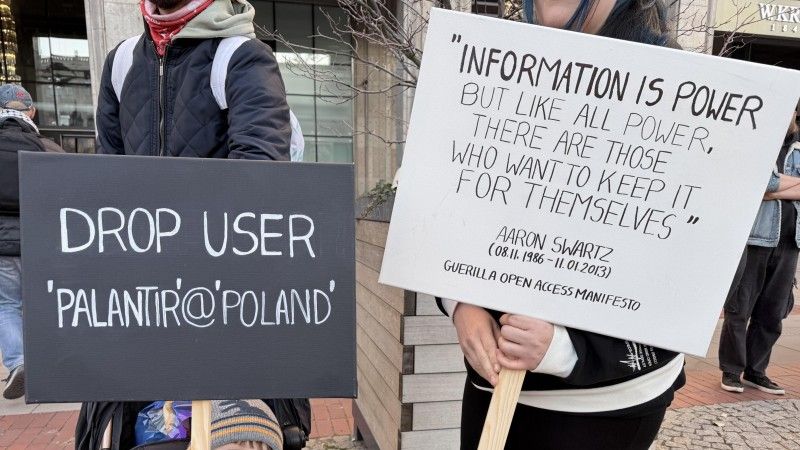
A protest titled „Stop Palantir. We Won’t Give Up Our Data” was held in Warsaw. The demonstration concerned the currently negotiated contract between the Ministry of National Defence (Ministerstwo Obrony Narodowej – MON) and Palantir, which has sparked significant controversy regarding digital sovereignty and ethics. One of the protesters« primary demands was for an independent audit to be conducted before implementing solutions within the systems of the Polish Armed Forces (Siły Zbrojne RP – SZ RP). Through our portal, the American company expressed its readiness to cooperate with Polish services and addressed these pressing issues.
On 15 October this year, Frontstory published an article titled”Palantir: on every side of the table”, concerning the potential purchase and implementation of Palantir solutions within the systems of the Ministry of National Defence.
According to the company, the ”Maven Smart Systems Poland” solution is intended to be fully separated from the company’s infrastructure, and all data would be stored on the client’s infrastructure (SZ RP). Palantir’s responses to our press inquiries (including on this matter) will be discussed in more detail in the second part of the article.
The Frontstory report included the following statement from”one of the interlocutors familiar with the details of the negotiations”:
We wanted a solution separate from Palantir’s cloud solutions. They said it was possible, but the price they quoted made us feel faint. It was decided that for now, we are providing them with fake data prepared solely for the purpose of testing the system.
FRONTSTORY.PL, „PALANTIR: Z KAŻDEJ STRONY STOŁU”
On 8 November, a protest against the implementation of Palantir solutions in the Polish Army took place in Warsaw, organised by, among others, the „Nasze Dane” (naszedane.pl) initiative.
Protest against Palantir
The protest began with a minute of silence dedicated to the victims of the tragic events in Krakow last Saturday. For the same reason, the duration of the protest was shortened.
Opening speeches were delivered by: Natan Chromik (East Initiative / Inicjatywa Wschód), Dominika Lasota (East Initiative / Inicjatywa Wschód), Bogumił Kolmasiak (Action Democracy / Akcja Demokracja), and Wojciech Klicki (Panoptykon Foundation / Fundacja Panoptykon).
Patryk Gruszka, co-organiser representing the „Nasze Dane” organisation, was absent for almost the entire gathering as he had been detained by the Police.

”The reason was an unpaid fine. A police officer who has been on the force for 17 years told me it was the first time he had seen something like this,” Gruszka later explained via Instagram.
”Today we come to you with a clear message: the vision of Poland we want to create. It is a vision without techno-fascists, without systems that lead to extermination and destruction, as was the case in Gaza; as was the case on the streets in the United States, where people – protesters – are profiled by Palantir technology,” stated Natan Chromik.
We are here to oppose the Polish cooperation of the Ministry of National Defence and Deputy Prime Minister Kosiniak-Kamysz with this very company (Palantir - Ed. note). (...) We want to strive for a Poland that has access to its own data – where the digital sovereignty of this country is priority number one. We do not have to become dependent on an American private surveillance company that is known for violating human rights around the world.
NATAN CHROMIK, EAST INITIATIVE
Chromik also highlighted Western organisations« resignations from Palantir solutions. He further called upon the head of the Ministry of National Defence to conduct a reliable and transparent audit, adding that military analyses „are not verifiable.”
”We must stand in solidarity against this evil, and this evil has a name: »Palantir«,”* added Natan Chromik, referring to – as he put it – the enabling of extermination in other parts of the world.

Photo. Oskar Klimczuk / CyberDefence24
Dominika Lasota (East Initiative) stated that Palantir’s CEO”openly propagates views that are genocidal views” – she also described them as extreme right-wing and fascist.
Bogumił Kolmasiak (Action Democracy) described the aim of the protest as opposition to the”dictatorship of techno-feudals”. He emphasised the building of technological sovereignty at the European Union level.
See also 

Wojciech Klicki (Panoptykon) highlighted the issue of data control, particularly in a military context.
”We cannot rely solely on declarations,” he added, pointing to the need to learn lessons from Pegasus. Klicki also added that security does not have to be linked to increasing surveillance.
In the context of Pegasus, no one checked, or even if they did, they ignored the fact that data from Pegasus would flow to another country. It could be the same with Palantir. Except Pegasus was used against 600 people, while Palantir will affect us all. Let's learn lessons from Pegasus. Let's not be just a "user".
WOJCIECH KLICKI, PANOPTYKON

Photo. Oskar Klimczuk / CyberDefence24
Course of the protest
”Hands off our data!” – the crowd chanted after the speeches concluded.
The main slogans during the march included:
- "Palantir kills in Gaza";
- "No freedom without transparency";
- "Audit first, signature later";
- "We want democracy, not surveillance";
- "Our data is not for sale";
- "Free, free Palestine";
- "Hands off our data";
- "Palantir murders, Poland finances/cooperates";
Palantir’s CEO (Alex Karp) and the Chairman of the company’s Supervisory Board (Peter Thiel) were referred to as „terrorists”.

Photo. Oskar Klimczuk / CyberDefence24
Appeal to the President
The protest ended in front of the Presidential Palace, where Patryk Gruszka („Nasze Dane”) joined the head of the demonstration and was greeted with an ovation. He emphasised that a petition to the head of state had been signed by several thousand people (3,852 at the time of editing the article according to „naszedane.pl”).
We know that any day now, a contract could be signed that is a truly massive threat to us; which could be the beginning of a very dangerous cooperation with technocrats; with billionaires who tell us directly that Silicon Valley has an obligation to take power.
PATRYK GRUSZKA, NASZE DANE
Gruszka appealed for the building of Polish systems to maintain digital sovereignty. He also held Palantir co-responsible for civilian deaths in Gaza.
Gruszka and Chromik read an open letter (petition) to the President of the Republic of Poland, Karol Nawrocki, the content of which is available here.

Another protest has been announced for 22 November in front of the Ministry of National Defence.
”We don’t want cooperation with techno-fascists!” – chanted the co-organisers (Patryk and Natan) at the end of the protest.

Photo. Oskar Klimczuk / CyberDefence24
Palantir responds to our questions
On 5 November, we sent over a dozen questions to Palantir’s press office. Less than 24 hours later, we received responses from Maciej Łaska, Managing Director of Palantir Technologies Poland.
Due to the length of the document (nearly 15,000 characters), we will not describe it in its entirety, although we have attempted to present it as broadly as possible – we will make the original file with the company’s position available to all interested parties.
”Palantir has been cooperating with the Polish Armed Forces since 2023 as part of exercises, training, and technology demonstrations. In December 2024, a memorandum of cooperation was signed, and in October 2025, a letter of intent regarding further cooperation in the area of artificial intelligence and information technologies, specifically the possibility of using the Maven Smart System (MSS),” highlighted Łaska. He added that any potential system implementation, supplier selection, and terms of cooperation lie with the Ministry of National Defence.
”We do not comment on media reports regarding negotiations,” he concluded.
Oskar Klimczuk, CyberDefence24: What does Palantir's involvement in operations in the Gaza Strip consist of?
Maciej Łaska, Palantir:Palantir has publicly confirmed its cooperation with the Israeli Ministry of Defence. Due to the nature of cooperation in the defence sector, we do not disclose details of all supported programmes and missions.
Palantir unequivocally denies that it provided or co-created the Gospel and Lavender systems, mentioned in publications regarding the use of artificial intelligence to identify targets in the Gaza Strip. These solutions were created independently of Palantir and before the start of the announced cooperation between the company and the Israeli Ministry of Defence.
See also

Does the implementation of MSS-P include transferring exclusive control over encryption keys and administrator accounts to the Polish side?
These are the assumptions of the Maven Smart System implementation model.
The system operates on infrastructure belonging to the client, who independently manages encryption keys, administrator accounts, user permissions, network traffic, and access to data. Palantir does not possess encryption keys nor the capability to independently gain access to information. The client remains the administrator and disposer of the system.
Technological sovereignty
On our part, we would like to remind readers that companies based in the USA are subject to the so-called „Cloud Act,” which assumes an obligation to transfer data to selected US services upon their request.
”Palantir maintains the position that, as a software provider for enterprises and institutions, it does not fall under the scope of these regulations regarding this type of client data. The company has never received a request to share data based on the CLOUD Act,” Łaska informed us.
Oskar Klimczuk: To what data can Palantir – even technically or theoretically – gain access after a potential contract is signed with the Ministry of National Defence?
Maciej Łaska, Palantir: Palantir has no independent access to client data nor the technical capacity to independently obtain it.
The MSS system operates within the client’s closed infrastructure, under their full and exclusive control. Palantir does not possess the data, does not store it, does not have encryption keys, nor the possibility of a remote connection to the system. Therefore, it cannot independently view, download, or export information processed by its clients.
Providing software does not mean access to the data processed using it.

How is Palantir able to ensure and demonstrate to the public the full control of the Polish Armed Forces over data, networks, procedures, and infrastructure?
The basis is the architecture of the solution itself. MSS-P would operate on ICT infrastructure belonging to the Polish Armed Forces and remaining under their exclusive and full control.
The Polish military would manage servers, networks, administrator accounts, encryption keys, and user permissions. Palantir would not have (as it does not have in other installations) the possibility of remote access to the system nor a mechanism allowing it to be remotely disabled, a so-called kill switch. The software also provides full control of permissions, detailed logging of user actions, and the ability to trace data sources and processing methods.
These mechanisms are independently verified by the client’s relevant security teams and authorised state institutions. The results of any verification could be presented to the public to the extent permitted by regulations and state security requirements.
Audit and resignations
One of the issues raised by protesters is an independent software audit. In December 2025, we described the Swiss Army’s resignation from the potential use of Palantir solutions.
”It was indicated that the software increases dependence on an American supplier and heightens the risk of potential loss of control over data and national sovereignty,” we wrote in our article at the time, based on findings by the Swiss outlet Republik.
The experts' conclusion from the approximately 20-page report is unequivocal: the Swiss Army should consider alternatives and abandon Palantir's solutions.
"REPUBLIK" QUOTED BY CYBERDEFENCE24
We asked Palantir about the audit issue. The company expressed its readiness to cooperate with Polish services. We did not receive a declaration of an independent audit.

Oskar Klimczuk: Is Palantir willing to submit its solutions to an independent audit regarding risks to digital sovereignty and data security if such a requirement is presented by the Ministry of National Defence?
Maciej Łaska, Palantir:Data security, client control, and the possibility of auditing the system are among the core assumptions of Palantir’s technology.
Our software provides detailed control of permissions, logging of user actions, and the ability to trace the origin of data and how it is processed. Palantir’s solutions can operate in a client’s closed infrastructure and be subject to their security procedures.
It is worth noting that Palantir’s software has been subjected to an independent source code audit conducted by the German Fraunhofer Institute at the request of the Bavarian police. The study confirmed the absence of hidden access mechanisms (so-called backdoors) and unauthorised data exfiltration. Furthermore, the Maven Smart System used by NATO obtained full security accreditation this June, enabling its operation in the Alliance’s classified network.
Would Palantir agree to an audit conducted by the ABW, SKW, or another relevant Polish service? Has such an audit already been performed and what were its results?
Palantir is ready to cooperate with relevant Polish institutions in the field of technology security verification, in accordance with the requirements applicable in the Polish Armed Forces. We cannot speak on behalf of the Ministry of National Defence or the relevant services regarding the activities they perform or the results of any security assessments.
It is worth recalling that the Maven Smart System used by NATO has obtained full security accreditation allowing it to operate in the Alliance’s classified network and is successfully and securely functioning for many NATO government clients.
Why are certain European countries resigning from Palantir solutions? What are the reasons?
Each state independently determines its technological strategy, operational needs, and rules of cooperation with software suppliers. We understand the aspiration of European states to develop their own technological capabilities.
However, one should distinguish declarations regarding the creation of national alternatives from the actual termination of cooperation. Contrary to emerging reports, our clients are not terminating existing contracts or withdrawing from cooperation. They continue to cooperate closely with us, many of them for over a dozen years. For example, the French DGSI extended its contract with Palantir for another three years in December 2025 (in June 2026, French Prime Minister Sébastien Lecornu announced that the local National Counter-Intelligence Service (DGSI) will use the „ChapsVision” solution, which is to replace Palantir – Ed. note).
Palantir’s position is that developing the European technology industry and using the proven solutions of international partners are not contradictory goals. The key factor is whether the product works and realistically supports the client’s operational priorities, while the client simultaneously maintains control over data, infrastructure, and decisions, as well as the ability to use technologies from other suppliers.
Data Export
We asked Palantir about the issue of data separation and export.
”(…) Palantir platforms are designed so that the client maintains full control over their data and can independently export it in commonly used formats both during the cooperation and in connection with its termination. In the case of on-premise installations, there is no mechanism for Palantir to remotely disable the system. Importantly, the mere expiration of a licence does not cause an automatic technical shutdown of the software,” Maciej Łaska informed us.
”The company does not sell a box with a disc; it puts its own engineers into the client’s institution and pulls their data into a closed structure from which exiting is costly. When the New York Police Department wanted to withdraw in 2017, Palantir refused to provide analyses in a format that would allow migration elsewhere,” stated the portal of the Nasze Dane initiative. Palantir replied that the dispute concerned „elements linked to Palantir’s proprietary technology”.
The issue of the New York Police Department’s data was described by BuzzFeed News. According to the article, the NYPD received a copy of the raw data entered into the system, without the (expected) data analysis.
Oskar Klimczuk, CyberDefence24: On the naszedane.pl portal, there is a statement that in 2017, Palantir refused to provide the New York Police Department with analyses in a format allowing for migration. Is this true?
Maciej Łaska, Palantir:In 2017, publications appeared regarding a dispute between Palantir and the New York Police Department related to transferring analyses to another system. The dispute concerned the possibility of using elements linked to Palantir’s proprietary technology in the new environment. One must therefore distinguish between data belonging to the client and the functionality and components of the supplier’s software.

Current Palantir platforms are designed as open and interoperable solutions. Clients can independently export not only their data in many standard formats but also metadata and business logic code. The platform supports work based on widely known programming languages. This allows for integration with other solutions, the development of own applications, and free migration to solutions from other suppliers.
Changing a provider of advanced software may require the recreation of specific functionalities, but it does not mean a loss of control over data or business logic, nor the inability to transfer them to another system.
Responsibility for errors
An important aspect of the case is the potential liability for software errors, especially concerning artificial intelligence. Łaska emphasised that Palantir supports the decision-making process, but the responsibility rests with humans.
Oskar Klimczuk: Who bears responsibility for the actions of MSS-P, especially in the event of an error leading to financial damage, injury, or death?
Maciej Łaska, Palantir:Maven Smart System is a platform supporting information analysis and decision-making. Artificial intelligence can analyse data, identify objects, present recommendations, and automate specific actions, in accordance with the rules established by the client. In this sense, it remains a »co-pilot«, but the final decisions to take action based on the artificial intelligence’s suggestions are made by a human.

Accordingly, in military applications, responsibility for operational decisions remains with authorised personnel acting within the military chain of command, in accordance with relevant procedures and legal regulations.
Summary
The topic of Palantir is complex and controversial. In this article, we do not rule on who is right or correct: we wish to present the broadest possible range of views from every side of the dispute. To this end, we recommend several articles relating to the matter:
- "One Palantir to rule them all" - Joanna Cisowska, didleth.pl;
- "Palantir reports to ICE where to find immigrants. We live in times of total surveillance" - Joanna Cisowska, oko.press;
- "Palantir: on every side of the table" - Frontstory;
- "One person with a laptop instead of a staff. Palantir's head in Europe explains how AI is changing the war in Ukraine" - Puls Biznesu;
- "Palantir enters the Polish Army. High hopes, but also fears" - Łukasz Maziewski, xyz.pl;
- "MON analyses alternatives to Palantir" - Szymon Palczewski, CyberDefence24;
- "Palantir scrutinised by Polish soldiers. Will it conquer the military?" - Szymon Palczewski, CyberDefence24;
- "Will Palantir get the data of the Polish Army? Doubts grow around MON cooperation" - Nikola Bochyńska, wnp.pl.
- "Can Palantir spy on the Polish military" - Panoptykon.