


- WIADOMOŚCI
Delays and contractual penalties. German air defence system for Romania facing problems

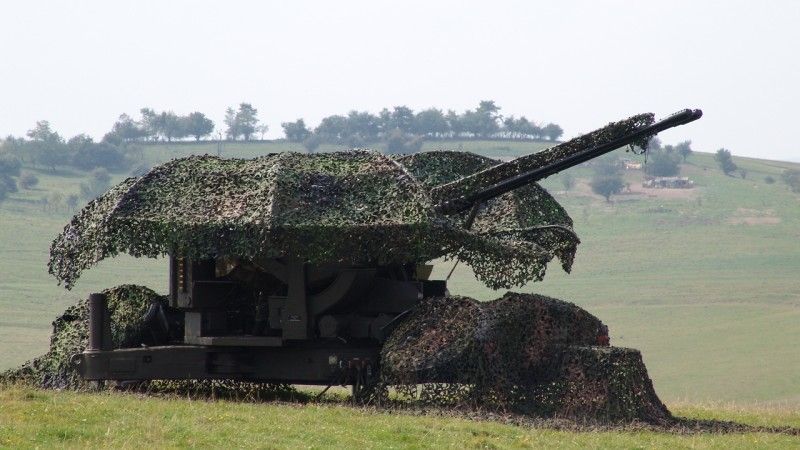
Deliveries of the Oerlikon GDF-003 air-defence systems, modernised by the German concern Rheinmetall, to the Romanian Army are facing a several-month delay.
In December 2023, the Romanian Ministry of National Defence signed a contract with the German group Rheinmetall AG for the modernisation of GDF-003 air-defence systems to the GDF-009 TREO version, including the integration of Oerlikon Skynex system elements. The value of the contract signed at that time was set at nearly €330 million and involved the modernisation of four batteries of the aforementioned air-defence systems owned by the Romanian Army.

Programme facing delay
Each battery consists of six fire units; therefore, a total of 24 units were to be modernised out of the 72 currently held. In addition to the automatic cannons, each was to include a new Oerlikon Skymaster TLCN fire control system, an X-TAR3D multi-functional radar station, and two trucks with a hook-lift system for their transport.
The delivery of the first two batteries (12 fire units) was scheduled within two years of signing the contract, while the remainder were to be upgraded and handed over a year later. However, as reported on 23 September by the Romanian portal G4Media, the entire programme is already experiencing a several-month delay. The portal indicates that the delivery of the first two batteries was supposed to have taken place as early as April.
This did not occur, however, as they failed the acceptance tests. Subsequent tests were scheduled for September, but it is unknown whether the modernised air-defence systems managed to pass them. Furthermore, the authors of the article reportedly accessed Romanian Ministry of National Defence documents indicating that “some subsystems do not fully meet the requirements of the technical specifications of the order”.
The German side acknowledges the delays, citing technical failures and difficulties in securing the supply chain as the reasons. The contracting authority has charged contractual penalties starting from the first day of the delay, in accordance with the provisions of the agreement. Penalties will be charged until the day the acceptance certificate for the systems is signed without objection – the Ministry of National Defence (MApN) stated at the request of G4Media.
See also 

Skynex and GDF-009 TREO air-defence systems
Skynex is a very short-range air-defence (VSHORAD) system developed by the German company Rheinmetall Air Defence and first publicly presented at the Eurosatory 2016 trade fair in Paris. It consists of a Skyranger unmanned turret module armed with a 35 mm Oerlikon Revolver Gun Mk3 automatic cannon, a Skymaster command and control system with an optoelectronic head, and an X-TAR3D three-dimensional radar station. The cannon, with a theoretical rate of fire of 1,050 rounds per minute, can effectively engage a wide range of targets at a distance of up to 4,000 metres. In turn, the radar can detect targets at distances ranging from 25 to 55 km, depending on their type. This allows the system to effectively combat small C-RAM targets (including drones, cruise missiles, or mortar shells), providing comprehensive very short-range air defence.
Skynex enables the integration of radar equipment from various manufacturers, which highlights its flexibility for potential customers. The system also offers significant freedom regarding effectors, allowing for the integration of many different advanced types of anti-aircraft weapons. The only condition is having its own tracking unit. In addition to individual sensors and effectors, existing air-defence systems, such as the Skyshield and Skyguard families, can be built into the new architecture as fire units. In a remote command and fire control centre, the recognised air situation is presented on a map alongside sensors and effectors deployed in the field, simplifying target allocation for air-defence assets connected to the system.

Photo. Rheinmetall
GDF-009 TREO is an artillery-based very short-range air-defence system produced by the German concern Rheinmetall AG. A twin Oerlikon 35 mm anti-aircraft gun is responsible for eliminating targets at a range of up to 4,000 metres. The theoretical rate of fire for each has been determined at 1,100 rounds per minute. The entire unit can be placed on a towed four-wheel platform. The system can be plugged into various types of fire control systems (e.g., Skyguard or Skynex) and integrated with a wide range of radars.
When combined with its own sensors, such as an optoelectronic head or radar, it allows for independent target detection and engagement without the need for external data. The system has its own power source, which allows for greater operational independence. Currently, this variant of the system based on Oerlikon 35 mm guns is used by countries such as Bangladesh and Romania.

Photo. Rheinmetall AG


