












- WIADOMOŚCI
Russian General Anton Grunis confirmed dead in Ukraine
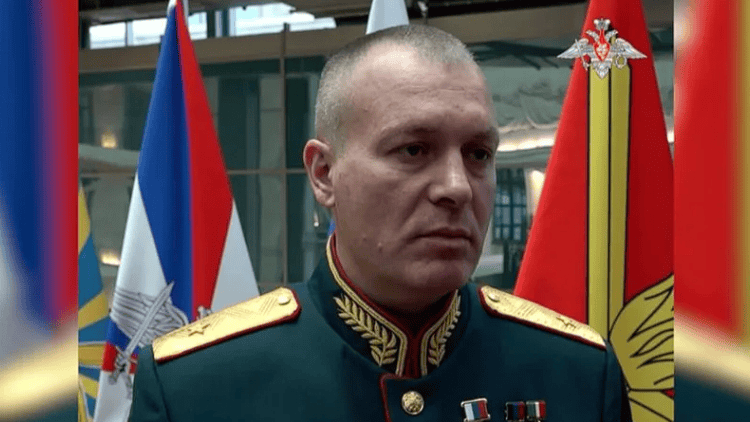
Photo. Kremlin.ru / Wikimedia Commons / CC BY 4.0
Russian Major General Anton Grunis, commander of the 4th Separate Motorised Rifle Brigade, has died. The officer became known for, among other things, his personal report to Vladimir Putin regarding the alleged capture of Kostiantynivka in the Donetsk Oblast. Shortly thereafter, he was awarded the title of Hero of the Russian Federation. Russian sources have now confirmed his death. However, the circumstances of the event remain unclear.
Grunis was one of the Russian commanders involved in the fighting in eastern Ukraine. His 4th Separate Motorised Rifle Brigade had previously participated in battles in areas including Bakhmut, Chasiv Yar, and Kostiantynivka. News of the general’s death was first reported by Russian channels associated with military circles. The information was shared by, among others, „Suvorovskoye Bratstvo,” and Grunis’s death was later confirmed by Apti Alaudinov, commander of the „Akhmat” Chechen special forces and deputy head of the Main Military-Political Directorate of the Russian Armed Forces. However, no official statement has been made regarding exactly when or under what circumstances the general died.
"Putin’s Ear" reported the capture of Kostiantynivka
Grunis came into the spotlight in July this year when he personally presented Putin with information regarding the battles for Kostiantynivka. Russian authorities reported the capture of the town at that time. According to Russian accounts, during a call with Putin, the general detailed the various stages of the operation and reported taking control of Kostiantynivka. The Russian president later commented on him, saying: „A man with a Lithuanian surname, born in Kazan, fighting excellently.”
The problem was that the Russian announcement regarding the capture of the town did not correspond to the situation on the front. The Ukrainian side denied that Kostiantynivka had been completely occupied by Russian troops. Furthermore, the Russian Ministry of Defence later reported that fighting for the town was still ongoing. It was precisely because of these direct reports to the Russian president that Grunis became one of the more recognisable Russian commanders operating in this sector of the front.

Grunis’s death occurred shortly after his promotion to the ranks of the most highly decorated Russian military personnel. On 27 August, Russian Defence Minister Andrei Belousov presented the general with the „Golden Star” of the Hero of the Russian Federation. According to the official Russian account, the decoration was awarded for „courage and heroism” in the performance of military duties. Less than three weeks passed between the presentation of the highest Russian decoration and the reports of the general’s death. Grunis had also previously received recognition for the actions of his brigade during the fighting in the Donetsk direction. His formation was involved in the battle for Bakhmut and subsequent operations conducted to the west of the city.
Anton Grunis was born in Kazan in 1979. He graduated from the Kazan Suvorov Military School and then the Moscow Higher Military Command School. According to available information, he served in the Russian armed forces during operations in the Caucasus, the war with Georgia, and the Russian intervention in Syria. He also took part in the Russian occupation of Crimea in 2014. Following the start of the full-scale Russian invasion of Ukraine, he took command of the 4th Separate Motorised Rifle Brigade. On 6 May 2024, he was promoted to the rank of Major General. His call sign was reportedly „Grozny.”
Grunis's brigade fought for Bakhmut and Kostiantynivka
His unit, the 1st Brigade, has a history dating back to 2014. It was formed on the basis of pro-Russian armed formations operating in the Donbas, including personnel associated with the „Prizrak” unit. Over time, it was integrated into the regular structures of the Russian armed forces. The unit was involved in combat operations in both the Luhansk and Donetsk Oblasts. In the first phase of the full-scale war, it fought in areas such as Toshkivka and Hirske. It was then deployed to the vicinity of Bakhmut. Following the Russian capture of Bakhmut, the brigade’s operations shifted westwards. Chasiv Yar became a significant sector, followed by the approaches to Kostiantynivka. For the Russian command, Kostiantynivka is an important element of the Ukrainian defence system in the Donbas. The battles for the town and its surroundings are part of broader Russian efforts aimed at pushing the front line to the west. It was in this direction that Grunis commanded his brigade before he also began appearing in official Russian reports as one of the commanders responsible for conducting operations in the region.

How did the Russian general die?
Many unknowns remain regarding this matter. Initial reports of Grunis’s death did not include details concerning the location, date, or cause of his death. Russian sources confirmed the general is dead but did not provide a full description of the events. However, reports emerged suggesting that Grunis might have been in the Alchevsk area in the occupied part of the Luhansk Oblast. A few days before the news of his death appeared, Ukrainian forces carried out strikes on targets in that city. There is, however, no confirmation that the general’s death was linked to these attacks. Claims have also appeared in the information space from the Ukrainian side regarding an attack in which the general was allegedly killed. At this stage, however, these have not been independently verified.
Therefore, two pieces of information are primarily certain: Grunis is dead, and his death has been confirmed by Russian military sources. There is still no full, independently verified information regarding the location and manner of his death. The general, who until recently personally reported the alleged capture of Kostiantynivka to Putin and was subsequently honoured with the title of Hero of the Russian Federation, has thus become another high-ranking Russian officer whose death has been recorded during the war in Ukraine.


