- WIADOMOŚCI
Shield against Iskanders. France is closing in on air defence

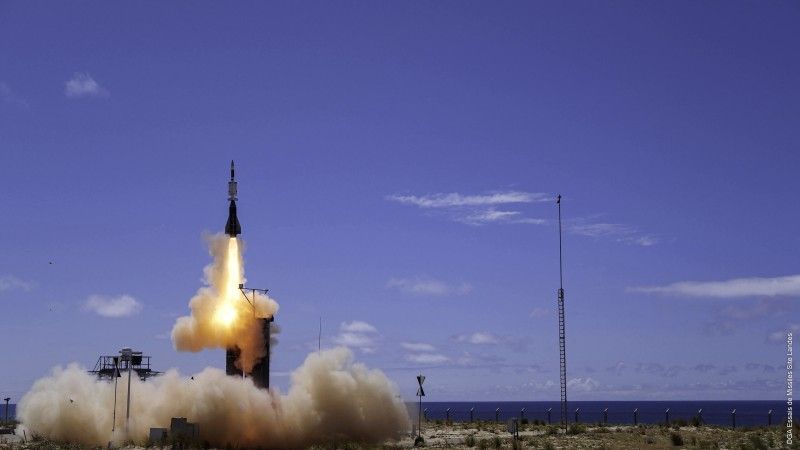
The French Directorate General of Armaments has placed an order for four additional SAMP/T NG air defence systems. By 2035, the Air and Space Force is expected to deploy 12 such units.
On 21 October, the French Directorate General of Armaments (fr. Direction générale de l’armement, DGA) announced that it had placed an order with Eurosam for four SAMP/T NG (fr. Sol-Air Moyenne Portée/Terrestre de Nouvelle Génération) medium-range air defence systems for the Air and Space Force (fr. Armée de l’Air et de l’Espace). The contractors will be MBDA France, MBDA Italia, and Thales, who are the shareholders of Eurosam. The agreement was signed through the Organisation for Joint Armament Co-operation (fr. Organisation conjointe de coopération en matière d’armement, OCCAR), a European entity managing numerous joint defence programmes for member and associated states, including Poland.
This marks the second production contract for these air and missile defence systems for the benefit of the Armée de l’Air et de l’Espace. In the original version of the Military Programming Law 2024–2030 (fr. Loi de programmation militaire 2024–2030), the purchase of eight SAMP/T NG systems was planned by the end of 2030. On 16 August this year, the law was amended, and the number of systems intended for acquisition during the aforementioned period was increased to 10. According to the current version of the legal act, the Armée de l’Air et de l’Espace is to deploy 12 SAMP/T NG systems by 2035. The agreement from 21 October indicates that this plan is being implemented. A portion of these 12 systems consists of older SAMP/T Mamba units, which are being upgraded to the SAMP/T NG standard. The remaining systems will be newly manufactured.
See also 

The first French SAMP/T NG system was delivered to the Military Air Expertise Centre (fr. Centre d’expertise aérienne militaire, CEAM) at Air Base 118 in Mont-de-Marsan. It will undergo detailed testing there before being commissioned into service. The additional units will significantly strengthen French air defence, increasing the total number of launchers to 48. In total, the Armée de l’Air et de l’Espace will possess a number of launchers equivalent to six batteries of the Polish Wisła (Vistula) system (the Polish Armed Forces intend to purchase a total of eight Patriot batteries, comprising 64 launchers). Italy is also participating in the SAMP/T NG programme, having so far ordered 10 units equipped with the Leonardo KRONOS Grand Mobile High Power radar for the Army (it. Esercito Italiano) and the Air Force (it. Aeronautica Militare). In July 2026, four more systems were ordered by Ukraine, which also acquired a licence to produce Aster 30 Block 1 New Technology (B1NT) missiles. Last year, the SAMP/T NG was selected by Denmark.
What is SAMP/T NG?
A French SAMP/T air defence battery consists of a radar station, a command vehicle, armament and electronics repair vehicles, ammunition vehicles, and four launchers (each carrying up to eight missiles). If necessary, the number of launchers can be increased to six. The Thales Ground Fire 300 radar introduced in the SAMP/T NG operates in the S-band. It features a rotating Active Electronically Scanned Array (AESA) antenna with Gallium Nitride (GaN) semiconductors. A full rotation of the antenna takes one second. The instrumental range is specified at 400 km, with coverage of 360° in azimuth and 90° in elevation. Deployment at a radar post takes 15 minutes. According to manufacturer data, the Ground Fire 300 can track over a thousand targets simultaneously. The radar is operated by two personnel.
The core of the SAMP/T NG system is the MBDA Aster 30 Block 1 New Technology (B1NT) missile. The new effector features a two-stage design. Both the jettisonable booster and the sustainer motor are powered by solid propellant. The range is approximately 150 km, and the maximum target altitude is 25 km. In the initial flight phase, the missile utilises an inertial navigation system and a two-way data link. In the terminal phase, a seeker head with a Ka-band radar is activated. Course corrections are performed using aerodynamic control surfaces and a gas-dynamic system called PIF-PAF. In 2024, the DGA announced that by 2028, the production of all missiles in the Aster family is expected to reach 300 units per year.
The command post is equipped with a Link 16 data link and a satellite communications terminal. Thanks to the new radar station and missiles, the SAMP/T NG battery can engage combat aircraft as well as air assault assets, including cruise missiles, short-range (up to 1,000 km) or medium-range (up to 3,000 km) ballistic missiles, and hypersonic missiles. The SAMP/T NG is intended to be integrated with MBDA VL MICA and VL MICA NG short-range missiles, allowing a single battery to independently form a layered air defence system. In March this year, Thales announced the commencement of work on SkyDefender, a command system for integrated, multi-layered, network-centric air defence. The SAMP/T NG is intended to form part of this solution.