












- WIADOMOŚCI
- ANALIZA
The Czech P13 pistol enters service with the Bundeswehr. The end of the hammer-fired P8 era

 Add as preferred on Google
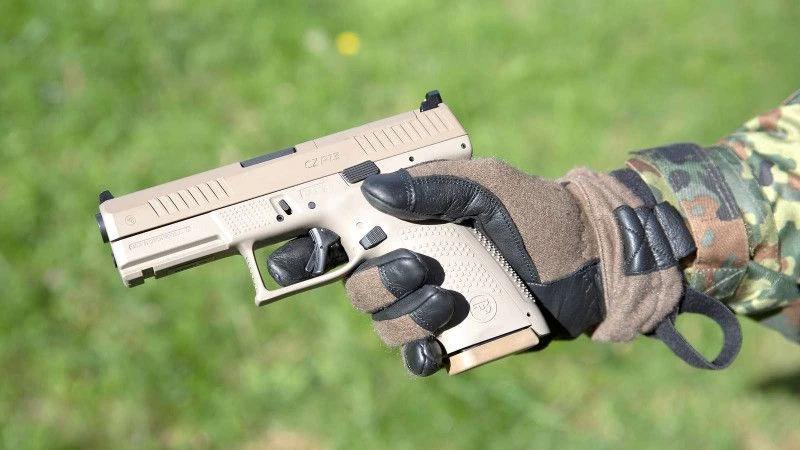
The German Armed Forces have begun receiving the first production P13 pistols, manufactured by the Czech company Česká zbrojovka (CZ) at its facility in Uherský Brod. Based on the CZ P-10 C OR, the pistol will replace the P8, in service since 1994, marking a significant shift in the Bundeswehr’s long-standing small-arms procurement policy.
Serial deliveries follow the weapon’s successful completion of an integrated certification and qualification testing process, including drop tests and checks of the safety mechanisms. Testing concluded in autumn 2026. The contract, equipment deliveries and logistical support are being handled by German company POL-TEC GmbH & Co. KG, CZ’s long-standing commercial partner in Germany.
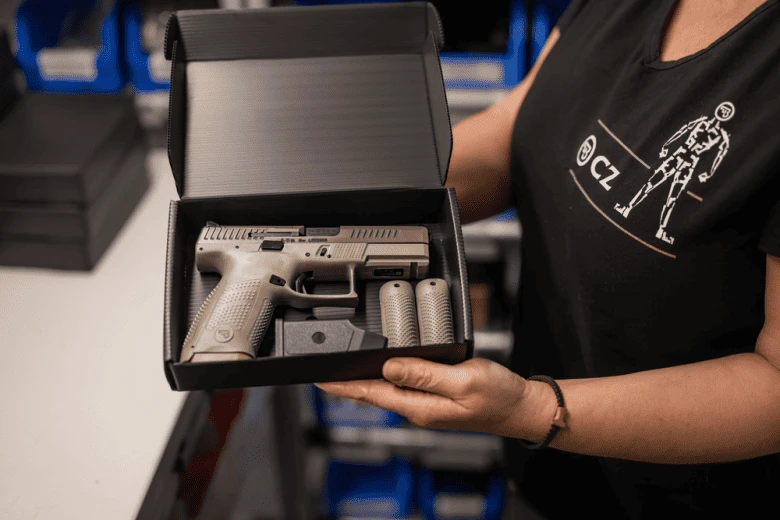
Photo. Česká zbrojovka a.s.
From tender to contract: how CZ’s design was selected
The programme, known as “Pistole querschnittlich” (universal pistol), aimed to standardise and modernise 9 × 19 mm sidearms across the Bundeswehr. After more than three decades of service, the P8 pistol, based on the Heckler & Koch USP, no longer met modern requirements for ergonomics, modularity or compatibility with contemporary optics.
During the competitive procurement process, Germany’s Ministry of Defence assessed bids from European manufacturers. It selected a proposal based on the CZ P-10 C OR (Optics-Ready), marking a loss for the incumbent domestic supplier, Heckler & Koch. The Bundestag Budget Committee approved funding for the project on 5 November 2025, and the supply contract was signed shortly afterwards.
The Bundeswehr’s total requirement for the new weapon exceeds 200,000 pistols. Initial batches are due to reach units at a pace that will allow the P8 to be gradually withdrawn from stores and sub-units.
What sets the P13 apart from the P8?
The variant developed for the Bundeswehr has a Flat Dark Earth (FDE) finish. It features a polymer frame with interchangeable grip panels, an Optics-Ready configuration for quick fitting of red-dot sights, and a striker-fired mechanism without an external manual safety.

For soldiers, one of the most noticeable differences in everyday use is the trigger: its pull weight of around 2.3 kg remains consistent from the first shot, whereas the P8’s double-action trigger required more than twice as much force. The interchangeable grip panels also allow the pistol to be adapted to soldiers’ different hand sizes. The P13 system package also includes training weapons and Level 2 and Level 3 retention holsters, supplied in cooperation with Italian company Radar 1957.
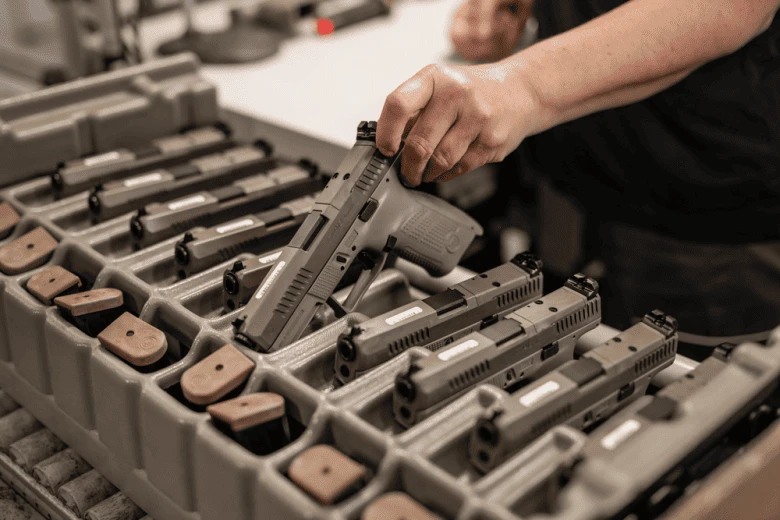
Photo. Česká zbrojovka a.s.
Significance for the European small-arms market
Česká zbrojovka’s (CZ) success in a major, high-profile tender to supply sidearms to a NATO member’s armed forces shows that foreign suppliers can compete effectively with established brands at the heart of the European defence market. For CZ, part of the Colt CZ Group, the Bundeswehr contract is one of its most important military-sector wins and strengthens its credentials ahead of future tenders in Europe.
The selection of a striker-fired design, factory-ready for red-dot sights, confirms that hammer-fired DA/SA pistols such as the P8 are becoming a legacy option for general frontline service in European armed forces. Manufacturers without ready-made optical interfaces and consistent ergonomics are losing ground in major government procurement contracts.
The P13’s deployment model—combining production in Uherský Brod in the Czech Republic, logistical integration and support from German company POL-TEC GmbH & Co. KG and equipment including holsters from other European countries such as Italy—illustrates the growing role of specialised local partners and international supply chains.


