












- WIADOMOŚCI
- ANALIZA
France promised a war economy. CAESAR ammunition still depends on one fragile forge

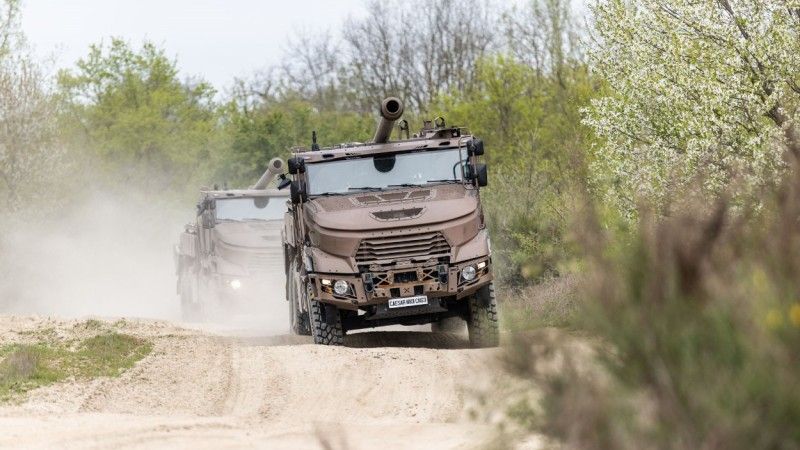
Photo. KNDS France
France has spent the years since Russia’s full-scale invasion of Ukraine speaking about a return to the „war economy”. Yet one of the most important links in its 155 mm artillery ammunition chain still rests on a single forge in Tarbes, whose machines are failing, deliveries have been disrupted and ownership remains uncertain. The case is not only about one troubled factory. It is about whether France can still turn political declarations into industrial depth.
France does not lack an ammunition industry. KNDS, Eurenco and other companies remain important parts of the French and European defence-industrial base. The problem lies in one specific and sensitive stage of the chain: the forged bodies used for large-calibre 155 mm artillery shells, including ammunition fired by CAESAR systems. Forges de Tarbes is not „the only French ammunition factory”, and it should not be described as such. It is, however, the only French forge able to produce these large 155 mm shell bodies at scale. That distinction matters, because it makes Tarbes a critical domestic point of failure.
This is not an interpretation imposed from outside. In 2026, the French DGA itself acknowledged that KNDS had, in practice, no real domestic alternative for this type of component. That means France can have modern artillery, operational experience, export success and political ambition, but still remain exposed if one industrial stage cannot follow demand.
The orders exist. At the end of 2025, KNDS signed an unprecedented three-year agreement with Forges de Tarbes covering between 60,000 and 150,000 155 mm shell bodies in total for 2026–2028, with the possibility of extending the agreement for another three years. That point has to be stated precisely. It is not an annual volume of 60,000 to 150,000. It is the total publicly announced range for the initial three-year period. The contract confirms that Tarbes remains central to French artillery production, but it does not prove that France has already rebuilt the industrial depth required for a long war.
The gap between ambition and capacity is the real issue. Europlasma had previously presented plans to raise output at Tarbes to 150,000–160,000 shell bodies per year by the end of 2025. Yet in 2026, DGA figures pointed instead to a capacity of around 65,000 shell bodies, with an ambition to reach roughly 100,000 in 2027. In other words, the problem is not only that one factory suffered a difficult month. The problem is that the industrial reality remains far below the level that had been presented as the horizon of the „war economy”.

The latest reports make the situation even more serious. Production was reportedly stopped from around mid-August to mid-September after repeated machine failures. Employees also described severe disruption in raw-material deliveries since March, late salaries and a climate of fear inside the plant. The workforce figure also tells its own story. Recent reporting puts the site at around 60 employees, whereas earlier in 2026 the DGA referred to roughly 100. There may be methodological explanations for that difference, but the image is still troubling, and a site described as essential to artillery production does not look like a secure industrial pillar.
Europlasma’s financial position strengthens that concern. The group reported a heavy loss for 2025, including a net loss attributable to the group of €35.6 million, negative EBITDA and negative equity. It has relied increasingly on highly dilutive convertible-bond financing, a type of instrument about which the French financial regulator has repeatedly warned because it is often used by companies whose financial situation makes conventional credit difficult to obtain. In a normal industrial sector, such a structure would already raise questions. In a critical defence supply chain, it becomes much harder to accept.
The pressure has also reached the physical assets of the factory. In March 2026, the real estate of the Tarbes site was sold in a sale-and-leaseback transaction. In practice, the company exchanged ownership of the site for immediate liquidity while taking on a recurring rental cost. For an ordinary company, this might be presented as a financial adjustment.
There is also no clear public ending to the ownership story. In April 2026, Europlasma announced exclusive negotiations with an unnamed French investor over the sale of its defence activities for around €150 million. The exclusivity period was later extended, and in June the group said talks were continuing. By early October, however, there had been no public confirmation that the transaction had closed and no public identification of the buyer. For a site described as essential to national defence production, such uncertainty is difficult to reconcile with the language of urgency.

The French state has not been absent. Paris provided more than €7 million in public advances or loans in 2022 and 2023 to support modernisation, and the DGA says it remains in regular contact with Europlasma while monitoring the proposed sale in order to protect French industrial sovereignty. This matters, because the case should not be reduced to the claim that the state simply disappeared. The problem is different because the state has been watching, supporting and monitoring, but has not yet presented a clear public solution that matches the strategic importance of the site.
The comparison with Germany is uncomfortable for France. Rheinmetall opened its new 155 mm plant in Unterlüß in 2025, with planned capacity rising from 25,000 rounds that year to 140,000 in 2026 and up to 350,000 in 2027. The German model is not perfect, and no country has solved every problem in the ammunition chain, but Berlin is bringing a large integrated production site online at the same time as Paris is still dealing with uncertainty around one critical forge.
Poland is also moving in the direction France says it wants to take, although Warsaw has not yet completed the full chain at target scale. MESKO plans new shell-body capacity in Kraśnik, while Nitro-Chem is expanding elaboration capacity and Poland is working with Eurenco on modular charges. The point is not that Poland already has everything. It does not. The point is that Poland is building additional nodes in the chain, while France still depends on one domestic source for a critical forged component. In a long-war environment, that difference matters.
The deeper problem is therefore not that France lacks knowledge, companies or artillery tradition. France remains one of Europe’s most serious military powers, and CAESAR has become one of the most visible symbols of its defence industry. But artillery credibility is not the same as industrial depth. A gun is only as useful as the ammunition chain behind it, and an ammunition chain is only as strong as its most fragile stage. If the shell body depends on one financially vulnerable site, the whole political language of ramp-up becomes weaker.

The issue is therefore not a temporary difficulty at one provincial factory. It is a test of whether France really treats artillery production as part of national power, or only as a sector that can be described in speeches when the political moment requires it. Four years after Paris started speaking about a „war economy”, one of the key links in the 155 mm ammunition chain still depends on a single domestic forge, weakened by financial uncertainty, an unresolved ownership situation, ageing equipment and disrupted deliveries. In peacetime, this might be presented as another industrial restructuring. In the current security environment, it is much more serious.


