- WIADOMOŚCI
- ANALIZA
Oman in the geopolitical strategy of the Russian Federation

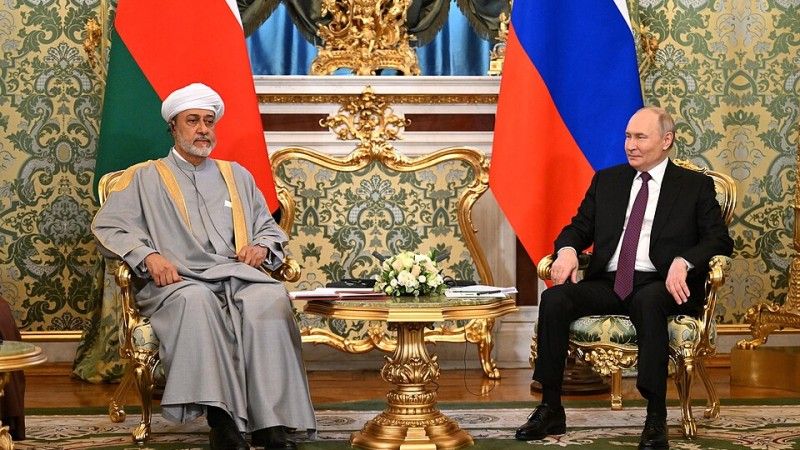
Photo. Presidential Executive Office of Russia / Wikimedia Commons
For decades, the Sultanate of Oman has positioned itself as a state with the status of a neutral mediator in the Middle East security architecture. Nevertheless, the intensification of diplomatic, intelligence, and economic relations between Muscat and Moscow is raising justified concerns in Western capitals. The Russian Federation sees Oman not only as a means of facilitating the circumvention of the sanctions regime, but also as a strategic partner in gaining access to the Arabian Sea and sea lines of communication (SLOCs) at the entrance to the Persian Gulf.
The cornerstone of Oman’s foreign policy, developed during the reign of Sultan Qaboos and continued under Sultan Haitham, remains strict multi-vectorism and diplomatic restraint. This paradigm enabled Muscat simultaneously to maintain asymmetric allied relations with Washington, informal dialogue with Tel Aviv, and the role of a key, credible channel of communication with Tehran. Its status as a buffer state has so far constituted an important stabilizing factor in the regional security environment.
In an era of the reconfiguration of the global balance of power and the ongoing high-intensity conflict in Eastern Europe, Oman’s traditional neutrality is, however, undergoing structural redefinition. Russia, subject to economic and technological restrictions and pursuing a doctrinal pivot towards the Global South, identifies Omani political pragmatism as an instrument for breaking international isolation. From the Kremlin’s perspective, Oman’s jurisdiction and infrastructure now constitute a node of critical importance for maintaining the continuity of the state’s logistical processes.
Sanctions-evasion architecture and the "shadow fleet" logistics
The economic dimension constitutes the primary area of Russian penetration into Oman’s state system. Muscat has refrained from joining the sanctions regime implemented by the G7 states. Consequently, the sultanate’s legal and administrative framework facilitates the free absorption of Russian capital, opening the way for the instrumentalization of Omani infrastructure by state entities and front companies linked to the administration in Moscow.
Oman has become one of the central operational areas for the so-called “shadow fleet”, involved in the transfer of Russian hydrocarbons while circumventing the price-cap mechanism. Omani territorial waters and exclusive economic zones (EEZs) are systematically used for ship-to-ship (STS) transfers. Commodities transferred between vessels with unregulated insurance status, often operating with their AIS transponders switched off, undergo a process that obscures their country of origin.
Additionally, free economic zones, including the strategically located ports of Sohar and Duqm, have become areas for registering numerous special-purpose companies (shell companies). Through them, Russian entities manage supply chains for dual-use goods, including advanced microelectronic components necessary to maintain the replenishment potential of the Russian defence-industrial complex.

INSTC Project and power projection in the Indian Ocean
Economic cooperation forms the foundation for the implementation of broader geostrategic objectives in the region. Moscow’s overriding priority is the integration of Omani infrastructure with the International North–South Transport Corridor (INSTC). This transport route, connecting the Russian Federation with India via Iranian land and port infrastructure, is intended by Russian strategists to serve as a secure alternative to maritime routes passing through the Suez Canal.
Oman’s territory is a natural operational extension of the INSTC corridor. Russian decision-makers are particularly interested in the special economic zone and deep-water port at Duqm. Located outside the Strait of Hormuz, the facility provides unobstructed operational access to the waters of the Indian Ocean. Although influence in this area has so far been contested primarily by the People’s Republic of China (capital investment) and the United States (the US Navy regularly uses local facilities for the logistical support of its fleet), Russia is beginning to articulate its own ambitions actively. As part of the strengthening of strategic cooperation with Iran, Moscow seeks rights to use logistical support points for the Russian Navy. Providing Russian vessels with logistical facilities at ports such as Duqm or Salalah would significantly expand the Russian fleet’s power-projection capabilities in the Arabian Sea.
Dynamics of cooperation in the defence and security sector
Bilateral relations have also intensified in the security domain (Security & Defence). Recently, a noticeable increase has been observed in the frequency of consultations at the ministerial level and within intelligence structures. The Russian Federation positions itself in the Middle East as a transactional partner that avoids conditioning cooperation on political-system criteria, deliberately contrasting this with US policy.
Moscow actively promotes technology transfers in the fields of cybersecurity and electronic warfare systems. In the face of growing activity in cyberspace in the Middle East, Russian solutions represent a form of technological diversification sought by Gulf states. At the same time, the Russian state arms exporter Rosoboronexport continues to explore opportunities to penetrate the Omani market, focusing on integrated air-defence systems. Although the Armed Forces of the Sultanate of Oman base their interoperability on Western weapons platforms, primarily from the United States and the United Kingdom, any acquisition of Russian equipment, even on a limited scale, would constitute a breach in the Western security architecture of the region.

Implications for the US and allied security architecture
From the perspective of the United States and NATO, the uneven vectors of Oman’s foreign policy generate significant planning challenges. The US Fifth Fleet, based in Manama, treats Omani territory in its operational concepts as a key stabilizing element on the western flank of the strategically important Strait of Hormuz.
The US Department of State and Department of Defense face a complex strategic dilemma. Applying assertive pressure mechanisms on Muscat concerning compliance with the sanctions regime carries the risk of permanently reorienting the sultanate towards a Chinese-Russian-Iranian cooperation format. On the other hand, maintaining the current political passivity effectively means tacit acceptance of Oman functioning as a hub supporting Russian asymmetric operations. The paradigm under which Omani multi-vectorism served exclusively to de-escalate tensions is becoming exhausted. The absence of a categorical diplomatic response from Western states facilitates the implementation of a multidomain strategy by revisionist powers aimed at circumventing Western deterrence mechanisms.
The established status of Oman in the academic literature as a strictly neutral state is becoming a convenient pretext for Euro-Atlantic capitals to avoid difficult political decisions. An analysis of operational conditions, however, demonstrates that in an era of renewed great-power rivalry, asymmetric multi-vectorism is in fact a form of state economic opportunism. The Russian Federation is effectively instrumentalizing this situation, using Omani jurisdiction, financial system, and maritime infrastructure to systematically circumvent international sanctions restrictions.
See also 

In my assessment, Washington’s and European capitals’ limitation of themselves to conservative forms of diplomatic pressure on Muscat, motivated by concerns about weakening the cohesion of the Gulf Cooperation Council (GCC) bloc, is a strategic mistake. The continuation of a policy of passivity will, in the long term, lead to a situation in which the Navy of the People’s Liberation Army of China and its Russian counterpart acquire real capabilities, based on permanent land infrastructure, to exert influence over the strategic sea lines of communication of the Arabian Sea. States in the region cooperating with the United States in the defence domain should be subject to an appropriate degree of alliance discipline. Accepting a model in which the territory of a partner state facilitates logistical operations by sanctioned entities undermines the fundamental credibility of the Western deterrence strategy.