












- ANALIZA
- WIADOMOŚCI
Peru pauses the K2. South Korea must wait for South America

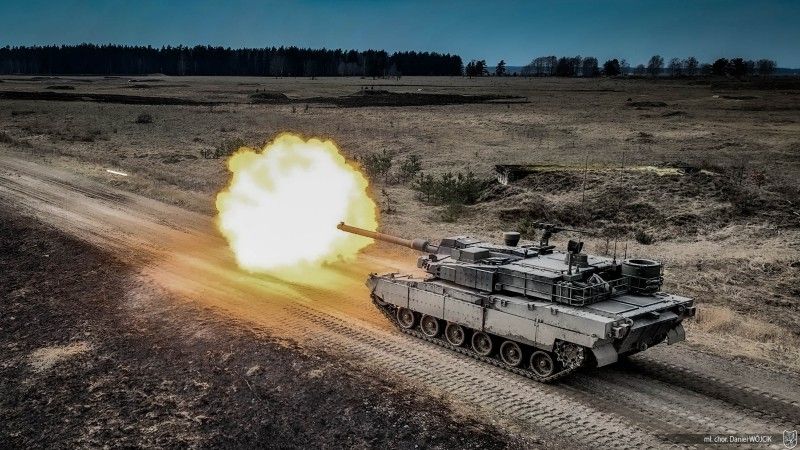
Photo. mł. chor. Daniel Wójcik / 16 Dywizja Zmechanizowana
Peru has not formally closed the door on the South Korean K2 Black Panther, but the programme has been politically and budgetarily paused. Defence Minister Rafael Belaúnde has said that the army has not submitted an investment project, the purchase is not included in the 2027 budget, and any future replacement for the T-55 should go through an international tender. This does not mean that the K2 has failed. It means that South Korea must wait longer for a real breakthrough in South America.
The Peruvian case is more interesting than the simple line that there is no money for Korean tanks. In December 2025, the Peruvian Army, FAME and Hyundai Rotem signed a framework agreement covering the possible future acquisition of 54 K2 Black Panther tanks and 141 K808 White Tiger armoured vehicles. But this was not yet a state-financed executive contract. It was a political and industrial route towards procurement, not procurement itself.
Belaúnde has now stopped that route. The previous logic was based on a strategic FAME-Hyundai Rotem arrangement. The new one returns to three basic questions: does the army have a formal requirement, does the state have funding, and will the process be competitive? At the moment, the answer is no.

It would still be wrong to write that Peru has abandoned the K2. Hyundai Rotem remains present in the country, the K808 is already part of the relationship, and three K2 tanks were brought to Peru for demonstrations. The problem is different: the 54 K2s are not today an approved modernisation programme. They are an ambition without money in the next budget.
K2 remains a serious tank
This does not change the wider assessment of the K2. It remains one of the most interesting main battle tanks available on the market. Its strength is not only the platform itself, but also the offer around it: fast deliveries, industrial flexibility and willingness to build local participation. In a market where many European programmes are delayed, that matters.
The actual users of the K2 are South Korea and Poland. Poland is now the key export reference point. The first stage gave the Polish Armed Forces rapid deliveries of K2GF tanks. The more important stage is K2PL with the Polonised version, with Polish industry involved in production, maintenance and further development. This is why the Polish programme is so important for Hyundai Rotem. It is not only a contract, but also a test of whether the K2 can become a European industrial project.
If K2PL succeeds, Poland will become the main European reference centre for the tank. That will matter for states that do not want to wait many years for future European platforms or rely only on the Leopard 2 ecosystem. For South Korea, Poland is therefore not just a customer. It is the gateway to credibility in Europe.
A tank watched beyond Poland
Interest in the K2 does not stop with Peru. During Defence24Days in Poland, Armenia was visibly engaged in discussions with the Korean side about possible future strengthening of its land forces, including armoured capabilities. This does not mean that Yerevan has a K2 programme. It shows, however, that the Korean tank is already treated as a serious option by states looking for rapid modernisation.

France is not considering buying the K2. Paris has its own armoured tradition, its Leclerc experience, its view of MGCS and its own work on future systems. But France cannot ignore the Korean model. The K2 shows that a non-European producer can offer a modern tank, quick production and industrial partnership. For France, it is not a procurement option. It is a competitive signal.
That is the wider meaning of the K2. Germany has the Leopard 2 network. The United States has the Abrams and political weight. France wants to preserve its own heavy-armour competence. South Korea comes with a simpler message: a modern tank, fast production and readiness to adapt the platform industrially.
South America will have to wait
Peru could have been a breakthrough because an entry into South America would have given Hyundai Rotem more than another contract. It would have created a first major foothold in a region where several armies still operate older tanks and where land-force modernisation has often been delayed.
For now, that scenario has been pushed back. Peru is not saying that the K2 is a bad tank; nevertheless, there is no investment project, no funding in the 2027 budget and no procedure that would make the K2 the selected successor to the T-55.
The K2 can be attractive, modern and industrially flexible, but even the best offer cannot replace a state budget decision. Poland had the Russian threat, an urgent need to rebuild armoured forces and a political decision to buy quickly. Peru has old T-55s and clear interest in the K2, but not yet an approved programme.
It must be underlined that the K2 remains one of the strongest export tanks in the world, and Poland is becoming its most important European laboratory. But South America will not open automatically. If Peru returns to the issue, the K2 will be one of the natural candidates. If it does not, Hyundai Rotem will need another opportunity to prove that the Black Panther can become not only a European success, but also a global armoured product.


