












- ANALIZA
- WIADOMOŚCI
Cold war at the top of the world. The militarisation of the Arctic and the sino-russian alliance on the Northern Sea route

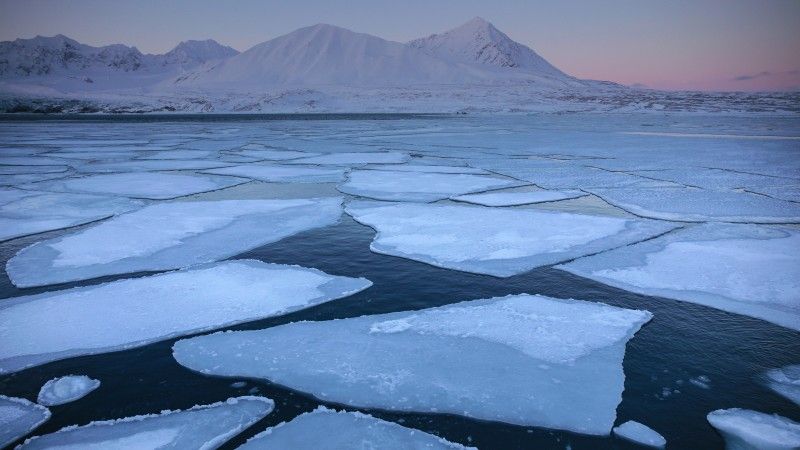
Climate change, which Western societies primarily regard as an environmental challenge, represents a geopolitical window of opportunity for strategists in Moscow and Beijing. The melting ice cover is transforming the Arctic Ocean from an inaccessible frozen wilderness into one of the most important and contested transport arteries of the twenty-first century. Although Sweden and Finland’s accession to NATO has theoretically closed the Alliance’s polar ring, Russia’s sustained militarisation of the High North and China’s expansion through investment are turning the Arctic into a new arena of great-power confrontation.
Geopolitics abhors a vacuum, and retreating ice is opening access to immense natural wealth. It is estimated that the seabed of the Arctic Ocean contains as much as 30% of the world’s undiscovered natural gas resources and 13% of its oil, as well as deposits of rare-earth metals. Yet hydrocarbons are not the only prize in this contest. The real geostrategic game-changer is the Northern Sea Route (NSR), which reduces cargo transit times between Asia and Europe by 30–40% compared with the route through the Suez Canal. At a time when routes through the Middle East are being disrupted, the NSR is gaining importance as a strategic logistical alternative.

Fortifying the Kola Peninsula and Russia's projection of power
For the Russian Federation, cut off from Western markets by sanctions, the Arctic is essential to the economy’s physical survival and forms the foundation of its status as a military superpower. The core of Russia’s offensive capabilities, the Northern Fleet—which operates strategic nuclear-powered ballistic missile submarines (SSBNs)—is based on the Kola Peninsula.
In Russian naval doctrine, the concept of „bastion” defence is a priority. Moscow has not only reactivated dozens of military bases and airfields abandoned since the Cold War, such as Nagurskoye and Rogachevo, but has also saturated the High North with anti-access systems. The deployment of advanced coastal defence systems (Bastion), air-defence systems (S-400s adapted for Arctic conditions), and interceptor aircraft armed with hypersonic missiles has one objective: to turn the NSR and its adjacent waters into a Russian inland sea. Moscow claims the right to control and license all shipping in these waters and, in a crisis—including an armed one—to block it, in open contradiction with the law of the sea (UNCLOS).
China as a "near-Arctic state"
The People’s Republic of China is Russia’s most significant ally in the region, but also a long-term challenge for Moscow. In official documents published in 2018, Beijing unilaterally described itself as a „near-Arctic state” and announced the development of a Polar Silk Road.
Dependent on Western capital and technology, Russia was compelled—albeit with evident reluctance—to open the Arctic to Chinese investment. Chinese entities are co-financing massive extraction projects, such as Yamal LNG, and actively expanding their own fleet of nuclear-powered icebreakers. For China, access to the NSR offers a way to resolve the so-called Malacca dilemma: reducing dependence on the narrow straits of Southeast Asia, which would be immediately blockaded by the US Navy in the event of an invasion of Taiwan.

The Arctic and NATO enlargement
Finland and Sweden’s accession to the North Atlantic Alliance has dramatically altered the balance of power in the Arctic Council: seven of its eight member states are now NATO members. This gives the Alliance considerable strategic depth on its northern flank.
NATO’s problem, however, is not geography but a shortage of specialised operational platforms and a lack of adequate means to project power physically in these waters. The United States suffers from a severe shortage of operational icebreakers, with just two ageing vessels, whereas Russia has more than forty, including the powerful nuclear-powered icebreakers of the Arktika class. Without the physical capability to operate in ice-covered waters, Washington’s declarations in support of freedom of navigation in the Arctic remain little more than diplomatic notes.
The prevailing Western perception of the Arctic is evolving too slowly. For too long, the region was discussed almost exclusively in environmental terms, while for states with revisionist ambitions, the melting ice cover represents a key force multiplier and a foundation for the future geo-economic architecture. The West’s analytical focus on the land dimension of NATO’s eastern flank, although entirely justified operationally, paradoxically obscures the structural shift in the centre of gravity of global competition towards the High North.
It is an illusion to treat the accession of the Nordic countries to the Alliance as a definitive solution to the security challenges in this theatre. Even the most coherent treaty architecture remains a dead letter without the ability to project power physically and deter adversaries by denial. The current asymmetry of forces, in which Russia enjoys near-monopolistic control over a fleet capable of operating in extreme ice conditions, while China consistently pursues a strategy of military-civil fusion in the region, effectively marginalises Europe’s and the United States’ geostrategic position. The absence of a rapid, multi-billion-dollar technological response encompassing not only ships but also the wider polar infrastructure amounts to acquiescence in the creation of an alternative circulatory system for global trade, under the full and exclusive control of an authoritarian axis. Victory in this arena will not depend on the number of armoured divisions, but on the physical ability to maintain maritime lines of communication in one of the planet’s most inhospitable operating environments.


