












- WIADOMOŚCI
France risks Rafale isolation as India pushes back

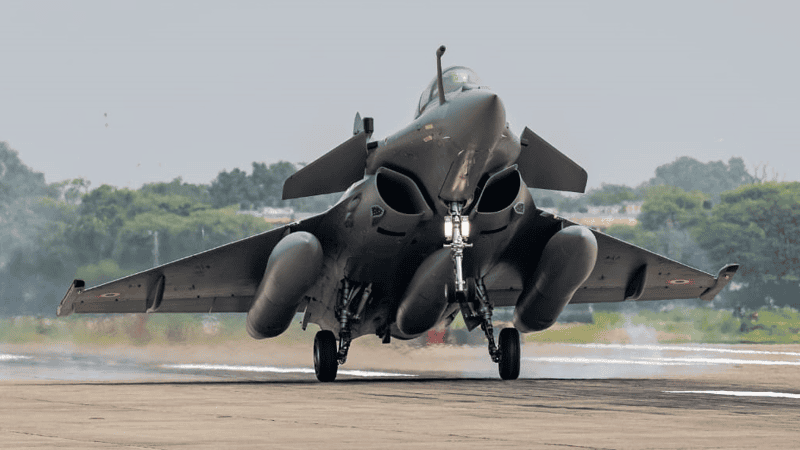
France is facing a growing strategic problem in its flagship Rafale programme. After the withdrawal of the United Arab Emirates, tensions with India now raise the risk that Paris may be left to finance and develop its next-generation fighter largely alone.
The Rafale F5 programme was intended to be a cornerstone of France’s future airpower and defence industrial strategy. However, the decision of the United Arab Emirates to withdraw over disputes related to technology transfer—particularly in sensitive areas such as optronics—has already exposed structural limits in French defence cooperation. Paris« reluctance to share key technologies has come at a tangible cost: the loss of a partner ready to contribute billions of euros to development.
A similar dynamic is now visible in India. Negotiations over the acquisition of 114 Rafale fighters have reached a critical stage, with New Delhi openly signalling that without access to key elements of the aircraft’s digital architecture—including the Interface Control Document—there may be no deal at all. From the Indian perspective, this is no longer simply a procurement issue, but a question of strategic autonomy. Without control over integration and software, even the most advanced platform risks becoming a dependency rather than a capability.

Taken together, these developments point to a broader problem. France is increasingly positioning itself as a supplier unwilling to share critical technologies, while its partners are moving in the opposite direction—seeking sovereignty, control, and long-term independence. The cases of the UAE and India show that this gap is not theoretical; it is already translating into stalled negotiations and withdrawn commitments.
This also has direct implications for the Rafale F5 programme itself. Without external funding, France will have to absorb the full financial burden, estimated at several billion euros, while also facing potential delays. More importantly, the pool of potential partners is shrinking. After the UAE and India, there are no obvious candidates willing to join such a programme under current conditions—certainly not in Europe, where similar capability development paths already exist.

In this context, France risks placing itself in a difficult strategic position. By prioritising technological control over partnership flexibility, it may retain sovereignty—but at the cost of reduced cooperation and higher financial exposure. Other countries, observing the cases of the UAE and India, will draw their own conclusions and are likely to demand broader access and guarantees before committing to similar programmes.
As a result, Paris may eventually be forced to look for alternative partners or financing models. However, its negotiating position will be weaker. In the long term, this is not just about Rafale F5—it is about the credibility of France as a defence partner in an environment where technology sharing is increasingly seen as a prerequisite, not a concession.


