












- WIADOMOŚCI
German drones will protect the sky over Ukraine. Will they intercept Russian jet-powered UAVs?

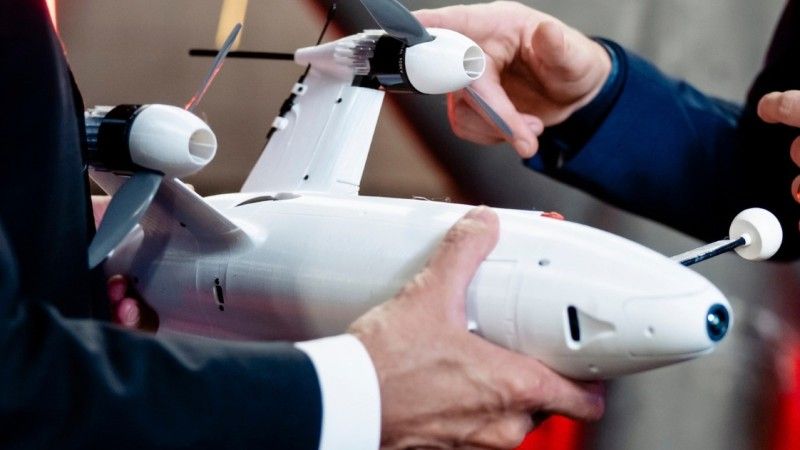
The Russians anticipate that a clash involving thousands of Russian Geran kamikaze drones and German SPYS interceptor drones will take place over Kyiv in just two months.
Federal Chancellor Friedrich Merz announced during a visit to Kyiv on 4 October 2026 that Germany would fund the purchase of tens of thousands of SPYS interceptor drones for Ukraine as part of the German military aid package for the winter of 2026/2027. These are intended primarily to assist in the fight against the Russian jet-powered Geran-4 and Geran-5 drones.
The SPYS drone is being developed by Quantum Systems in collaboration with the Ukrainian company WIY Drones Ukraine. On the company’s website, it is still marked as „under development”. However, thanks to the German government’s funding of the project, work has accelerated rapidly, and several thousand SPYS interceptors, fully ready for operational use, are expected to appear in Ukraine later this year.

These are urgently needed because the Russians« mass use of jet-powered drones has overwhelmed Ukrainian air defences, which have begun to let through an increasing number of Russian UAVs. Consequently, urgent work has begun in Ukraine to find an effective antidote to this new threat.
The main problem was the speed of the jet-powered Gerans, which in the case of the „five” exceeds 600 km/h, and an altitude reaching up to 6,000 m. The SPYS interceptor was developed in response. Carrying a warhead weighing up to 300 grams, according to WIY Drones, it can operate at altitudes of up to 4,000 metres within a radius of up to 15 km, flying at speeds of up to 480 km/h. However, some sources report that the SPYS has a ceiling of 6,000 m and can reach speeds of 600 km/h. According to the manufacturer, „such high flight dynamics allow for the distance to the target to be quickly closed and for it to be intercepted before it enters the protected zone”.

Photo. wiydrones.com
It is a highly autonomous system. Based on previously provided data from reconnaissance and surveillance systems, it is possible to programme an autonomous take-off, with an approach to the interception zone and an automatic approach to the target controlled by artificial intelligence systems. SPYS can be equipped with both daylight and thermal imaging cameras. It is therefore a system adapted for conducting operations around the clock.
Russian media are now analysing whether such interceptor drones can indeed provide air cover for Kyiv. Of particular interest was the assessment presented by Mikhail Khodaryonok, a retired colonel and military analyst for the Gazeta.Ru portal. He confirmed that SPYS interceptors would fulfil their tasks.
However, he warned that Russia would not stand idly by as advanced Ukrainian interceptor drones are mass-produced. He announced the rapid development and implementation of countermeasures, even during ongoing combat operations. These solutions include:
- the destruction of SPYS drones by Russian escort drones, which will be included in Geran kamikaze drone formations;
- the neutralisation of SPYS systems using electronic warfare measures;
- the introduction by the Russian army of "even faster and cheaper variants of the Geran, which would effectively negate the current advantage of SPYS systems".

This opinion is significant because Khodaryonok, as a former air defence specialist (a 1976 graduate of, among others, the Minsk Higher Engineering School of Anti-Aircraft Missile Forces), noted the advantage that SPYS drones already have over Russian long-range unmanned systems.
In the current situation, he therefore proposes that, even before the mass production of SPYS UAVs begins, the intensity of mass strikes be increased „using drones – such as modernised Geran models, which could inflict such severe damage on the Ukrainian defence industry, lines of communication, and national infrastructure that the authorities in Kyiv might be forced to fundamentally change their position on the war”.
Gazeta.ru protected itself against potential Kremlin sanctions, however, by placing a note under his analysis stating that „the author’s opinion does not necessarily reflect the position of the editorial board”.


