












- WIADOMOŚCI
More Western fighter jets for Ukraine? Talks nearing completion

 Add as preferred on Google
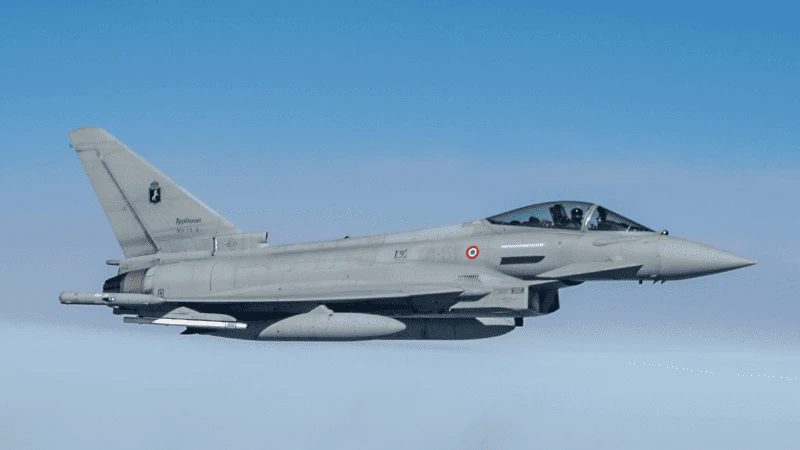
Reports are emerging that the Ukrainian government is in the final stage of negotiations with Italy over the transfer of F-2000 fighter jets. The Italian newspaper La Repubblica broke the story.
The F-2000A is the Italian designation for the Eurofighter Typhoon. The talks concerned the transfer of between 10 and 20 aircraft in the earliest Tranche 1 configuration — enough for one squadron. Tranche 1 was a very early version of the Typhoon, far short of its intended capabilities. The countries that manufacture it — the United Kingdom, Italy, Spain and Germany — nevertheless ordered it to keep the programme alive, paving the way for the aircraft’s eventual full development.
Tranche 1 aircraft are significantly less capable than Tranche 3 and later versions. They have mechanically scanned, rather than electronically scanned, radar, and are designed for air-to-air combat rather than multirole operations. Even in air combat, they cannot use one of the newer Eurofighter’s biggest advantages: MBDA Meteor air-to-air missiles. Their main weapons are C-series AMRAAMs — the same missiles used by Ukraine’s F-16AM/BMs — and IRIS-T missiles for short-range engagements.
Would Eurofighter Tranche 1 be of no use to Ukraine? Of course not. As Ukraine’s Soviet-era aircraft are worn down and lost, and given its capabilities, Tranche 1 would still be able to carry out many missions, particularly air defence. The aircraft have also received a modest upgrade known as Block 5, which allows them to use a targeting pod and drop precision-guided bombs.
Eurofighter vs F-15 — less demanding and easier to operate
The adversary is not especially demanding either, given the Russian air force’s performance over the past five years. If Ukrainians have been able to stand up to it and protect their own airspace from incursions with MiG-29s and Su-27s, they should be even better placed to do so with even the least capable Typhoon: a newer aircraft that is still far more advanced, representing Western technology of the late 1990s.
All consortium members must approve the transfer, but none seems to have reason to veto it. On the contrary, if the aircraft prove their worth, it may be worth considering transferring Spanish, German and British aircraft as well. Spain and Germany have ordered Tranche 4 and Tranche 5 aircraft as replacements, while the UK has retired its Tranche 1 aircraft without a direct successor.
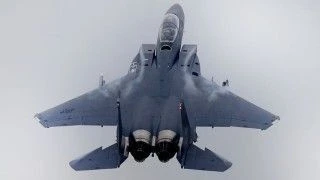
Given that Gen. Deptula’s proposal to transfer F-15Cs to Ukraine has been widely discussed recently, it is worth asking how the Eurofighter compares. Much more favourably, despite its inferior technical specifications. Unlike the F-15, the European aircraft has less demanding infrastructure requirements, and its design is based on one key principle: the aircraft can be turned around very quickly after a mission and prepared for the next one. As a result, it can be dispersed and rapidly redeployed — just as Ukrainians are doing now.
Europe’s resolve makes support easier
Of course, the Typhoon has its own requirements, and transferring it would add another aircraft type to Ukraine’s arsenal — the fourth, after the F-16, the small number of Mirage 2000s and the Gripen. Like the F-15, it would require trained personnel, prepared infrastructure and spare-parts stocks. But this ultimately depends on Europe’s commitment, capacity and willingness. Despite its shortcomings, Europe is more determined to help than the United States. And although the Italian and other Eurofighters are worn, they are not as worn as the American Eagles.


