












- WIADOMOŚCI
- ANALIZA
- KOMENTARZ
Is the F-15 suitable for Ukraine? There are many downsides, but it may be the only option

 Add as preferred on Google
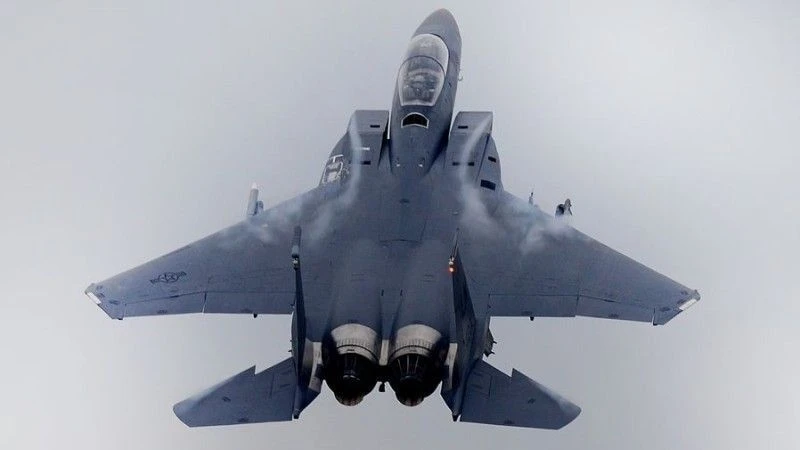
Recently, there has been a suggestion that Ukraine be given F-15C and F-15D combat aircraft. The issue was raised by retired US Air Force General David Deptula in an article for Forbes. There are arguments in favour of transferring these aircraft, but doing so would involve numerous challenges.
At the beginning of 2026, F-15C/Ds were still serving only with the US National Guard, and the last of them are now being withdrawn from service. The final Eagles are being sent to the Air Force storage facility at Davis-Monthan in Arizona. They are being replaced by more F-35As and F-15EX Eagle IIs. There are currently around 240 F-15C and F-15D aircraft in storage. Four squadrons of F-15E Strike Eagles also remain in service.
The F-15C/Ds being retired are worn-out airframes, partly because the F-15 programme was cut back at the time, limiting the production of their successor, the F-22 Raptor. Their technical capabilities also do not put them among the world’s leading aircraft. Nevertheless, at least some have been fitted with the APG-63(V)3 active electronically scanned array (AESA) radar. Combined with strong flight performance — including a service ceiling of up to 20 km, a weapons load of eight air-to-air missiles and 1.8 times the ammunition capacity for the onboard cannon, and a top speed of Mach 2.5 — this system could open up a whole new world of possibilities for the Ukrainians.
A plan to use US F-15s to ease the burden on Ukraine’s F-16 fleet
General Deptula proposes selecting 50–60 aircraft from the Arizona storage facility that are in the best technical condition and would therefore be easiest to refurbish and prepare for service. Some of these processes might be accelerated by cannibalising parts from other aircraft. The selected aircraft would, of course, be those already fitted with AESA radars.
The F-15C could take over the air-defence role from the F-16 and would be far more effective at it. In other words, one sortie by an F-15C could deliver benefits equivalent to, for example, two F-16 sorties. At the same time, General Deptula argues, this would free up F-16s for more effective use on other types of missions, such as strikes at the front or against targets behind enemy lines.
It is worth adding that an F-15C with AESA radar could be used not only to destroy cruise missiles and drones, but also to threaten Russian air operations, such as those involving Su-34 frontline bombers and their escorts. Easing the burden on the F-16s could also help keep the fleet at an optimal strength, without a situation in which most of the aircraft are undergoing maintenance abroad.
The general proposes the F-15C as an interim solution that could be introduced quickly, bridging the gap between the current situation and the future Ukrainian air force equipped with new-build Rafales, Gripen NGs, and F-16s. The F-15s could not remain in service for long because of their heavy wear — not without reason: they are being finally retired this year.
Logistical and infrastructural challenges
However, this solution presents numerous problems, even assuming that the necessary support infrastructure can be put in place. First, Ukrainian pilots and ground crews would need to be trained to operate this type of aircraft. It would already be the fourth type of Western combat aircraft, further deepening the logistical nightmare. The general suggests training current Ukrainian Su-27 and MiG-29 pilots to fly the F-15, allowing them to move on to a better aircraft and abandon the platforms they currently use, which are now extremely worn out. Even veterans of years of combat need time to train on a particular type, although, of course, less time than a young aviation recruit starting from scratch.
But let us remember how much time and effort it took to train Ukrainian crews to operate the simpler F-16, and how long it took to build up crews for the Gripen. The F-15C would be a more substantial undertaking in this respect, though the process would be shorter because the Ukrainians have learnt the Western approach to aircraft operation on the F-16. The F-15C has demanding infrastructure requirements, including the length and quality of the runway surface. It is also relatively vulnerable to foreign-object ingestion into its engines.
Can this aircraft be redeployed quickly and operated from small airfields? From enough locations that the Russians would not know where the aircraft were at any given time? This is highly doubtful, though it would be best to hear from the Ukrainians themselves and… the Americans. It is not clear whether Washington has the political will to do this; after all, the United States has yet to provide Ukraine with a single combat aircraft.
If it did have the will, however, it might be worth taking a look at other aircraft stored at Davis-Monthan.
There are often calls for F/A-18s as the aircraft Ukraine needs most. Newer, heavier aircraft are out of reach because they are, and will continue to be, in service aboard American aircraft carriers. However, around a hundred smaller, older F/A-18C/Ds are in storage, veterans of the US Navy and the US Marine Corps.
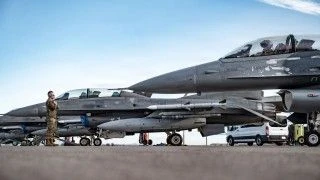
At first glance, Hornets seem ideal for the Ukrainians. They are highly capable of operating in a dispersed manner and from lower-quality airfields, and their capabilities are comparable to those of Ukraine’s F-16s. However, these aircraft were pushed to the limit while awaiting the B and C versions of the F-35. Those in Arizona have exceeded their service life by as much as several thousand hours beyond the original estimates; to achieve this, their landing gear and airframes had to undergo life-extension work.
The F-15 is the only option available immediately
Another possibility would be F-16s. In the 1990s, the United States accumulated hundreds of A and B variants as part of force reductions following the end of the Cold War. Unfortunately, it turns out that these aircraft were already in poor technical condition 20 years ago. The Italian Air Force found this out first-hand after leasing a number of F-16s brought out of storage. Over the course of a decade, they suffered five accidents, three of them caused by technical problems. Romania provides another example: it began building its own F-16AM/BM fleet by purchasing and upgrading Portuguese F-16AMs. Because no two-seat aircraft were available, it decided to bring two F-16Bs out of storage and restore them to a similar standard. Work on the American aircraft took considerably longer and cost significantly more than work on the Portuguese aircraft.
The storage facility also contains recently retired AV-8B Harrier IIs and A-10 Thunderbolt IIs. The usefulness of both types is, however, open to question.
See also 
The F-15 is therefore the only combat aircraft from the US surplus that could be made available at short notice. Its career might nevertheless come to an end very quickly, given the high demand for it and how easy it would be to predict where these aircraft would be at any given time.


