- ANALIZA
- WIADOMOŚCI
Russian influence operation exposed in Angola

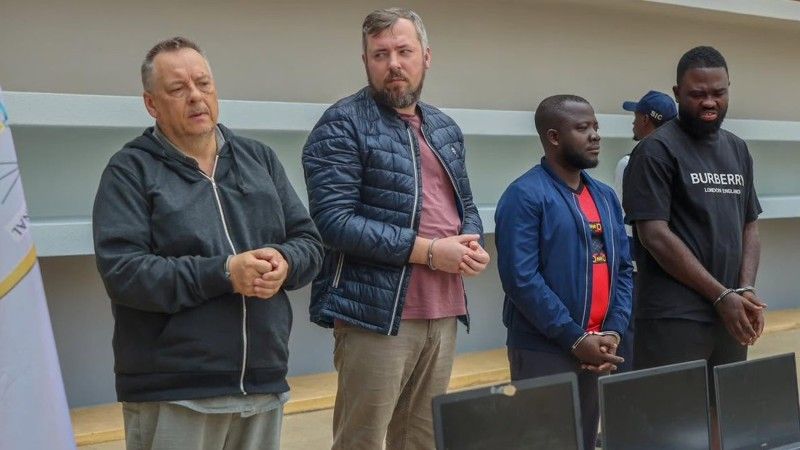
Photo. Ministerio do Interior/Governo de Angola
The conviction of two Russian nationals in Angola shows that Moscow-linked political networks are facing growing resistance in parts of Africa. The case concerned alleged attempts to spread disinformation, cultivate political contacts and influence public unrest ahead of the country’s next presidential election. At the same time, questions remain over the quality of the evidence and the way in which the trial was conducted.
According to the BBC, a court in Luanda found Russian political consultant Igor Ratchin and translator Lev Lakshtanov guilty of terrorism, espionage, criminal association and the illegal retention of currency. Ratchin was sentenced to 11 years in prison, while Lakshtanov received an eight-year term. Both men denied the charges.
They were arrested in August 2025 over allegations that they had participated in a political influence operation linked to Africa Politology. Angolan authorities described the organisation as a Russian political network that emerged from structures connected with the former Wagner Group.
Prosecutors argued that the network sought to spread anti-Western narratives, develop contacts with political figures and influence Angola’s political environment ahead of the next presidential election. The Russians, however, maintained that they were working on plans to establish a Russian cultural centre in Luanda and denied any connection to Wagner or the Russian state.

Influence operations beyond the battlefield
The case is important because it demonstrates that Russian involvement in Africa does not depend only on mercenaries, arms deliveries or formal security agreements. Political advisers, media activity and local networks can also be used to influence governments and public opinion.
According to the prosecution, the defendants paid local journalists and experts more than $24,000 to produce pro-Russian and anti-government content. Investigators also cited publications allegedly connected with the operation, material concerning the 2025 protests and contacts with senior Angolan political figures.
The authorities further accused the defendants of helping to organise deadly unrest in 2025. This remains one of the most disputed elements of the case. Angolan activists have argued that the protests were driven by domestic grievances and did not require foreign organisation.
The Russians reportedly acknowledged meeting representatives of both the ruling MPLA and the opposition Unita, but denied that the discussions had any illegal purpose. The court rejected a defence request to call some of those politicians as witnesses, deciding that their testimony was not necessary to establish the facts.
This creates a difficult situation. On the one hand, Russia and networks linked to Wagner have a documented history of political activity in African states. On the other hand, the existence of Russian contacts does not automatically prove terrorism or responsibility for domestic protests. The strength of the judgement will therefore depend on whether the authorities can show more than political meetings, payments and hostile publications.

Questions over the trial
The proceedings were marked by controversy from the beginning. During one of the first hearings, the prosecutor refused to read the indictment aloud, arguing that the defendants were already familiar with the allegations. The defence responded that the trial was public and that journalists and observers should be able to hear the charges.
The indictment itself was also criticised for relying on assumptions and for containing misspellings and apparent factual errors. The defence repeatedly challenged the evidence, while the prosecution did not publicly clarify all of the disputed points.
Two Angolan nationals were tried alongside the Russians. Sports journalist Amor Carlos Tomé received a two-year suspended sentence, while political activist Francisco Oliveira was acquitted. Prosecutors immediately appealed, and Tomé was expected to remain in custody pending the outcome.
The verdict therefore does not close the case. It may instead begin a longer legal and political dispute concerning the presence of Russian influence networks in Angola, the limits of foreign political activity and the willingness of the authorities to treat such operations as a threat to national security.
What has already become clear is that Angola does not want to become another state in which Russian political structures operate without serious restrictions. At the same time, the authorities will have to demonstrate that the accusations were supported by strong evidence and not only by the broader reputation of Wagner-linked networks in Africa.
Russia has spent years expanding its influence through security cooperation, political consultancy and information operations. Angola has now shown that such activity can also lead to long prison sentences. Whether this case becomes a warning for other Russian networks will depend not only on the severity of the verdict, but also on whether the judgement survives further legal scrutiny.