












- WIADOMOŚCI
- ANALIZA
The “Era of Unrest.” Finnish threat assessment through 2040

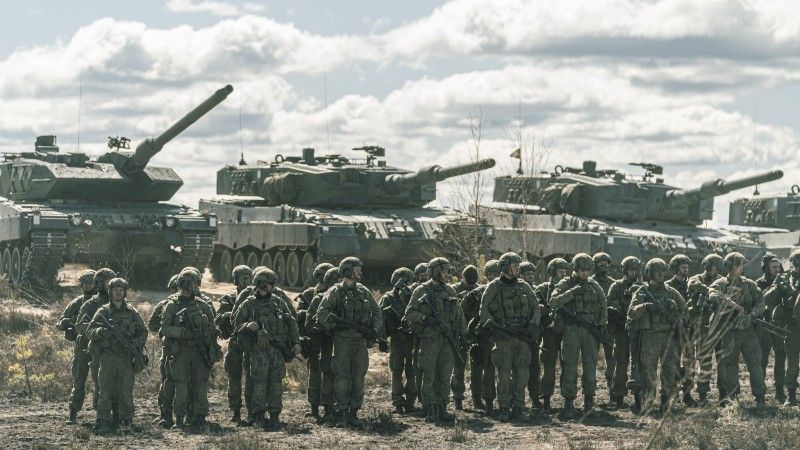
Photo. Maavoimat / @maavoimat / X
The Finnish Defence Research Agency has just published one of the most important strategic documents of recent years: the report “ERA OF UNREST: Finnish Future Operating Environment 2040.” It is a systematic, multilayered analysis of the operational environment in which Finland will have to function over the next decade and beyond.
A new concert of great powers
The document, which follows on from the Strategic Foresight Study 2044, is built around five broad drivers of change. The first is great-power competition. According to the authors, the United States is in the process of transforming its role on the international stage, moving away from the model of the “world’s sheriff.” Its focus will gradually shift toward the Indo-Pacific, despite continuing turbulence in the Middle East, although Washington is not expected to withdraw from Europe altogether. The American presence will become more conditional and increasingly dependent on the administration in power in Washington.
On the opposite side stand China and the Russian Federation. China will primarily seek to gain the upper hand in the Arctic, even at Russia’s expense. In the worst-case scenario for the Kremlin, Russia could be reduced to the role of Beijing’s vassal. China will also continue seeking to make Europe more dependent on it and to “pull” Europe out from under Washington’s strategic umbrella.
Moscow, meanwhile, regardless of the outcome of the war in Ukraine, will seek to rebuild its sphere of influence and will not abandon its most important instruments: force and fear. It will also attempt to exploit all of its capabilities to destabilize Europe, from the former Yugoslavia to the Arctic.
The second driver concerns direct threats from Finland’s immediate neighbourhood. Russia remains the principal determinant of Finnish security. The expansion of the Leningrad Military District, hybrid activities conducted below the threshold of war, and Russia’s readiness to employ military force create a permanent background threat. Alliances form the third pillar. NATO and the EU give Finland greater freedom of action, but this must be considered alongside the differing threat perceptions of individual allies and the level of U.S. capabilities available at any given moment.
The fourth area concerns the development of cognitive warfare and hybrid operations by the Russian Federation, regardless of whether Europe is formally at war or at peace. Russia remains a threat to the region.
The final—and perhaps most distinctly “Finnish” element of the report concerns society and the doctrine of total defence. The authors emphasize that a system based on universal conscription and a large reserve will function only as long as the population’s will to defend the country and psychological resilience do not erode. Demographic change, polarization, immigration, and the growing role of global corporations all represent genuine risks. For that reason, the report’s authors regard the preservation of a well-functioning nation, resilient to all attempts to fracture its cohesion, as critically important.

Future scenarios
The analysis also presents two scenarios facing not only Helsinki but Europe as a whole. The first assumes the continuation of strategic uncertainty. In the coming years, the United States will continue reshaping its international role, while Russia, following a potential end to the war, will maintain an aggressive foreign policy and intensify operations below the threshold of war against Europe. Assuming that a high level of readiness is maintained and allies remain mobilized, however, an outright conventional war could still be prevented under this scenario.
The second scenario is simply called “War in Europe”. This is the worst-case scenario, in which Russia completes the annexation of Belarus and attacks the Baltic states and the Suwałki Gap, while China supports Russian operations in the Arctic. In this scenario, despite declarations of assistance under Article 5, NATO is delayed in coming to the aid of its allies. This causes the Alliance to erode and forces Finland to fight largely on its own on Finnish territory.
The report outlines a potential opening phase of a Russia–NATO conflict in which Russian forces would launch an offensive against the Baltic states, concentrating their main effort along the southern shore of the Gulf of Finland. Following the capture of Narva, they would pose a direct threat to Tallinn. At the same time, Moscow would seek to restrict NATO’s freedom of action in Northern Europe by attacking Poland from the area south of Kaliningrad and using long-range strikes to isolate Finland and the Baltic states from allied support.
The operating environment through 2040 is described as one characterized by continuous uncertainty and constant readiness for crises and both internal and external destabilization. This will require a multilayered defence system, from deterrence to genuine preparation for a war involving hundreds of thousands of soldiers.
Poland? Allied role increasing?
The Finns place considerable emphasis on close regional cooperation with their nearest partners. The authors note that as the military role of the United States in Europe has diminished, the United Kingdom, France, Germany, and Poland have assumed a greater role within NATO. They add that although most Alliance members continue to emphasize the importance of collective defence, differing views on how it should be implemented and financed have slowed the development of NATO’s deterrence and defence capabilities.
The authors add that, given the outlook for the coming years and the defence investments already announced, Poland and Germany are set to become Helsinki’s most important security partners.
Time of unrest and divisions
The report highlights the division of the world into new spheres of influence, based on historical and cultural ties, economic cooperation, geopolitical location, and access to resources. This means that many countries, particularly smaller states, will simply find themselves incorporated into the bloc of one great power or another. Contested regions sought by more than one major power will be especially unstable and subject to continual attempts at political, economic, informational, or military influence.
For a small state, the key question becomes which category it will fall into. A major determining factor will be changes within the transatlantic world, driven above all by the reorientation of American strategy and the perception of Europe as a consumer of security. If that perception, and European passivity, were to become entrenched, NATO could formally survive while losing its genuine operational capability, the credibility of nuclear deterrence, and the significance of bilateral agreements. Europe would then have to build its own structures—either regional frameworks, arrangements centred on the largest European states, or a strengthened role for the European Union. None of these options, however, resolves the fundamental problem: where to obtain sufficient military capabilities, and how to generate a common political will to use them.
The final issue highlighted by the authors is the possible breaking of the nuclear taboo, whether by a major power or a non-state actor. Such an event could lead to the collapse of the arms-control treaty system, a renewed arms race, and growing distrust of conventional security arrangements. Nuclear weapons could then shift from being primarily an instrument of deterrence back toward being an instrument of warfare. This could encourage smaller states in particular to consider acquiring nuclear weapons as a means of safeguarding their territorial integrity, while at the same time exposing whichever actor first used such weapons to international isolation. From a military perspective, this would fundamentally alter battlefield dynamics, increasing pressure on political and military decision-makers and reducing the time available for a rational assessment of consequences.


