












- WYWIADY
- W CENTRUM UWAGI
US vs. Venezuela: it's not (entirely) about oil

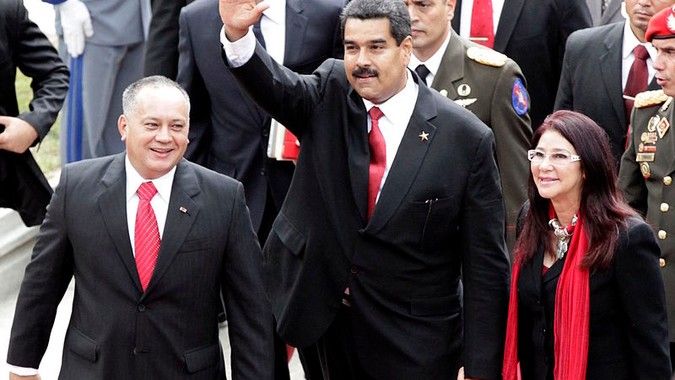
Tensions between Washington and Caracas are mounting. Last Saturday, US forces detained a tanker carrying Venezuelan oil bound for China in international waters. US military pressure in the region is increasing. The White House talks about the “war on drugs,” while the media talks about the war for oil. However, as Rafał Michalski, an analyst specializing in US affairs, points out, the reason for Washington’s recent actions may lie elsewhere entirely.
Magdalena Melke, E24: Let’s start by outlining the background to the current conflict between the United States and Venezuela. If you don’t follow American politics closely, the news of a potential war seems bizarre and unlikely.
Rafał Michalski, US analyst: The current conflict did not come out of nowhere. The issue of Venezuela has been very present among members of the Republican Party in the state of Florida for many years. And for good reason – it is there that the largest number of migrants from Venezuela settled in the 21st century, approximately 340,000 people, almost half of all migration from that country to the US. Among them were also those fleeing the rule of Nicolas Maduro.
However, to understand the current conflict, we must go back even further, to the presidency of Hugo Chavez [1999-2013, editor’s note]. Initially, the US administration viewed Venezuela primarily as an energy partner that would supply the US with cheap oil. However, when Chávez came to power and started the Bolivarian revolution [the declared goal was to replace capitalism with so-called 21st-century socialism – editor’s note, E24], American politicians divided into two (bipartisan) factions, which we will tentatively call the tolerant and the patient.
The „tolerant” faction of politicians admitted that Chavez was not a democrat and that Venezuela was turning towards a socialist state, but Washington should tolerate this because of energy cooperation. The „patient” faction, on the other hand, believed that Chávez’s term in office would end with the creation of a socialist state cooperating with Iran and China. However, due to the high political risk and social perception of „US imperial policy,” they did not want to risk attempts to overthrow the Chávez government.

When did the breakthrough in Washington’s approach to the Chávez and then Maduro governments occur?
In 2006-2008, when an anti-American shift began to be noticed in Caracas. This aroused strong emotions among the aforementioned Venezuelan migrants and their descendants in Florida, who represented a very conservative worldview, strongly anti-socialist. One of their representatives (albeit from the Cuban side) is the current Secretary of State, Marco Rubio.
In 2011, during Barack Obama’s presidency, most Republicans were convinced that Venezuela would become a strongly anti-capitalist and anti-American country and a center of influence for China, among others, in the region. Nicolas Maduro’s rise to power only reinforced this belief.
Therefore, we are not talking here about a sudden or unexpected political shift in Washington, but rather about an issue that has been simmering beneath the surface of everyday politics for over 19 years.
In our conversation, not once has the argument of organized crime or drug trafficking been raised, even though this is the narrative being promoted by the White House and Donald Trump’s Truth Social account.
This is true. From the US perspective, drugs are not the biggest threat from Venezuela – according to government data, only 10-20% of illegal substances smuggled into the United States come from that country. Migration is a partially valid argument, but it cannot explain the current deterioration in relations – the main migration routes do not run through Venezuela.
The White House and the increasingly radical conservative camp see the threat primarily in Nicolas Maduro's anti-capitalist and anti-American stance, as well as his cooperation with Iran, Russia, and China. According to the current administration and a faction of politicians from Florida, the policy of cooperation and partnership with Caracas was short-sighted. In their opinion, it was necessary to turn to “tough solutions” from the very beginning.
These are precisely the measures that Trump is currently introducing: „closing” the airspace over Venezuela, attacking and detaining tankers, and threatening attacks on land targets.
These are now necessary because the Maduro regime has strengthened itself over the years thanks to oil revenues and has strengthened its relations with the United States« rivals. Both Secretary of State Marco Rubio and Secretary of War Pete Hegseth believe that all peaceful means of pressure on Maduro have been exhausted – the only option left is to use military force.
Do you see any explanation for the current US policy towards Venezuela related to energy issues?
The conservative camp cannot forget the Venezuelan regime’s sale of Citgo, an American oil company acquired in 1990 by the Venezuelan state-owned giant PDVSA.
Citgo was an important energy partner for many states in the northeast, and its sale – set in the context of the nationalization of companies at that time – became a controversial issue, which is still the subject of ongoing legal proceedings.
The US Congress was particularly outraged when, in 2010, Chávez wanted to sell PDVSA to Rosneft. This was seen not only as a pro-Russian move, but also as a threat to US security (Citgo controlled about 10% of the domestic refining market in the United States at the time).
However, as energy analysts point out, the issue of oil supplies or control over raw materials cannot be the main reason for the escalation we are now seeing. Firstly, in 2019, at the moment of „maximum pressure” on Venezuela, the first Trump administration planned to completely abandon oil from Caracas, and Marco Rubio strongly criticized Chevron for circumventing sanctions and called on the company to cease cooperation with the Maduro regime.
Even if, according to Trump’s post, „It will only get bigger, and the shock to them will be like nothing they have ever seen before (…) We want it back (…) They took our oil rights — we had a lot of oil there. As you know they threw our companies out, and we want it back”?
Yes. In his post, Trump refers to the sale of Citgo to the Venezuelan oil giant PDVSA. American companies began drilling in the early 20th century. Companies such as Standard Oil led the way in investment in extraction – which is why the issue of further nationalization is viewed so negatively.
At the same time, from the perspective of American conservatives, Venezuela’s natural resource-rich territory is too crucial to be handed over to a socialist regime over which Washington has absolutely no control.
Unfortunately, the Department of War under Pete Hegseth does not share its strategic goals or plans with Congress, including in the context of Venezuela.
Can you elaborate on that?
The Department of War has a legal obligation to communicate its strategic objectives to Congress. After each military operation, the Department must prepare a briefing for Congress: why force was used, how many troops were involved, and what was the basis for the attack. In this way, the legislative branch has controlled the executive branch for years.
Currently, the Pentagon has abandoned this practice. We do not know what the objectives of the US military attacks are. We do not know what they are aiming for in their actions. The White House does not answer questions from Congress, let alone questions from journalists.
It is worth noting that the consent of Congress is required to declare war. However, Congress will return to work in January, so the War Department can only carry out a limited military operation against a land target.
An American version of a special military operation?
It may turn out that the Pentagon will decide on a limited military operation, which Congress will later refuse to approve. This would be a complete disaster and a major blow to the Republican Party in the upcoming election year.
Can we assume that the current goal of American actions is to overthrow the government of Nicolas Maduro?
That is the stated goal. We are not sure if it is a realistic goal. Congressmen do not know either.
I see two scenarios explaining the White House’s actions. The optimistic scenario assumes that the Trump administration wants to get rid of Maduro and install a pro-Western government (perhaps with the help of the Venezuelan opposition).
The pessimistic one is that the „tug of war” is taking so long because Washington is afraid that the situation will spiral out of control and that failure will stick to Donald Trump just as the withdrawal from Afghanistan stuck to Joe Biden in 2021. The US election year is approaching, and Trump’s support among voters is falling. Only 40% of Americans support attacks on Venezuelan boats.
Perhaps this is why the US is focusing on weakening the Maduro regime’s financial base by blocking oil tankers, hoping that Caracas will then be more open to negotiations.
I would also like to point out that there is currently full awareness of the Maduro regime’s actions among Congressmen who support tougher sanctions (though not necessarily ground attacks).
Thank you for the interview.
Thank you.


