












- WIADOMOŚCI
- ANALIZA
A thaw in diplomatic relations and the revival of the T-70 programme

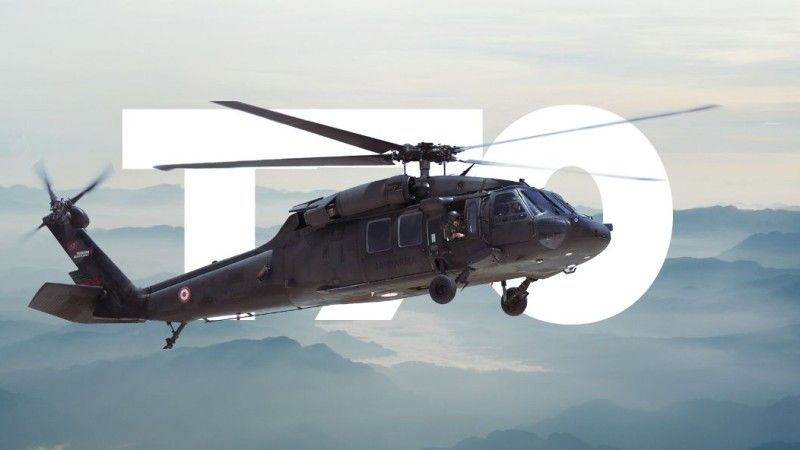
Photo. Turkish Aerospace Industries, official website
After a period of significant delays and suspended production, Turkish Aerospace Industries (TUSAŞ) and Lockheed Martin, the parent company of Sikorsky, have decided to resume production of the T-70 multi-role helicopter. The announcement, made by TUSAŞ CEO Mehmet Demiroğlu at the Farnborough International Airshow, marks a turning point for the Turkish defence industry.
T-70 – Turkish Black Hawk configuration
The T-70 helicopter was designed as a versatile, high-payload, and highly manoeuvrable platform for a wide range of missions, both military and civilian, including:
- Effectively fighting forest and urban fires. A special firefighting helicopter concept, codenamed “Nefes” (“Breath”), was developed for these operations.
- Conducting search-and-rescue operations.
- Transporting military personnel and providing logistical support.
- Ensuring border security and conducting surveillance operations.
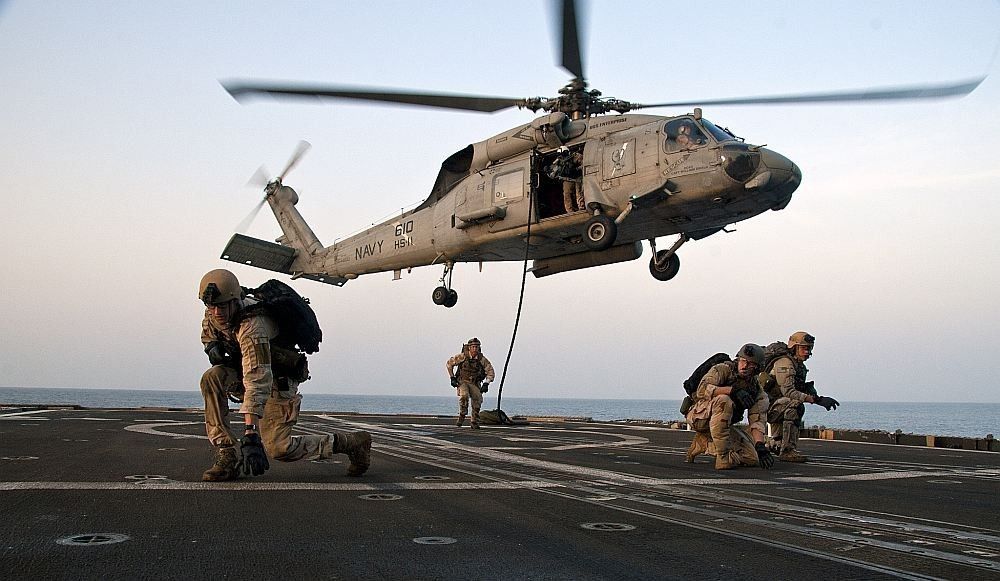
To perform these diverse missions, T-70 helicopters are being delivered to six different government institutions in Türkiye, including: the Land Forces Command, Air Force Command, Special Forces Command, Gendarmerie General Command, General Directorate of Security, and General Directorate of Forestry. In this way, despite differences in mission-specific configurations, operators can benefit from a shared training infrastructure, common spare parts, and domestic maintenance and repair facilities. This is particularly important for Türkiye, which has operated Black Hawk helicopters for decades and has extensive experience in their use in military, rescue, and homeland security operations.
It is important to emphasise, however, that this is not merely a standard S-70i helicopter assembled in Turkish factories. The design is equipped with the Integrated Modular Avionics System (IMAS), developed with significant input from ASELSAN, domestic mission systems, and solutions tailored to the needs of the Turkish Armed Forces and security services. The localisation of the avionics allows Türkiye to independently integrate communications, navigation, surveillance, and self-defence equipment without requiring a foreign manufacturer to redesign the entire helicopter architecture each time.
From platform selection to the start of production
The T-70 programme’s path to series production was exceptionally long. Sikorsky was selected as the programme partner in 2011, and the main agreements between the Undersecretariat for Defence Industries (SSM), Turkish Aerospace Industries (TUSAŞ), Sikorsky, and domestic subcontractors were signed in February 2014. Industrial cooperation formally began in 2016, but the first series deliveries did not begin until late 2022. This means that, even before licensing issues became more acute, programme implementation required a lengthy process of avionics integration, design qualification, licensed production organisation, and the expansion of the domestic supply chain.
Origins of the crisis and the impact of CAATSA sanctions
The production disruptions were a direct result of sanctions imposed by the United States in 2020 on Türkiye’s Presidency of Defence Industries (SSB) and several of its officials. These restrictions were Washington’s response to Ankara’s purchase of the Russian S-400 air defence system. The sanctions prohibited the issuance of new US export licences and authorisations to SSB, affecting access to components and technology required for the programme. The situation reached a critical point on 5 October 2024, when Lockheed Martin partially suspended work on the TUHP, citing the effects of US sanctions and force majeure. The company disclosed this decision in its financial filings. Lockheed Martin’s financial reports warned of potential significant losses and the possibility that the affected contracts could be restructured or terminated, as the sanctions limited the company’s ability to continue performing its obligations under the programme.
Although the programme initially called for the production of 109 helicopters, only 38 had been completed by the time it was partially suspended. It is worth noting that the sanctions did not immediately halt production, as some previously issued licences remained valid. Problems arose with obtaining the permits necessary to relocate additional production units.
Financial implications for Lockheed Martin
In the second quarter of 2025, Lockheed Martin recorded a pre-tax loss of $95 million on a reach-forward contract related to the TUHP programme. Renegotiating the programme reduces the risk of further write-offs and allows for the utilisation of previously accumulated production capacity and offset commitments, while also preventing the complete disruption of long-standing partnerships with Turkish suppliers.
It is also important to note that, although the 39-aircraft programme is relatively small from Lockheed Martin’s perspective compared with US Black Hawk orders, it nevertheless carries significant political and contractual importance. From a political and business perspective, it can be assumed that its complete cancellation could further hinder US companies from competing for future Turkish aviation programmes.
Diplomatic breakthrough and new production prospects
In recent weeks, the Trump administration has expressed a desire to improve relations with President Recep Tayyip Erdoğan, even considering Türkiye’s return to the F-35 fighter aircraft programme. This thaw in relations between Ankara and Washington has created the conditions for finding a regulatory and contractual solution for the T-70 programme. However, this did not mean a formal lifting of CAATSA sanctions. TUSAŞ, Sikorsky and representatives of both governments modified the end-user regulations. These changes led to the renegotiation of the helicopter contract and enabled TUSAŞ to obtain export licences for another batch of helicopters.
Under the renegotiated contract, Lockheed Martin is to deliver production kits for an additional 39 helicopters. Their completion will increase the total number of helicopters produced from 38 to 77. Demiroğlu expressed his firm belief that licences for the final 32 kits will be secured, allowing the target number of 109 units to be achieved. Helicopter assembly is expected to resume within 12 to 18 months.

Major threats to the restarted programme
When analysing the potential risks associated with the programme’s resumption, the first factor to consider is uncertainty surrounding the future of the final 32 helicopters. Demiroğlu pointed to the possibility of completing the remaining units planned under the original programme. However, available industry reports are inconsistent as to whether the required approvals have been formally obtained or are still in the process of being secured. Therefore, the completion of all 109 helicopters should not yet be regarded as certain.
Additional uncertainty concerns cost increases. The value of the renegotiated contract has not been disclosed, so it is unclear whether the price of the next batch corresponds to the terms of the original contract. However, long-term delays, inflation and rising material and labour costs could affect the final unit cost of the helicopters.
Restarting the entire supply chain will be a significant challenge. The expected 12–18-month period before production resumes indicates the need for preparations by manufacturers, subcontractors and assembly plants. However, there is currently no reason to believe that these preparations will lead to further delays.
The final significant risk is the obsolescence of the original programme requirements. The programme was defined many years ago. During this time, requirements regarding communications, electronic warfare, missile defence and interoperability with unmanned aerial vehicles have changed. Some systems may require modernisation before the entire production cycle is completed.


