












- ANALIZA
- WIADOMOŚCI
Germany is creating an unmanned systems regiment. It could change how its divisions fight

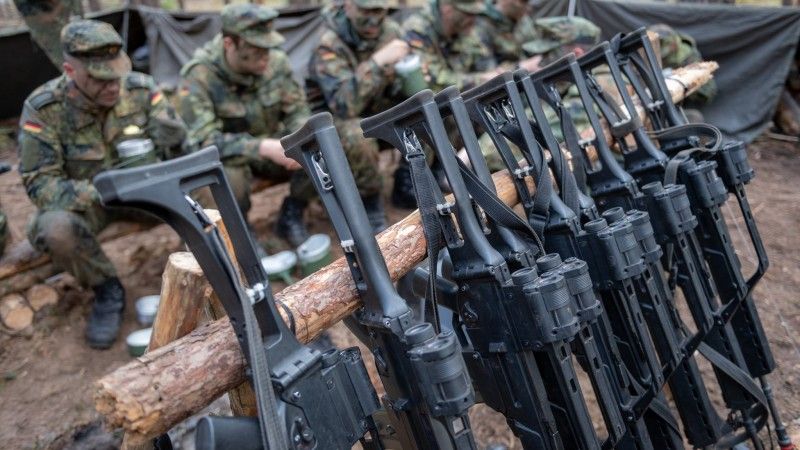
Germany is creating a dedicated unmanned systems regiment from 2027, assigned directly to the 10th Armoured Division. This is not only another procurement decision after the war in Ukraine. Berlin is beginning to organise drones, electronic warfare, counter-drone capabilities and unmanned ground systems as a divisional capability, not only as equipment distributed among individual units.
The decision announced by Defence Minister Boris Pistorius shows how quickly the war in Ukraine is changing the structure of European land forces. The Bundeswehr is not treating drones as a niche tool for reconnaissance patrols or small tactical teams. The new regiment is meant to combine reconnaissance, strike, protection against enemy drones, electronic warfare and unmanned systems operating both in the air and on the ground. That makes the project broader than a classic „drone regiment”.
The new unit is expected to reach initial operational capability in 2027 with around 300 soldiers, before growing to roughly 600 posts. Its future location has not yet been chosen, partly because the Bundeswehr needs a site that allows realistic training and testing of unmanned systems. This already shows that the project is not a symbolic innovation cell. It is supposed to become a regular formation inside the German Army.
The most important element is the level at which the regiment will operate. It will be subordinated directly to the 10th Armoured Division, not to one of its brigades. That is significant. Small drones will still be needed at battalion and brigade levels, close to the troops. But Germany is now creating a higher-level formation for more complex tasks: long-range reconnaissance, loitering munitions, electronic warfare, counter-UAS and strikes deep inside the enemy’s formation.
See also 

General Christian Freuding has described this in very direct terms. The Bundeswehr, he argued, has to „remeasure the geometry of the battlefield”. In practice, this means that a German division should be able to affect targets at a distance of around 500 km, and possibly beyond. This is the real meaning of the reform. It is not only about FPV drones or short-range reconnaissance systems. It is about giving a division its own ability to see, disrupt and strike far beyond the immediate line of contact.
At the same time, Germany is not centralising all drones in one unit. Pistorius has made clear that brigades and battalions will also receive their own unmanned capabilities. From the turn of 2026 and 2027, the Bundeswehr is expected to develop such capabilities in light infantry, reconnaissance and armoured forces. The emerging German model is therefore two-layered: drones embedded at lower levels, and a specialist divisional regiment for more advanced reconnaissance-strike, electronic warfare and counter-drone tasks.
This is one of the clearest organisational lessons from Ukraine. Small drones must be close to the soldiers who use them every day. Larger and more demanding systems need specialised personnel, command structures, electromagnetic protection and integration with fires. A modern army cannot simply buy drones and scatter them across units. It has to decide where they sit in the chain of command, how they are protected, how they are linked to artillery and how they operate under enemy jamming.
The Lithuanian dimension makes the German decision particularly important for Poland and the Baltic states. Germany is already testing parts of this logic with Panzerbrigade 45 „Litauen”. During Freedom Shield 2026 in Pabradė, the brigade used around 350 drones and operated a central drone operations centre. This centre coordinated reconnaissance, the employment of German drones, counter-drone measures and force protection.

This matters because Panzerbrigade 45 is not just another German unit. It is Germany’s permanent combat brigade on NATO’s eastern flank. If Berlin equips it with counter-drone capabilities before its full deployment in Lithuania, it will directly influence the defence of the Baltic region. It also shows that the new regiment is not an abstract reform designed in Berlin. It is connected to the way Germany wants to fight close to Russia’s border.
The electronic warfare element may be the most important part of the whole project. The regiment is to include its own electromagnetic warfare company. This means that drones are being treated as part of a wider battlefield system. Ukraine has shown that the number of drones matters, but it is not enough. If a force loses the electromagnetic spectrum, it loses a large part of its drone capability as well.
The equipment path is also changing. The Bundeswehr has signed contracts with three German producers for loitering munitions: Helsing with HX-2, STARK with Virtus and Rheinmetall with FV-014. Germany is deliberately testing several systems in parallel, reducing dependence on one supplier and forcing faster technological development. It is closer to the Ukrainian wartime model.
If the experiment works, the 10th Armoured Division will probably not remain the only formation with such a regiment. Freuding has indicated that other German divisions could receive similar units. That would make the 2027 regiment a pilot project for a broader redesign of the Bundeswehr’s divisional structure. The question is therefore not only whether Germany is buying drones. The question is whether Germany is changing what a division must contain in order to fight a high-intensity war.

The wording matters here because Germany is not only creating a regiment of drone operators; it is simply creating a formation for unmanned systems, while at the same time pushing smaller drones down to the lowest useful levels. That is a serious organisational change. It moves the discussion from platforms to the architecture of the battlefield. These are crucial lessons from Ukraine.
Germany has often been criticised for moving too slowly after 2022. In this case, however, the direction is quite clear. The Bundeswehr is taking lessons from Ukraine and translating them into force structure where they have unmanned systems in regular units, a specialised regiment at divisional level, electronic warfare from the start, loitering munitions from several producers and a direct link to the defence of Lithuania. Who will be next? France, Poland or the United Kingdom?


