












- WIADOMOŚCI
- ANALIZA
CAESAR becomes Southeast Asia’s artillery choice

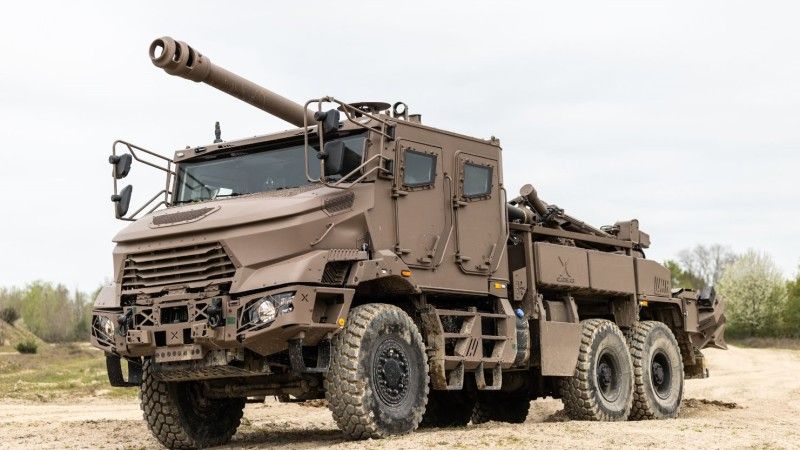
The CAESAR 155mm wheeled self-propelled howitzer has become one of the most important artillery systems in Southeast Asia. Indonesia, Thailand and Malaysia have all selected the French-built platform, showing that the region is not only buying new guns, but also changing the way it thinks about mobility, fire support, local production and conflict preparedness.
Few Western artillery systems have gained such a position in Southeast Asia as CAESAR. Built by KNDS, formerly Nexter Systems, the platform combines a 155mm/52-calibre gun with a truck chassis, giving armies long-range firepower without the weight, cost and logistical burden of tracked artillery. For countries such as Indonesia and Malaysia, where forces may need to move across islands, ports and long distances, this matters. For Thailand, with a contested land border and recent combat experience against Cambodia, mobility and the ability to fire and move quickly are not abstract requirements, but lessons drawn from operations.
Indonesia remains the main CAESAR user in the region. The Indonesian Army first ordered 36 systems in 2012 and later added another 18, bringing its fleet to 56 guns organised across three artillery battalions. This made Indonesia the largest CAESAR operator in Asia and one of the largest worldwide. The relationship with France has also moved beyond simple procurement. During President Emmanuel Macron’s visit to Jakarta in 2025, Indonesia signed a Letter of Intent covering additional CAESAR systems and 155mm ammunition, followed by cooperation between KNDS France and Pindad on artillery and large-calibre ammunition. This shows that Jakarta wants more than equipment. It wants industry, production knowledge and greater control over its own defence supply chain.
Thailand has a much smaller CAESAR fleet, but it brings something Indonesia and Malaysia do not yet have in the region: combat experience. During the 2025 Thailand-Cambodia border clashes, Thai forces used 155mm artillery, including CAESAR, in a conflict that involved infantry, rockets, howitzers, drones and fighter aircraft. The fighting around disputed temple areas showed that Southeast Asia cannot treat artillery as an old capability kept only for deterrence or prestige. In a regional crisis, long-range fire support can return quickly to the centre of military operations.
See also 

Malaysia’s decision in 2026 to buy 18 CAESAR 6×6 systems confirmed the platform’s growing position. For Kuala Lumpur, this is especially important because these will be the Malaysian Army’s first self-propelled artillery systems. Malaysia is not only adding another type of equipment, but also creating a new artillery capability. The deal with KNDS and Advanced Defence Systems also includes local assembly and technology transfer, which follows the pattern already visible in Indonesia. Southeast Asian states increasingly expect major arms purchases to support domestic industry, not just to fill capability gaps.
The reasons for CAESAR’s success are not difficult to understand. It is lighter than tracked systems such as the K9 or M109, can move on ordinary roads, can be transported more easily, and offers ranges above 40 kilometres with standard base-bleed ammunition and more than 55 kilometres with rocket-assisted rounds. It is not as protected as a tracked howitzer, but Southeast Asian armies have clearly decided that mobility, lower operating burden and easier deployment matter more in many of their scenarios. In archipelagic states, roads, bridges, ports and airlift often decide whether a system can be used at all.
The regional picture is not without competitors. Singapore operates the tracked Primus, Vietnam is buying South Korean K9 howitzers while modernising older Soviet systems, Myanmar and Cambodia operate Chinese SH-1 wheeled howitzers, and the Philippines has introduced Israeli ATMOS 2000 systems. Yet CAESAR has achieved something different: it has become the common choice of three separate Southeast Asian armies, each with different geography, threat perceptions and procurement traditions. That makes the platform not just another export success, but a regional artillery reference point.

The broader meaning is that Southeast Asia is preparing for conflicts in which distance, islands, borders, drones and counter-battery threats will matter more than before. The South China Sea, the Thai-Cambodian border and wider regional tensions are pushing states to seek artillery that can move quickly, strike at long range and survive by leaving its firing position before the enemy responds. CAESAR fits that requirement well enough to become the leading Western wheeled howitzer in the region.
Malaysia’s order does not end the artillery race in Southeast Asia. It confirms that the race has already changed. Countries in the region are not only asking what system fires the farthest or carries the most armour. They are asking what system can be moved, sustained, assembled locally, linked to national industry and used in conditions where drones and counter-battery fire make static artillery increasingly vulnerable. That is why CAESAR has become more than a French export product. It has become one of the symbols of Southeast Asia’s new approach to fire support.


