- WIADOMOŚCI
„Flawed and outdated.” The Dutch criticise a German tank

The Netherlands Ministry of Defence has decided to purchase additional armoured vehicles. Interestingly, criticism has also emerged regarding one of the types of specialised armoured vehicles operated by the Royal Netherlands Army.
More CV90s
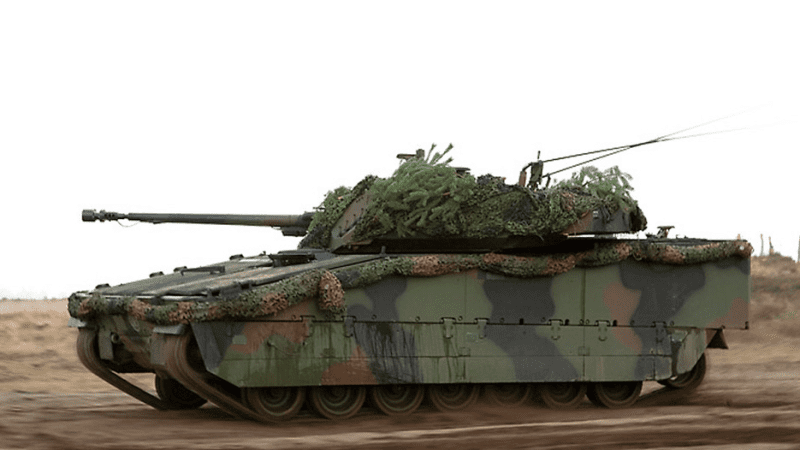
The Royal Netherlands Army (Koninklijke Landmacht) operates approximately 128 CV9035NL infantry fighting vehicles, which are currently being modernised under the MLU (Mid-Life Upgrade) programme to the CV9035NL MkIIIC standard. Furthermore, there are plans to purchase additional vehicles to equip another battalion, which is to be formed and stationed in the town of Budel. The vehicles will likely be purchased as part of a Swedish-led programme, which, in addition to Sweden, involves Finland, Norway, Lithuania, and the Netherlands.

Photo. BAE Systems Hägglunds
This programme concerns the joint procurement of CV90 infantry fighting vehicles in the MkIIIC and MkIV variants. Sources indicate that under the programme, Norway plans to purchase up to 80 new vehicles, while Sweden and Lithuania have confirmed plans for coordinated purchases of several hundred vehicles. Unfortunately, at this stage, it is unknown how many additional vehicles the Netherlands may purchase, but information regarding the formation of another battalion suggests a planned purchase of at least 56 further vehicles, provided sources are correct about the organisational structures of Dutch mechanised companies and battalions.

The Flawed and Outdated Kodiak
Interestingly, the Dutch are complaining about the Pionierpanzer 3 Kodiak armoured engineering vehicles based on the Leopard 2 tank. Users explicitly call the vehicle obsolete. It is said to have low resilience against current and future threats, particularly when used to clear paths through minefields and enemy fortifications. Furthermore, the Dutch point out that the Kodiaks have low readiness due to frequent technical faults; therefore, the need to acquire a new armoured engineering vehicle is being highlighted.

Photo. Rheinmetall
The new vehicle is expected to have greater resilience, as well as higher reliability, and should be capable of overcoming the widest possible spectrum of obstacles and engineering barriers. Today, the Royal Netherlands Army possesses 10 Pionierpanzer 3 Kodiak vehicles. The Dutch opinion on these vehicles is very interesting. They are not old vehicles – they achieved full operational capability in 2018, and the Pionierpanzer 3 Kodiak itself had been under development by a consortium consisting of Rheinmetall Landsysteme GmbH, RUAG Defence, and Krauss-Maffei Wegmann GmbH since 2002.
See also 

Self-Propelled Bridges
The Dutch, however, plan to buy more self-propelled bridges. All indications suggest they will join the Germans, meaning they will most likely purchase Panzerschnellbrücke Leguan bridges based on the Leopard 2 tank. The German Heer possesses 7 such bridges, and an additional 24 were ordered in 2020 with delivery dates between 2023 and 2028. Meanwhile, the Royal Netherlands Army already possesses 8 such self-propelled bridges, which were purchased in 2016.

Photo. Bundeswehr/Jonas Weber
Leguan self-propelled bridges are capable of supporting tracked vehicles weighing up to 72.6 metric tonnes (MLC 80) and wheeled vehicles weighing up to 83.5 metric tonnes (MLC 90). The bridge span itself weighs approximately 10.5 metric tonnes, is 26 metres long, and 4.01 metres wide. Leguan-type bridges are of the sliding type, meaning the bridge is deployed and positioned horizontally at all times, unlike scissor-type bridges, which are first raised to a vertical position before the span assumes a horizontal position during the unfolding and deployment process.
Support Vehicles from FFG?
The Dutch have reported that they will likely order new armoured recovery vehicles and have pointed to a design from Flensburger Fahrzeugbau Gesellschaft GmbH (FFG), namely the Wisent 2. It is based on the Leopard 2 tank, but more importantly, it is actually a modular design. Thus, on the same platform, depending on the installed accessories, a variant of either an armoured recovery vehicle or an armoured engineering vehicle – adapted for either earthworks or clearing paths through minefields and fortification lines – is available.

Photo. FFG
Furthermore, FFG claims that the vehicle can also be adapted for the role of a self-propelled bridge. Therefore, in theory, a single platform such as the Wisent 2 could replace the Bergepanzer 3 Büffel recovery vehicles, the Pionierpanzer 3 Kodiak engineering vehicles, and the Panzerschnellbrücke Leguan self-propelled bridges. Of course, there is no certainty as to whether the Dutch would opt for such a solution, especially since the self-propelled bridge configuration for the Wisent 2 only provides for a short 12-metre span with a load capacity of MLC 80.

Photo. Norwegian MoD
The Dutch are also considering the purchase of ACSV (Armoured Combat Support Vehicle) support vehicles from FFG Flensburger Fahrzeugbau Gesellschaft GmbH. This is a tracked platform that can be configured in various variants. In the case of the Royal Netherlands Army, the discussion involves purchasing variants such as an armoured ambulance, a command vehicle, a self-propelled mine-layer, and a driver training vehicle. Perhaps other variants, such as logistics versions, are also being considered.

Photo. FFG
Dutch Industry Participation
The Netherlands government assumes broad participation from Dutch industry. For instance, the Van Halteren Technologies plant would handle the final assembly of the ACSV vehicles and Wisent 2 recovery vehicles on Dutch territory. This plant would also handle the maintenance, repair, and overhaul (MRO) of these vehicles. Meanwhile, KONI Nederland and Neways Electronics are to provide spare parts and components, and Avient Protective Materials is to supply ballistic protection elements for the ACSV vehicles.