- ANALIZA
- WIADOMOŚCI
Mass drone production is more important than perfection [Pt. 2]

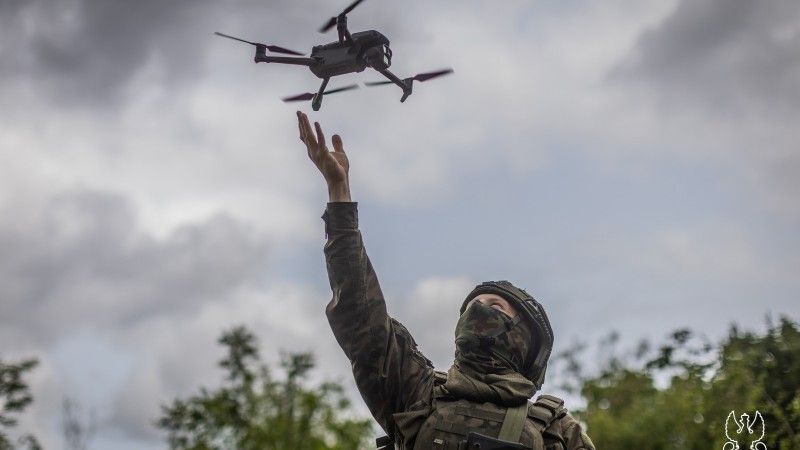
This article is the second part of the analysis entitled The Economics of Cheap Drones by Lt. Gen. (ret.) Andrzej Fałkowski. In this part, the author seeks to answer the question: where does the value of droneisation lie, and how can it be translated into a lasting drone advantage?
Data as the new ammunition
The production of cheap drones increasingly resembles the consumer electronics market. The hardware itself is becoming easier to copy, while the advantage is moving ever faster to areas where simply ordering components from a catalogue is no longer enough. Data, software, and the ability to learn faster than the competition are becoming increasingly important.
The advantage, therefore, will not necessarily go to companies producing the best hardware, but to those that accumulate the largest amount of operational data, are able to develop and update software the fastest, create more effective artificial intelligence algorithms, and integrate their solutions most effectively with command-and-control systems. Equally important will be the ability to continuously improve the product based on user experience. In this model, the customer will become, presumably to their great delight, a source of data, a tester, a provider of feedback, and a co-creator of the next version of the product.
Every mission carried out becomes a source of new data. Information about the drone’s behaviour, flight conditions, the effectiveness of algorithms, methods of detecting objects, or problems with communications can be used to improve subsequent versions of the system. A drone returning from a mission therefore brings back something much more valuable than the recording itself. It brings experience that can be turned into code, and then into another advantage.
This creates a self-reinforcing mechanism. The more drones are operating, the more missions they perform, and the more users provide feedback, the more data reaches the manufacturer. The more data there is, the better the algorithms and software can become. The better the system, the more attractive it becomes to subsequent users, and therefore the more data returns to the manufacturer. At some point, it turns out that the greatest advantage is no longer the factory itself, but the accumulated experience.
It is somewhat like ammunition, only more troublesome to manage. Conventional ammunition has to be produced, delivered, and consumed. Data, by contrast, can be used repeatedly, and each subsequent operation can increase its value. Provided, of course, that someone knows how to make sensible use of it. Simply possessing several terabytes of drone footage will not turn a company into a technological hegemon. It may just as well turn it into the owner of a very large and very expensive film archive. Incidentally, this should apply to every type of technology used on the battlefield.
As a result, competitive advantage begins to accumulate with the number of users and operations conducted. A company that sells one thousand devices and is able to draw conclusions from their operation may, over time, find itself in a completely different position from a manufacturer that sold similar equipment but treated every transaction as the end of its relationship with the customer. In the world of cheap drones, therefore, selling the product should be only the beginning of an advantage, not its culmination.
See also 

Production as a continuous process
The traditional defence-industry model assumes a multi-year cycle of design, certification, and production. First comes the design, then the prototype, followed by a series of tests, analyses, committees, and documents, and after several years the product is finally ready for use. Then a minor problem emerges. Reality has already changed, the adversary has changed as well, and some of the assumptions on which the design was based have roughly as much in common with the current situation as a map from a decade ago has with today’s traffic.
The cheap-drone market operates quite differently. Here, a product cannot wait several years for its next generation. New versions should appear every few weeks or months, because that is all the time it may take for methods of disrupting communications, detection techniques, the adversary’s software, or simply a new idea for doing something faster, cheaper, and more effectively to change. A drone that was a next-generation solution in January may unfortunately already be a previous-generation solution by June.
That is why the design must be prepared for continuous change. Components should be quickly replaceable, software should be updatable, and the entire system should be adaptable to new conditions without having to start another multi-year programme from scratch. In an ideal world, changing a camera, communications module, or algorithm should not require building a new drone. Replacing the component, uploading new software, and sending the device back into service should be enough – precisely the kind of thing the defence industry has spent years learning not to do.
In practice, this means moving away from the „manufacturer-recipient” model. In the traditional approach, the manufacturer delivers a finished product, the user receives it, and then spends several years using it while patiently waiting for the next modernisation. In the case of cheap drones, such a model is losing much of its meaning. The user becomes part of the development process. It is the user who provides information about what works, what does not, what can be improved, and what the adversary has just come up with to make the whole thing stop working.
The manufacturer therefore has to learn to listen to the user as quickly as the user has learned to complain about the product. Information from the next mission should reach the design team as quickly as possible and then be turned into a design change, a software update, or a new version of the device. As a result, production ceases to be an event and becomes a continuous process.
This also means a change in mentality. The goal is no longer to create the „perfect drone” that will remain a symbol of technological excellence for the next dozen or so years. The goal is rather to create a good version and then a very fast mechanism for arriving at subsequent versions. The perfect drone is therefore not one that never requires changes. The perfect drone is one whose changes can be introduced faster than the adversary can prepare a response to them.
In the world of cheap unmanned systems, the advantage may therefore go not to the one who spends the longest designing, but to the one who learns the fastest. Which is somewhat amusing, considering that for decades the defence industry primarily perfected the art of convincing everyone concerned that if something had been designed for ten years, it must be exceptionally good. Now it turns out that it may be equally important whether, a few weeks from now, we are capable of making something better.
See also

Conclusions
In the coming years, the winners of the market will therefore not be those who build the „best drone”. That concept, incidentally, is beginning to make less and less sense. Far more important will be creating a system capable of using thousands of simple drones as elements of a single, intelligent operational architecture. An individual drone may be cheap, simple, and replaceable. Its true value emerges only when it becomes part of a larger whole.
Lasting advantage will not result from the drone’s design alone, but from the speed of development, scale of production, modularity, and close coupling with the user. Software, autonomy, resilience to EW, alternative navigation, communications, and integration with command-and-control systems will become crucial. As a result, the greatest value will be created not by an individual drone, but by a continuously developing, scalable ecosystem combining hardware, software, production, servicing, and data. Mass production is more important than perfection. It is better to produce thousands of good drones than hundreds of „perfect” ones.
And do we in Poland already have hundreds, or perhaps even thousands, of drones of various types ready for immediate use? Do we in NATO already have millions of them – especially in the context of Russia’s announced production of more than 3 million drones next year?
Do we have places to store, service, and replenish them? Or are they already sitting neatly in military units, with all soldiers – at least as far as the simplest models are concerned – being regularly trained to use them?
Are we still treating drones like museum exhibits: „please do not touch, easily damaged”? Or are we finally starting to treat them as ordinary equipment – something a soldier receives, like a rifle, and uses, wears out, replaces, and simply knows how to operate?
Because if drones are to become one of the basic tools of the modern battlefield, then surely it is high time we stopped treating them like precious gadgets that are best viewed through glass.