












- WIADOMOŚCI
- ANALIZA
Polish HIMARS at an impasse. What is the munitions production roadblock?

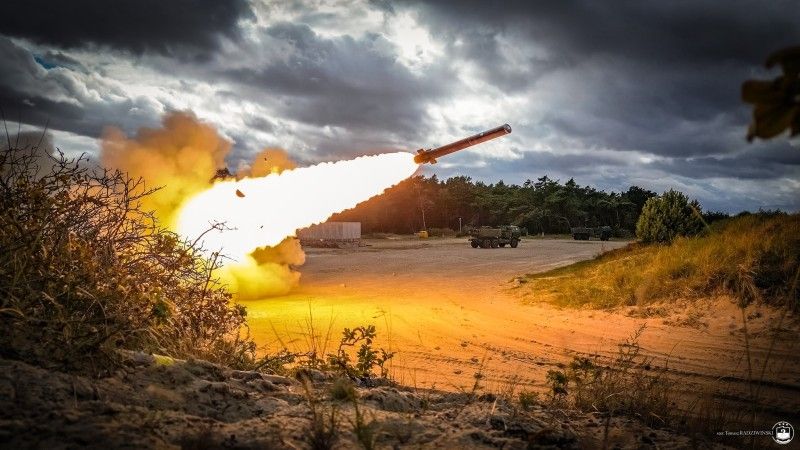
Photo. Pvt. Tomasz Radziwiński / 2nd Polish Corps
The next stage of the Homar-A programme, namely, the acquisition of further elements of the US long-range rocket artillery system, has stalled because Poland still does not have US approval to manufacture the missiles on its own territory. As Defence24.pl’s sources acknowledge, negotiations have been ongoing since 2023 and have still failed to produce a breakthrough.
Despite more than two years of talks, Poland has still not secured permission to move production of HIMARS missiles, known in Poland as Homar-A, to Polish territory. Defence24.pl sources indicate that this remains the most difficult issue in the negotiations and the one that has led to a deadlock. Poland wants any decision on building missile production capabilities to be linked to a further order for launchers, but for now the programme has reached a dead end. More than 100 launchers are on the table, and a further 300-plus are in the next batch, but Ukraine’s experience shows that buying launchers without guaranteed missile production makes little sense.
It is worth recalling that since 2022, Poland has pursued a two-track approach to building up its rocket artillery. Under the Homar-K programme, deliveries and technology transfer for the Korean system based on the Chunmoo launcher are being rolled out gradually. At the end of 2025, a contract was signed for missile production in Poland, following an earlier agreement on launcher technology transfer. In total, 290 Homar-K launchers are planned. The Homar-A programme, by contrast, was intended to give Poland the ability to produce launchers and missiles for the American HIMARS system, with plans, alongside Chunmoo, for as many as around 500 systems.
The procurement of Homar-A launchers, in effect localized (Polonized) HIMARS, is therefore one of the top priorities in the development of the Polish Armed Forces. For some time now, Poland has been seeking US approval to produce the system’s main ammunition type, the GMLRS rocket. Unofficial information obtained by Defence24.pl suggests that the transfer of production is precisely the most difficult point in the talks, and that no American approval has been given so far.
In response to questions from Defence24.pl, Col. Grzegorz Polak, spokesperson for the Armament Agency, said:
Talks on the production of GMLRS rockets for HIMARS launchers are still ongoing. As negotiations are currently underway, I cannot comment on the details of their course. I can confirm, however, that the talks have been going on since 2023 and, so far, no breakthrough has been achieved on the key issues. To conclude the negotiations, it is also necessary to obtain the appropriate government-level approvals from the US Department of State and from the European countries participating in the GMLRS programme: the United Kingdom, Germany, France, and Italy. @ Col. Grzegorz Polak, Armament Agency
Although Col. Polak did not disclose the details of the ongoing talks, he confirmed that they have been under way since 2023 and that no breakthrough has been reached on production. He also added that, in addition to business-level discussions, government approvals are required, not only from the US State Department, but also from four European countries. The GMLRS system, and earlier MLRS, has in fact been developed under a government programme jointly involving the four countries mentioned above, dating back to the late 1970s and early 1980s.
The GMLRS rockets are the standard armament of HIMARS and M270A1/A2 MLRS launchers. One pod of rockets, one on HIMARS, two on the heavier MLRS, carries six such missiles. They can engage targets at ranges of up to 85 km.

Photo. Siim Verner Teder/EDF
This puts Poland in a difficult position, because having its own production capacity is crucial, as the conflicts in Ukraine and the Middle East have shown. Gen. Krzysztof Król, Assistant Chief of the General Staff, spoke about this in a recent interview with RMF24.
We must definitely produce all kinds of rocket munitions, missiles that are consumed in large quantities. No one can guarantee that a future war will be very short, or that the Americans will participate fully with all their capabilities. It is absolutely necessary to develop our own defence industry and focus on the weapons that are consumed.
Gen. Krzysztof Król, Assistant Chief of the General Staff
The slowdown in negotiations over GMLRS production is another example of the United States« reluctance to broadly share strike capabilities with NATO’s eastern flank. HIMARS projectiles are, of course, available, but only for purchase from the US government, which imposes certain limitations. Neither Poland nor other countries in our region have received approval to buy Tomahawk cruise missiles either, despite Warsaw having shown interest in them for a decade. This points to certain assumptions underlying US policy, and also the policy of Western allies, whose consent is likewise required, toward our region.
How Poland has sought missiles for Homar?
For some time now, Poland has been seeking the possibility of locating GMLRS missile production in our country under the Homar-A programme. This is the codename for the purchase of a Polishised HIMARS system. Poland received State Department approval to buy as many as 486 launchers back in February 2022. Just over half a year later, in September 2023, a framework agreement was signed with Lockheed Martin.
As with the second Homar-K programme, based on the Korean Chunmoo launcher, the plan was for deep localisation. Alongside integration of the Polish Topaz battle management system — which was not the case in the first purchase of a HIMARS battalion in 2019 — not only launchers and vehicles were to be produced in Poland, but also GMLRS rockets.

Photo. Adam Świerkowski/Defence24
It is also worth adding that the Korean-based programme is being implemented in line with the localisation assumption. The first executive contract, signed in 2022, provided for the use of Polish chassis and the Topaz system. The second, concluded in 2024, covered launcher technology transfer and the production of launch containers. The third, signed at the end of 2025, provided for missile production by a Polish-Korean joint venture.

By contrast, talks with the Americans are moving much more slowly. After the framework agreement was signed at the turn of 2023 and 2024, it was revealed that the Ministry of National Defence planned to split the order into two parts: 126 launchers in the first tranche and another 360 in the second. The Polish side consistently maintained that GMLRS missiles should be manufactured in Poland. As recently as June 2025, Deputy Defence Minister Paweł Bejda said in response to a parliamentary inquiry: „Within the framework of the Homar-A programme and the implementation of the framework agreement for the delivery of 486 multiple launch rocket systems, preparations are under way to conclude Executive Contract No. 1, including work to define key conditions regarding the possible establishment of GMLRS missile production in Poland.”
The US is therefore continuing to develop the HIMARS system, but so far it has not decided to share the technology needed to produce this key ammunition with Poland. In the current situation, where the risk of threats to NATO countries could arise alongside conflicts in other regions, the US stance is particularly unhelpful. Independent production capacity to replenish ammunition stocks is critically important, especially in light of the risk of high-intensity conflict. All this makes the future of one of the key rocket artillery programmes uncertain, at a time when the Polish Armed Forces are increasingly being equipped with Korean launchers, while technology transfer is flowing into industry. Interestingly, Estonia chose to procure both Polish and Korean launchers in parallel, while Norway selected the Korean system in part because Poland is building production capabilities.
Collaborative Effort: Jakub Palowski


