












- ANALIZA
- WIADOMOŚCI
Rafale exports drive Dassault’s strong first half

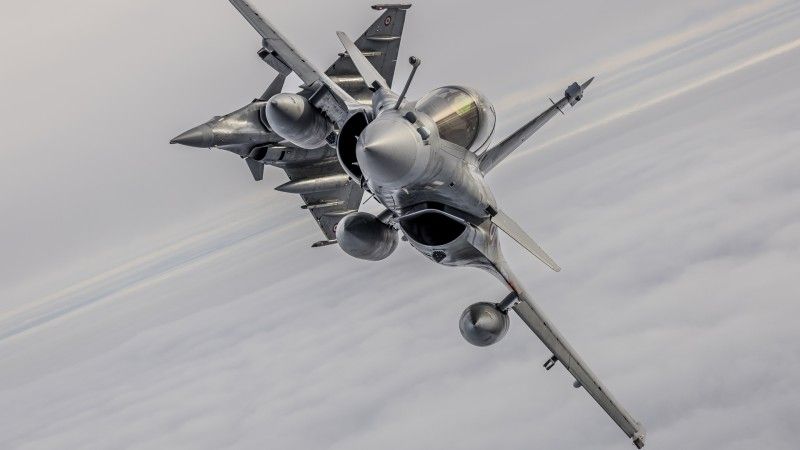
Dassault Aviation recorded a sharp rise in sales and operating profit in the first half of 2026, primarily because of higher Rafale export deliveries. The figures confirm the strength of the company’s defence business, but they also show that the next stage will depend on production capacity, the potential Indian order for 114 aircraft and the future of France’s next-generation combat aircraft programme.
Dassault Aviation generated adjusted net sales of €4.16 billion in the first six months of 2026, an increase of 46% compared with the same period in 2025. Adjusted operating income rose by 83% to €330 million, while the operating margin increased from 6.3% to 7.9%. The company also reported adjusted net income of €496 million, although the net margin declined from 13.6% to 11.9%.
The main driver was not a sudden change in the civilian aviation market, but the acceleration of Rafale deliveries. Dassault delivered 12 fighters during the period, including ten to export customers and two to France. A year earlier, it had delivered seven. Defence sales consequently increased from €1.75 billion to €2.94 billion and accounted for 71% of total adjusted sales.
This is important because Dassault is no longer simply benefiting from orders signed several years ago. It is beginning to convert its enormous Rafale backlog into deliveries and revenue. The challenge is now to maintain this tempo while supporting a growing number of operators and simultaneously preparing new production arrangements outside France.
See also 

Strong results, but fewer new orders
The fall in order intake may look alarming at first sight. New orders amounted to €2.88 billion, compared with more than €8 billion in the first half of 2025. However, the comparison is distorted by India’s order for 26 Rafale Marine aircraft, which was booked during the previous period.
Defence orders fell from €7.17 billion to just over €1 billion, while Falcon orders more than doubled to €1.85 billion. Dassault booked orders for 23 Falcon business jets, compared with eight a year earlier. This means that the civilian business partly compensated for the absence of another major fighter contract.
Nevertheless, the book-to-bill ratio stood at 0.69, while the backlog declined from €46.6 billion at the end of 2025 to €45.4 billion in June 2026. This is not a problem in the short term, because the company still has orders for 208 Rafale and 83 Falcon aircraft. On the other hand, Dassault cannot rely indefinitely on contracts already secured. It must continue winning new orders while increasing deliveries.
The financial position remains very strong. Available cash reached €10.1 billion, up from €9.4 billion at the end of 2025, mainly because of advance payments linked to Rafale export contracts. This gives Dassault considerable room to modernise production, finance development and prepare for further expansion.

India is now the main strategic objective
The most important future opportunity is India. According to Dassault, the Indian Defence Acquisition Council has decided to enter into direct negotiations for the acquisition of 114 Rafale aircraft. The company is finalising its response, while describing the contract and the acceleration of Make in India as its major strategic objective.
This would not be an ordinary export contract. Dassault is developing an industrial model that could ultimately include aircraft flight testing in India. Its partnerships already involve Dassault Reliance Aerospace, Tata Advanced Systems, Dynamatic and Hical. A new DRAL building is also under construction and is expected to double the company’s production area in India when it becomes operational in 2027.
From the Indian perspective, the objective is increasingly clear. New Delhi does not want only to buy completed aircraft from France. It wants production capacity, access to the supply chain and a stronger position within the programme. For Dassault, accepting a deeper industrial presence in India may be necessary to secure what could become one of the largest Rafale contracts in history.
At the same time, the company must ensure that Make in India does not disrupt production for France and existing export customers. The more widely the Rafale supply chain is distributed, the more difficult it becomes to maintain quality, delivery schedules and control over sensitive technologies. Dassault therefore needs India, but it must also manage the consequences of becoming increasingly dependent on Indian industrial capacity.
Rafale after FCAS
The report contains another major political declaration. Dassault states that the French President and German Chancellor agreed to halt the FCAS/NGF programme. Discussions are now under way with the French state over an alternative demonstrator for a future combat aircraft, developed either by France alone or with other partners.
This would represent a fundamental change in European combat aviation. The FCAS programme was intended to create not only a new aircraft, but a wider system combining manned fighters, drones, sensors and networked capabilities. Its termination would force France to decide whether it is ready to finance a national alternative or seek cooperation with a different group of states.
Dassault is already preparing the Rafale for a much longer operational future. Work continues on the F4.3 standard, while risk-reduction studies and preparations for the F5 contract are under way. The company expects the F5 standard to enter service between 2033 and 2035. It is also developing a virtual assistant and autonomous functions intended for the future aircraft.
After the end of the reporting period, France and Ukraine concluded a roadmap providing for Kyiv’s acquisition of 16 Rafale. On the same day, Dassault and Harmattan AI announced a successful collaborative in-flight engagement involving a Rafale and an unmanned system carrying the NAMIB electronic-warfare payload. These developments show that the Rafale is being positioned not merely as a fighter, but as the central platform within a wider combat system.
The Falcon business also remains important. Dassault delivered 13 aircraft and recorded 23 orders during the first half of the year. The Falcon 10X completed its maiden flight on 19 June, beginning the flight-test campaign, although entry into service has been rescheduled for 2029. This delay matters, but the increase in Falcon orders shows that demand has not disappeared.
Dassault has maintained its guidance for 2026. The company expects annual sales of approximately €8.5 billion and plans to deliver 28 Rafale and 40 Falcon aircraft. This means that production and deliveries will have to accelerate further during the second half of the year.
Ultimately, the first-half results show a company in a very strong financial position, supported by Rafale exports and an order book that guarantees years of production. However, the next challenge is more complicated than simply selling additional aircraft. Dassault must increase output, deepen its industrial presence in India, support a growing international fleet and help France define what will come after FCAS.


