- ANALIZA
- WIADOMOŚCI
Wildfire response systems in Southern Europe: National strategies and operational gaps after the 2025 crisis

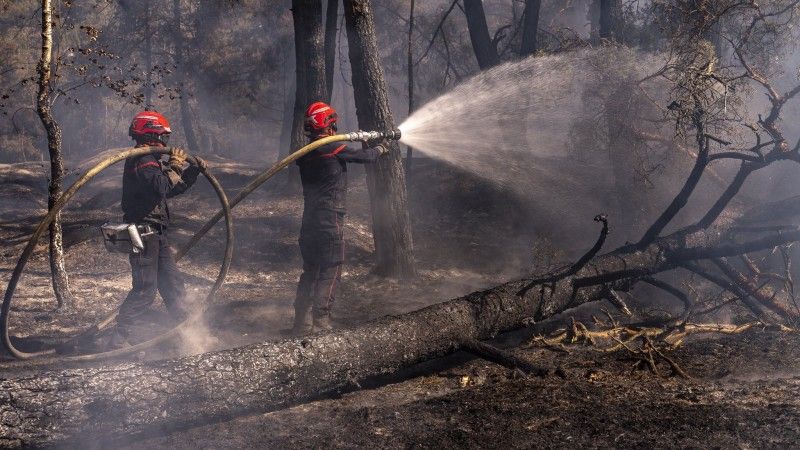
Photo. @EmmanuelMacron/X.com
The 2025 wildfire season recorded 1,079,538 hectares burned within EU territory (the worst in two decades); in the critical August period alone, simultaneous fires across Spain and Portugal consumed 460,585 hectares, representing 43 percent of the entire year’s EU damage. However, 2026 is tracking towards exceeding those records.
To date, as of July 29, 2026, 434,976 hectares have been destroyed by fires within the EU. This has surpassed the area burnt in the same period last year and could lead to new benchmarks in catastrophe.
Current crisis situation: End of July 2026
France is experiencing its worst-ever wildfire crisis. The fire in the Gironde region, which started on July 22, burnt an estimated area of 42,000 hectares by July 27 and came within 15 kilometres of the city of Bordeaux. The fire even produced its own weather system, namely the pyrocumulonimbus, meaning that it had its own updraft and lightning, which started other smaller fires. The event, which was known to occur in North America and Australia but never before in France, is now being experienced there. Another fire outbreak occurred in the Fontainebleau Forest, about 40 kilometres from Paris, where an estimated 2,000 hectares were burnt in two weeks, thus creating another threat near the French capital. Around 250,000 people have been evacuated from the surrounding area. France called this the worst situation “since World War II”. France used the A400M military transport plane with its firefighting kit on July 25-26, marking the first time that heavy military transport was used for firefighting purposes anywhere in the world.
Spain has faced the problem of simultaneous fires in multiple regions; as of late July 2026, around 206,768 hectares have been scorched (up to 117 percent of the twenty-year average) and eleven large fires have been reported. The Guadalajara/Sierra Norte Fire (which has burned since July 20), with 32,000+ hectares scorched by July 23, was still uncontrolled on that date. The Ávila and Madrid fires merged on July 24, forming a single fireline around fifty kilometres away from the city of Madrid. The government evacuated 63,152 people from the provinces of Madrid, Toledo, and Ávila. The Prime Minister, Pedro Sánchez, acknowledged ten active large fires but noted that they were being contained. The Castellón Fire lasted for five straight days without being contained. Spain used the EU Civil Protection Mechanism; six firefighting planes from Greece, Italy, and Turkey as well as 134 firefighters and 41 fire trucks from Portugal were sent there.
Greece witnessed a phase of escalation that began on July 29. A total of 37 wildfires erupted within a span of 24 hours in the country. Three firefighters have lost their lives during firefighting operations. Serious incidents took place in Crete (the Rethymno wildfire is yet to be contained), Lesbos (the Plomari wildfire, 50 firefighters employed), and the Attica area near Athens. The highest fire danger predictions were made by the Greek authorities for Attica, the Cyclades, the northern Aegean Islands, the Peloponnese, and central Greece until July 30. The Greek civil protection department has dispatched its contracted aircraft (Pay’s Aviation Services AT-802 bombers and Erickson Sky Crane helicopters). Under the EU Civil Protection Mechanism, Greece had sent its firefighting aircraft to Spain on July 27-28.
Regional context and trigger conditions
The 2026 fire season exhibits accelerated intensity compared to historical averages. France has recorded 3.4 times its annual fire average through July, and Spain has recorded 1.7 times its annual average. Multiple simultaneous heatwaves (the fourth wave expected mid-week in both countries) have pushed maximum temperatures to 40°C+ with no rain forecast for fire-affected regions through early August. Moisture-laden vegetation from the abnormally moist winter season (2025-2026) in Europe has dried up to tinder-like conditions due to persistent drought. Wind shear effects have increased fire spread speed to more than 10 kilometres per day.
Spain's operational response and constraints
Spain operates the region’s most institutionalised military firefighting response. The Military Emergency Unit (UME) deployed 500+ additional soldiers during peak activity. The Air Force’s 43rd Group (14 dedicated amphibious aircraft: 10 Canadair CL-215T and 4 Bombardier CL-415) conducted continuous aerial operations. Ground forces integrated engineering assets: SVMAC P75D unmanned ground vehicles (10 units) provided real-time fireline reconnaissance; Caterpillar bulldozers conducted firebreak creation in difficult terrain.
Critical constraint: delivery gap. Spain announced in April 2024 the acquisition of seven De Havilland Canada DHC-515 Firefighter aircraft; delivery is projected for 2028; until then, the 43rd Group operates at saturation during multi-fire scenarios. The current simultaneous Guadalajara (32,000 ha), Castellón, and Madrid fires demonstrate this capacity limit operationally; consequently, Spanish authorities began formal consideration of a national civil protection emergency declaration, indicating institutional strain. Police data document 27 arrests and 92 investigations for suspected arson (June-August 2025-2026 period), highlighting the security intersection.

France's surge capacity model and innovation
France demonstrates a different institutional approach: civilian fire services as primary, military assets as surge capacity. The traditional aerial fleet comprises Canadair CL-415 water bombers, Dash 8 regional aircraft, and contracted helicopters. During the Gironde crisis, France deployed approximately 1,400 ground firefighters and 18 aircraft/helicopters (predominantly civilian and contracted assets). When civilian capacity approached saturation by July 25, France activated the A400M firefighting system.
The A400M deployment is operationally significant. Chronology: July 17, French ministries signed an experimental agreement with Airbus. July 20-24, crew qualification and accuracy trials. July 25, first operational firefighting mission. This 8-day transition from experimental to operational represents the fastest military asset adaptation for firefighting response in European history. Technical capability: 20,000 litres per pass (equivalent to two Canadair CL-415 bombers). System removable within 1-2 hours; aircraft returns to military transport duties. France operates 25+ A400M airframes; ministry communications emphasise a complementary surge role, not a replacement for traditional water bombers.
Strategic significance: first operational deployment of heavy military transport aircraft for firefighting globally. Spain announced on May 21, 2026, its intent to equip a portion of its A400M fleet with an identical system, suggesting European institutional normalisation of this capability. However, a structural limitation remains: the French civilian aerial fleet is inadequate for sustained multi-fire suppression. The A400M deployment occurred because civilian infrastructure was saturated, not because it represented an available strategic choice.

Greece's structural crisis and technological innovation
Greece confronts the starkest structural challenge. The legacy aerial fleet (PZL Kalisz crop-dusters operated since 1983) lacks altitude and power capabilities for modern fire behaviour. Consequence: Greece contracts foreign operators. During the 2026 season, eight AT-802A/F fire bombers (Pay’s Aviation Services) and five Erickson Sky Crane S-64E helicopters augment national capability. Contracted assets provide surge capacity but indicate the absence of a permanent state-owned modern aerial fleet.
Ground structure: Hellenic Fire Service total personnel 18,031 (2026), comprising permanent staff, fixed-term firefighters, forest commandos (EMODE), and 2,500 seasonal hires. EMODE expanded from 16 to 21 units nationwide (2024), adding ~160 personnel. However, estimated staffing shortfall: 4,000+ personnel. Structural constraint: the average firefighter age is 47 years; the retirement rate exceeds the new-hire rate, forcing seasonal labour dependence.
Countervailing innovation: Greece deployed drone surveillance networks (2024-2025) and integrated AI-powered detection systems (summer 2026). The introduction of nanosatellite-based fire mapping positions Greece at the technological forefront of early-warning capability, despite physical suppression asset limitations. In the current crisis, Greece deployed its own aircraft to assist Spain, demonstrating institutional coordination despite resource constraints.
See also 

Comparative framework and operational assessment
Three national models operate simultaneously:
● Spain: Permanent militarisation. The UME is integrated into the defence chain; dedicated aerial assets and ground engineering are permanently allocated. Strengths: rapid mobilisation, integrated command, engineering capability. Weaknesses: aerial platform shortage (2028 delivery gap), saturation during simultaneous multi-region fires.
● France: Surge capacity model. Civilian services are primary; military assets are held as a strategic reserve. Strengths: doctrinal flexibility, preserves military readiness. Weaknesses: reliance on improvisation in a crisis (A400M operationalised in 8 days); civilian aerial fleet insufficient for sustained multi-fire suppression.
● Greece: Contracted capacity with technological innovation. Outsources significant aerial suppression; EMODE provides ground response. Strengths: fiscal sustainability, AI/nanosatellite detection leadership. Weaknesses: operational dependency on external actors, ageing legacy aircraft, demographic workforce challenges.
EU coordination and persistent vulnerabilities
The EU Civil Protection Mechanism (UCPM) functioned during the 2025-2026 crises. rescEU (EU strategic reserve) pre-positioned 18 aircraft, 4 helicopters, and 671 firefighters from 14 nations before the start of the 2025 season. In the current July 2026 crisis, UCPM activation coordinated the deployment of Croatian Canadair bombers, Portuguese Air Tractor aircraft, and Greek and Italian aircraft to support Spain and France. This represents functional multilateral burden-sharing.
However, critical vulnerabilities remain. Simultaneous fires across multiple nations exhaust regional capacity within 48-72 hours. Spain, France, and Greece combined are insufficient without external support. Personnel burnout has been documented (126 French firefighters injured as of July 29). Ageing equipment in non-leading nations creates cascading dependencies. The rescEU permanent fleet expansion (12 aircraft, 5 helicopters) is not operational until 2028, leaving a 2-year gap during the highest-risk period.

What this means for Europe's strategic future
The 2025-2026 wildfire seasons have exposed a fundamental strategic vulnerability: Europe is not institutionally prepared for climate-driven internal crises at scale. The militarisation of the firefighting response is not an optional adaptation; it is evidence of systemic inadequacy. When armed forces must suppress domestic flames instead of defending borders, the security equation has shifted irreversibly.
The current approach of reactive resource pooling, seasonal surge capacity, and cross-border improvisation cannot scale to the climate scenarios scientists are modelling. If 2026 exceeds 2025 records (current data suggest it will), then 2027 will likely exceed 2026. Europe is not facing a cyclical disaster. It is facing a structural transformation of its environment during a period of active geopolitical tension on its eastern border and economic strain across its south. This convergence is dangerous. Spain, France, and Greece demonstrate three institutional responses to the same crisis – militarisation, surge capacity, and outsourcing, but all three reveal the same conclusion: no European nation has sufficient capacity to suppress sustained simultaneous wildfire activity alone. The EU Civil Protection Mechanism works, but it is a coordination layer, not a solution. It manages crises; it does not prevent catastrophe.
Europe requires a fundamental strategic shift: permanent military-civilian integration for climate disasters, not as emergency response but as institutionalised doctrine. This means: (1) Accelerating rescEU permanent fleet deployment ahead of the 2028 schedule; (2) Establishing integrated command structures that treat wildfire suppression as a national security priority (Spain’s model); (3) Investing in prevention and landscape management rather than relying on aerial suppression as the primary defence; (4) Accepting that military resources will be permanently allocated to domestic climate emergencies.
The alternative is acceptance that southern Europe will experience regular internal displacement crises (mass evacuations, infrastructure destruction, personnel casualties) as a routine seasonal occurrence. The security implications are not minor. If fire seasons become unmanageable, social cohesion fractures. If cross-border coordination fails under simultaneous pressure, EU solidarity erodes. If Mediterranean nations face annual catastrophe while northern Europe remains relatively insulated, political divergence will accelerate.
Europe has twelve months to make this strategic choice: invest now in permanent capacity and integrated doctrine, or accept that internal climate warfare will become the defining security challenge of the next decade. The 2026 season suggests the window for preparatory action is closing rapidly.