


- WIADOMOŚCI
Finland is replacing its anti-tank weapon. The classic came out on top

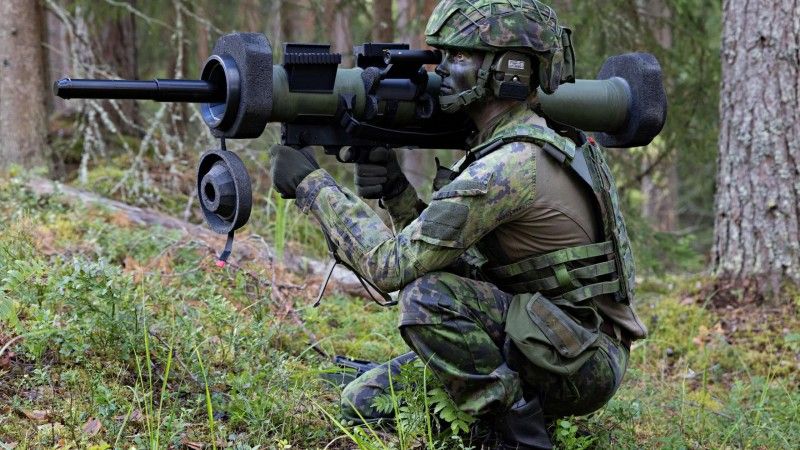
Finland will purchase RGW 110 disposable anti-tank grenade launchers from the German company Dynamit Nobel Defence. They will replace the French APILAS systems currently in use, some of which have been transferred to Ukraine.
A statement from the Finnish Ministry of Defence reads that the order for German grenade launchers will allow the army to develop its capability to engage armoured vehicles at close range. The value of the signed contract is approximately €84.5 million (approx. $91.5 million), excluding VAT, and deliveries of the equipment (including training systems) will begin in 2027. Training in the use of the aforementioned weaponry will also commence at that time.
Puolustusministeri Antti Häkkänen on valtuuttanut Puolustusvoimat hankkimaan raskaan kertasinkojärjestelmä RGW110:n saksalaiselta Dynamit Nobel Defenceltä. Hankinta kehittää Maavoimien kykyä torjua panssaroituja ajoneuvoja lähietäisyydeltä. https://t.co/NNbvxbrm1X
— Puolustusministeriö (@DefenceFinland) October 28, 2026
Generational replacement
It is unknown exactly how many German grenade launchers the Finns will acquire to replace the French APILAS systems purchased in the 1980s and 1990s, which likely numbered in the tens of thousands. They will provide a leap in capability for soldiers, who will now receive a tool for more effective engagement of armoured targets, including main battle tanks. An unspecified number of APILAS grenade launchers were transferred to Ukraine in 2023.

“With this order, we are significantly developing the army’s capabilities in close-range anti-tank warfare. The order is part of a broader development in which the focus of materiel procurement is shifting to the army. The materiel development of the army is a strategic investment through which we strengthen our entire defence system,” says Minister of Defence Antti Häkkänen.
RGW 110 and APILAS anti-tank grenade launchers
The RGW 110 is a handheld disposable anti-tank grenade launcher developed by the German company Dynamit Nobel Defence. Compared to the previously developed Panzerfaust 3, it features a weight reduction of approximately 3 kg and a significant increase in firing range (800 metres for stationary targets and 600 metres for moving ones). The warhead used allows for the setting of the operating mode (HESH or HEAT-Tandem).

The first setting is intended for destroying fortifications or unarmoured and lightly armoured vehicles, while the second is for hitting heavily armoured targets, such as main battle tanks (including those fitted with explosive reactive armour). The HEAT warhead is reported to allow for the penetration of up to 1,000 mm of rolled homogeneous armour (RHA) additionally shielded by explosive reactive armour.

Photo. DND.
APILAS is a French 112 mm anti-tank grenade launcher developed and produced by GIAT Industries (now the KNDS France group) until 2006. Work on it began in 1978, and serial production started in the mid-1980s. It was created as a supplement to MILAN anti-tank guided missiles and was intended to feature a similarly effective warhead. A total of over 120,000 units of this anti-tank grenade launcher were produced. The high-explosive anti-tank (HEAT) warhead, located in the rocket-propelled effector, is capable of penetrating 700-720 mm of RHA. The effective target elimination range using this grenade launcher is 25-500 m depending on the projectile used. Currently, these grenade launchers remain in service with the armies of countries such as Morocco, Ukraine, Finland, France, Jordan, Italy, and Saudi Arabia.

Photo. MKFI/Wikipedia


