












- ANALIZA
- WIADOMOŚCI
- KOMENTARZ
France has only 184 combat aircraft. Air Force chief warns of overstretch


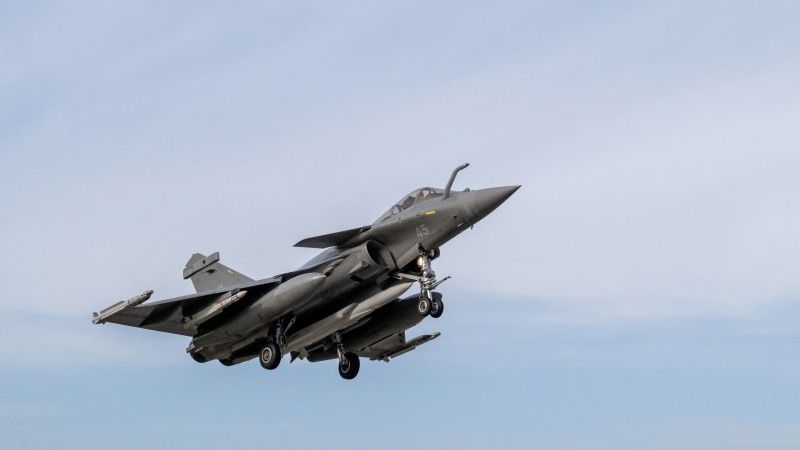
France has 184 combat aircraft, and its Air and Space Force is already operating beyond its planned capacity. General Jérôme Bellanger, Chief of Staff of the French Air and Space Force, has warned that the current fleet is insufficient to maintain nuclear deterrence, protect national airspace and simultaneously prepare for high-intensity warfare. During a parliamentary hearing, he revealed that French fighter aircraft are being used more than 15% above their planned operational level.
According to figures presented during the hearing on 14 October, France had 112 Rafales, 50 Mirage 2000Ds and 22 Mirage 2000-5Fs at the end of 2025. Bellanger recalled that, during a particularly demanding period before summer 2026, approximately 80% of the fighter fleet was committed to operational tasks. France was simultaneously conducting nuclear exercises, maintaining aircraft in the Middle East and on NATO’s eastern flank, participating in exercises in Côte d’Ivoire and protecting its own airspace. The number of missions continues to increase, while the number of available aircraft remains limited.
The French general also compared the size of France’s fighter fleet with other countries. Greece has approximately 240 combat aircraft and Germany 235, while Russia operates around 1,200 and China approximately 1,800, according to the figures he cited. Bellanger warned that Russia could increase its fleet to 1,500 aircraft by 2030. These figures do not directly reflect combat effectiveness, but they illustrate the numerical imbalance that French commanders must consider when planning sustained operations against a major military power.

The situation will not improve quickly. France is expected to receive only two additional Rafales in 2027, while further Mirage 2000 aircraft will be withdrawn from service. Although 50 Mirage 2000Ds have recently undergone modernisation to extend their operational lives beyond 2030, this does not resolve the wider problem of fleet size. France continues to invest in increasingly capable aircraft, but replacing older platforms with newer ones does not necessarily increase the number of aircraft available for operations.
What comes after Rafale?
The future of French combat aviation is becoming equally important. Following the collapse of the Franco-German Future Combat Air System (FCAS) fighter programme, Paris intends to develop its next-generation aircraft primarily through national industrial capabilities. Bellanger confirmed that the work already undertaken on FCAS would be used in the new programme. The future Avion de Combat du Futur (ACF) is expected to fly around 2040 and eventually carry the ASN4G nuclear missile, with 2050 identified as a longer-term programme horizon.
Before that, France will introduce the Rafale F5 standard, expected around 2035, incorporating technologies linked to propulsion, sensors, weapons and future combat systems. The new aircraft programme may remain open to international cooperation, but Paris does not want its development to depend on foreign partners. France therefore faces two simultaneous requirements: maintaining enough Rafales and Mirage 2000s to meet current operational commitments while financing the development of a new generation of combat aircraft.

Bellanger’s warning comes at a time when France is expanding its military commitments in Europe, maintaining operations beyond the continent and modernising its nuclear deterrent. The French Air and Space Force must sustain these missions with a fleet that its own commander considers too small. Even with Rafale F5 and a future sixth-generation aircraft, Paris will still have to address the number of aircraft it can deploy, maintain and replace during prolonged operations. The next military programming law will therefore have to address not only technological modernisation, but also the size of the combat fleet. As we have just seen, the numbers are quite significant.
Added context
Jakub Palowski from Defence24.pl commented on the situation:
“The claims that the French Air Force lacks fighter jets should be considered within a certain context. France, in its doctrines, assumes the possibility of conducting defensive operations, including on the Eastern Flank, without significant US involvement or, alternatively, without NATO structures. However, this could mean being deprived not only of the United States’ contribution but also, for example, that of Turkey, and in extreme cases, even other non-EU member states.

“The French Air Force, with fewer than 200 multi-role combat aircraft, is not, however, in a position to assume the role of an independent leader of the Eastern Flank. It must be taken into account that they would be required to perform tasks related to national territorial defence and nuclear deterrence, as well as conventional missions. Paradoxically, therefore, the French can – and do – provide a valuable contribution to NATO, which is sometimes criticised in Paris, but with this numerical capacity, they are in no way able to replace it. Furthermore, a slight numerical reinforcement would be beneficial for the French Air Force assuming operations within NATO, but for a leadership role, a quantum leap in capability enhancement would be required. One can cite the example of Israel, which has over 300 fighter jets.”


