












- ANALIZA
- WIADOMOŚCI
„Phoenix”: How Russians are mining Ukraine from the Air
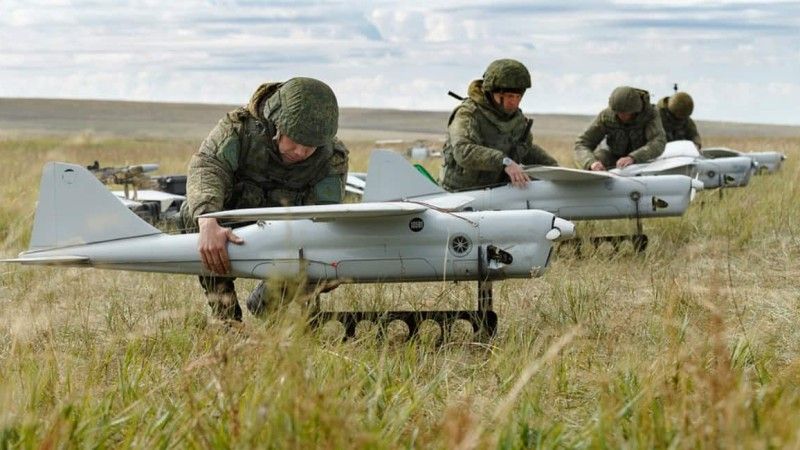
The development of unmanned military forces also entails the creation of specialized units dedicated to specific missions. One such unit within the Armed Forces of the Russian Federation (SZ FR), specializing in aerial mining, is the “Phoenix” Battalion.
Naturally, the battalion has a universal character—it can conduct standard, round-the-clock strikes using various unmanned aerial vehicles (UAVs). However, its primary specialization lies in mining logistical routes, carrying out area isolation missions by disrupting enemy vehicle movement along supply lines. This effectively halts personnel rotations and paralyzes, or completely prevents, the delivery of ammunition, water, food, and equipment.

The experimental “Phoenix” Special Mining Battalion was established within the 11th Independent Engineer-Sapper Brigade of the Southern Military District. Its connection to an engineering unit is no coincidence, as mining operations traditionally fall under the domain of engineer and sapper subunits. Alongside the battalion, which functions as a combat unit, there is also a training center and a laboratory.
The “Phoenix” Special Mining Battalion was formed in the summer of 2023, based on the resources of the 11th Engineer-Sapper Brigade. At that time, “Phoenix” was referred to as an experimental training and combat unit as well as an innovation center specializing in the use of drones for aerial mining. These were the first steps in this direction; later, aerial drone mining became widespread on both sides of the front.
Within the “Phoenix” Battalion, drones and munitions were modified for aerial mine deployment, initial experience was gained, and the training center conducted instruction in various specialties, including drone operators and sappers.
In the winter of 2025/2026, the “Phoenix” Battalion was operationally subordinated to the 1st Independent Engineer-Sapper Brigade “Siewier” (North) and operated on the Kupiansk front.
The unit’s personnel remain unknown. The battalion commander is an individual known as “Foks.” The battalion’s structure is also undisclosed, though it is known to consist of platoons and companies, likely autonomous units capable of independent operations. Depending on operational needs, drone operator platoons (teams) operate along different sectors of the front.
A combat team conducting a drone mission independently consists of only two people—a drone operator and a sapper-engineer. Including a driver, the team may number three.
The strength of the “Phoenix” Battalion lies in its experienced personnel and continuous equipment replenishment, including drones themselves. “Psikh,” a sapper-operator from the battalion, explained: “I’ve been flying for quite some time now. As you can see, even our engineering craft has welcomed these ‘birds.’ I can assemble a combat drone literally in a few minutes. After all, time is our most valuable resource. There are no supply issues. We receive enough unmanned aerial vehicles, both reconnaissance and combat types.”

Tactics
The battalion conducts standard reconnaissance and strike missions, including with FPV drones, but its specialty is aerial scatter mining. After proper reconnaissance, drones are used to mine enemy movement routes, roads, evacuation points, and approaches to bunkers and trenches.
The missions employ modified POM-2 and PMN anti-personnel mines—typically used for scatter mining via rocket or aircraft systems—as well as standard TM-62 anti-tank mines. Various drone models are used, from small to large (heavy) ones. Mining drones do not perform kamikaze missions; after dropping their mines, they return to base. To avoid detection of the launch site, evasive maneuvers and vigilance during the return flight are essential.
The primary FPV drone used is the mass-produced WT-40 (developed by blogger Vladlen Tatarsky), with a typical range of 7–10 km and a payload capacity of 1–3 kg.
The “Phoenix” Battalion operates along various front sectors—initially in platoons, now likely in companies.
At the turn of 2023/2024, a platoon operated on the Bakhmut axis; in May 2024, a detachment was active near the Dnipro River; in July–August, in Vovchansk and the Chasiv Yar direction; and since August of the previous year, in the Kursk region.
In recent months, primary targets have included vehicles, pickups, and armored cars—usually during rotations or supply transports—fortified positions, antennas, retransmitters, and Ukrainian drone operators. Strikes are carried out using Molniya drones or FPV drones. Logistical routes are also mined, causing additional losses, mainly in vehicles. For example, in September 2025, a pickup truck and an armored Kozak-2M were destroyed on an aerially mined road.

During assault operations, “Phoenix” drone teams provide close air support to assault groups, assisting them with reconnaissance and aerial strikes.
Their tactics rely on coordination: “Our assault troops advance and fortify their positions, and we set up engineering barriers in front of them so the enemy can’t approach. They indicate the targets, and we engage them. We also strike enemy logistics, their rear areas, and roads—disrupting their supply lines, food deliveries, rotations, evacuations, and so on,” explained “Bodrov,” a squad leader from the “Phoenix” Battalion.
These drone operations are typical of assault actions, similar to those conducted by Ukrainian units.
A turning point for the “Phoenix” Battalion came during the Kursk region campaign. In November 2024, the battalion’s strike capability significantly increased when several operator teams completed training on Molniya drones and began missions in the Kursk region (previously, only one crew operated the Molniya).
New operators completed their training under combat conditions, following a unit-developed algorithm: trainees assemble drones, prepare them for flight, install retransmitters, and set up the launch catapult. The instructor takes off first, controlling the drone via remote and FPV goggles, while the trainee observes through identical goggles, memorizing landmarks.
“I currently have newly trained crews with me, and we train them under combat conditions. I show the second crew how to control the drone, navigate terrain, and perform takeoffs. The crews are already very experienced, but standard quadcopters differ greatly from fixed-wing drones,” said an experienced battalion instructor in an interview with TASS.

Drone control is similar to FPV operation—via radio channel and goggles. The use of inexpensive, simple Molniya drones (made of styrofoam, plywood, and aluminum) greatly enhanced the battalion’s combat capabilities. Despite their drawbacks—large size and lower maneuverability—their main advantage over small FPV drones is greater range (30–40 km) and payload (5–6 kg).
The powerful warhead is ideal for destroying stationary targets such as buildings or fortified positions. A “Phoenix” sapper noted that the “Molniya-2” can carry up to 6 kg of explosives, comparable in power to a 152 mm artillery shell. A hit from such a drone can completely destroy a single-story building. By comparison, an FPV drone has a range of 10–15 km and carries only 2–3 kg. There are also reports of Molniya drones carrying heavier loads, such as TM-62 anti-tank mines. Deep strikes combined with the ability to mine communication routes made the “Phoenix” Battalion a key element of the drone operational group that isolated Ukrainian forces in the Kursk region.
In March 2025, the “Phoenix” Battalion operating in the Kursk direction conducted hundreds of missions daily—one operator crew alone could perform up to ten combat sorties per day.
Experienced Molniya sapper-operators could configure drone payloads for specific missions. Ukrainians observed that the Molniya’s payload was adjusted depending on the mission—heavier loads for short-range attacks at the expense of range, and lighter loads for deep strikes 20–30 km behind the front line to maintain range.

Training Center
By May 2024, the battalion’s training center had trained approximately 650–700 personnel forming combat pairs—pilot and sapper—qualified to conduct combat missions, prepare and mount munitions, etc. The training course lasts 21 days, during which sappers and operators cross-train in each other’s specialties to ensure interchangeability. A distinctive feature of FPV drone operator training at the “Phoenix” Battalion’s center is the use of mini-drones as an introductory stage. The center built a special obstacle course that cadets must confidently complete before moving on to full-size drones.
Hundreds of operators and specialists have been trained. In March 2025, it was reported that the “Phoenix” Battalion’s UAV Training Center had trained over 500 FPV drone operators. Specialists learned not only to pilot drones but also to prepare munitions, repair, and configure drone support equipment.
Laboratory
The battalion also operates a workshop-laboratory. Analytical and innovative work is carried out there, such as analyzing and adjusting drone frequencies to counter Ukrainian electronic warfare systems. Drone and ammunition parts are 3D-printed. Various drones are tested, repaired, and modified; software is improved; antennas, retransmitters, and munitions are prepared. Each specialist services up to eight drones daily to meet the battalion’s operational needs.
Ammunition can be custom-assembled for specific missions. For example, to target infantry, sappers mount small explosive charges called “bombki” (“little bombs”), weighing only 400–800 grams, with up to six attached to a larger drone.
“They’re 3D-printed to minimize weight so that range and flight time meet our requirements. What targets? Infantry. Trenches. Moving targets,” explained “Ara,” a sapper and drone operator from the “Phoenix” Battalion.

Combat Record
May 2024, Dnipro
Over the Dnipro River, the battalion’s drones mined the riverbed and tributaries from the air. Up to 20–30 anti-landing mines were deployed daily, targeting Ukrainian soldiers and boats. The unit claimed around 70 destroyed watercraft, including boats and jet skis.
July 2024, Vovchansk
The use of drones on the Kharkiv front proved highly troublesome for Ukrainian forces, with reports suggesting parity—both sides actively and massively employed UAVs. The “Phoenix” Battalion detachment conducted scatter mining and daily FPV kamikaze drone strikes.
August 2024, Kursk Region
In August, journalist Aleksandr Kots interviewed “Phoenix” Battalion soldiers operating in the Kursk direction. Their operations included mining and aerial strikes on targets in Ukraine’s Sumy region and Russia’s Kursk region. In addition to typical mining of main communication routes, they carried out standard strike missions using FPV and fixed-wing Molniya drones.
January 2026, Kupiansk
Footage from the Kupiansk direction indicates the battalion’s continued activity in this sector of the front.


