- ANALIZA
- KOMENTARZ
Humiliated Moscow. How Ukraine defeated Russia's warships

Four years of war in Ukraine have shown that the Russian Black Sea Fleet is unprepared for modern naval operations and is losing “even” to the Ukrainian Navy, which has virtually no ships of its own.
When Russian forces openly attacked Ukraine on February 24, 2022, the Russian Black Sea Fleet was assigned three primary tasks: to provide fire support for ground operations (using missiles and artillery fire), to gain control over the Black Sea, and to conduct an amphibious landing operation near Odesa. The Russians failed to fully accomplish any of these objectives, and the Russian Navy quickly became more of a liability than an asset.
Importantly, it was not Ukrainian warships that stood in the way of these goals—because there were essentially none. The greater problem for the Russians turned out to be the Black Sea Fleet itself, which, apart from its submarines, was completely unfit for operations in the Black Sea. The issue was not only that Russian ships were technologically outdated compared to their Western counterparts, but also that they were in poor technical condition. Any words of criticism were drowned out by pro-Russian enthusiasts of massive vessels bristling with antennas, gun barrels, and missile launchers.

The First Executioner of the Black Sea Fleet – Coastal Missiles
The true test of the Russian Black Sea Fleet’s capabilities came roughly two months after the invasion began. The “examiner” turned out to be Ukrainian coastal defense missile units, followed shortly thereafter by aerial and surface drones. Three years later, Western-supplied fighter aircraft joined the fight, effectively restricting Russian naval aviation to areas protected by coastal air defense systems.
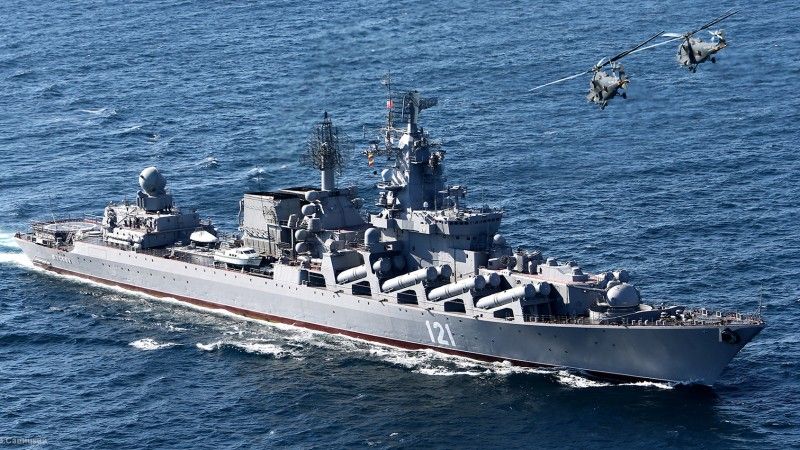
The Russian Navy first experienced the strength of the Ukrainian Armed Forces on April 14, 2022, when it lost the flagship of the Black Sea Fleet, the guided missile cruiserMoskva. This was a true public relations disaster, as the ship had long been showcased as a symbol of power—not only of the Russian Navy but also of the Russian shipbuilding industry. Yet the 11,000-ton cruiser sank after being struck on April 13, 2022, by just two Neptune anti-ship missiles.
This incident revealed not only the poor training of Russian sailors—who failed to save their ship after a 24-hour rescue effort—but also the vessel’s flawed design and ineffective or malfunctioning air and missile defense systems. The prestige damage was immense, especially since just two months earlier,Moskva had shelled Snake Island after the Ukrainian garrison refused to surrender—an act that became a lasting international symbol of Ukrainian resistance.
The Neptune coastal missiles proved such a challenge for the Russians that they were forced to reconsider their planned offensive on Odesa. Russian command had likely been preparing an amphibious landing to support ground forces advancing from Kherson along the Black Sea coast toward Odesa. The operation was intended to cut Ukraine off from its ports, leaving it at Russia’s mercy. Preparations were serious—by March 2022, reports emerged of a naval group near Odesa consisting of four large landing ships and three missile ships.
The successful strike onMoskva and the mining of approaches to Odesa definitively ended those plans. Moreover, Ukrainian Neptune anti-ship missiles and Bayraktar TB2 armed drones forced Russian ships to operate about 150 kilometers from the Ukrainian coast. The Russians, however, could still safely use Crimean ports, including the base in Sevastopol. This relatively stable situation for the Russian Navy changed in September 2022.

The Second Executioner of the Black Sea Fleet – Surface Drones
The Russians quickly realized that the Ukrainians had no intention of limiting themselves to pushing their ships 150–200 kilometers from the coast. On the night of September 17, 2022, the first two “Mykola-3” kamikaze surface drones appeared near Crimea, attempting an unsuccessful attack on the Project 11356M frigateAdmiral Makarov anchored in Sevastopol Bay. Although one Ukrainian drone was captured, the Russians failed to draw the necessary conclusions.
This negligence came back to haunt them on the night of October 28–29, 2022, when another attack targeted ships in Sevastopol—this time involving more than ten surface drones. The Ukrainians managed to damage at least three vessels, including the frigateAdmiral Makarov, the minesweeperIvan Golubets, and one landing ship.
It should be noted that the effectiveness of these kamikaze surface drones was not particularly high. Of 52 attacks carried out between October 2022 and October 2023, only eight were considered successful. One of the most notable incidents occurred on May 24, 2023, when three Magura V5 surface drones attacked the newest Russian intelligence ship,Ivan Khurs. For the first time, Ukrainians damaged a maneuvering vessel that returned fire.
As a result of these repeated attacks, Russian ships began limiting their voyages from Crimean ports. The fate of Sevastopol was effectively sealed on September 13, 2023, when Ukrainian aircraft-launched Storm Shadow (or SCALP-EG) missiles struck two Russian vessels in the Sevastopol shipyard: the Project 636Varshavyanka-class submarineRostov-on-Don (ultimately destroyed in Sevastopol on August 2, 2024, in another ATACMS missile strike) and the Project 775 (NATO:Ropucha-class) landing shipMinsk from the Baltic Fleet.
Following these attacks, Russia decided to relocate its most important ships to the more easterly naval base in Novorossiysk. However, this maneuver proved largely ineffective, as Ukrainian surface drones had sufficient range to threaten Russian vessels even there. The Russians then moved their key ships even farther away, accelerating construction of a new naval base near Ochamchire in Abkhazia.
Meanwhile, on July 17, 2023, Ukrainian Sea Baby kamikaze boats successfully attacked the Kerch Bridge, severely damaging its road and rail supports. By mid-2023, Ukraine also began targeting the so-called “Syrian Express”—the maritime supply route across the central Black Sea used to transport supplies for Russian expeditionary forces in Syria and ammunition for Russia itself. Ukrainian strikes hit the Project 22160 patrol shipVasily Bykov (twice: on August 1 and September 14, 2023), the tankerSig (on August 5, 2023), and two Russian landing barges with crews and equipment in the port of Chornomorske in western Crimea (on September 24, 2023).

In 2024, Ukraine changed tactics, aiming to sink Russian ships outright. Swarms of surface drones attacked previously damaged areas to widen breaches. Between February and March 2024, three Russian vessels were sunk this way: the Project 12411 missile boatIvanovets (sunk overnight on February 1–2, 2024), the Project 775/II large landing shipCaesar Kunikov (sunk on February 14, 2024), and the Project 22160 patrol shipSergey Kotov (sunk on March 4, 2024).
Not only did tactics evolve, but so did the drones themselves. Ukrainian specialists speaking to Defence24 identified three key stages. First, when Russia began using helicopters to counter the drones, Ukrainians equipped their unmanned boats with anti-aircraft missiles. As a result, on December 31, 2024, they shot down two Mi-8 helicopters—the first such event in history—and in May 2025, for the first time ever, a Su-30 fighter jet.
When Russia started using unmanned aerial vehicles to counter surface drones, Ukrainians mounted electronic jamming transmitters on their boats. In response, when Russia deployed fiber-optically guided drones immune to jamming, Ukraine began equipping its kamikaze boats with remotely operated machine guns.
These were not the only weapons carried by Ukrainian naval drones. They were also adapted to lay naval mines. Thus, Ukraine became the first country in history to mine enemy shipping routes during wartime using unmanned surface vehicles. It is estimated that by 2023, these mines had already damaged four Russian vessels, including a minesweeper.
The Third Executioner of the Black Sea Fleet – Aerial Drones and Manned Aircraft
The Black Sea Fleet also faced growing problems from Ukrainian aviation—both manned and unmanned. Initially, Ukraine lacked the fighter aircraft needed to challenge Russian jets over the Black Sea. Moreover, its drones did not have the range to strike targets in Crimea from the western bank of the Dnipro River. In the latter case, surface drones were converted into micro–aircraft carriers—not to launch planes, but to covertly deploy kamikaze drones close to shore.
As a result, virtually the entire Russian-occupied Black Sea coastline became vulnerable to attacks up to 30 kilometers inland. The Russian Black Sea Fleet proved powerless against this threat. Using these micro–aircraft carriers, Ukrainian drones began destroying Russian radars, missile launchers, air defense systems (including the well-known Pantsir systems), and command posts. Smaller vessels were also attacked in this manner.
See also 

Lacking air superiority and effective air or drone defenses aboard its ships, the Russian Black Sea Fleet became practically useless. Some of its vessels (including submarines) could still launch Kalibr cruise missiles toward Ukraine, but it was far cheaper to fire such missiles from land-based launchers or aircraft. Moreover, Shahed-class kamikaze drones emerged as a far greater nuisance to Ukrainians than missiles launched from the Black Sea.
So far, no official announcement has been made regarding changes to the equipment or structure of the Black Sea Fleet. Russia continues to build previously designed ships and even discusses entirely new naval projects. However, these are merely measures prolonging the agony—an agony also visible in the Baltic Fleet. There, too, it has become clear that when ports are under threat and constant enemy surveillance, coastal rocket artillery dominates, and hostile aircraft control the skies, only submarines have any real chance of combat operations.
For Russia, however, that chance in the Baltic and Black Seas would last only three days. No conventional Russian submarine is equipped with an air-independent propulsion system. After three days, they must surface or snorkel to recharge their batteries—a maneuver that could easily prove fatal.