


- ANALIZA
- WIADOMOŚCI
What will happen to Russian military aviation after the war? These aircraft could be scrapped

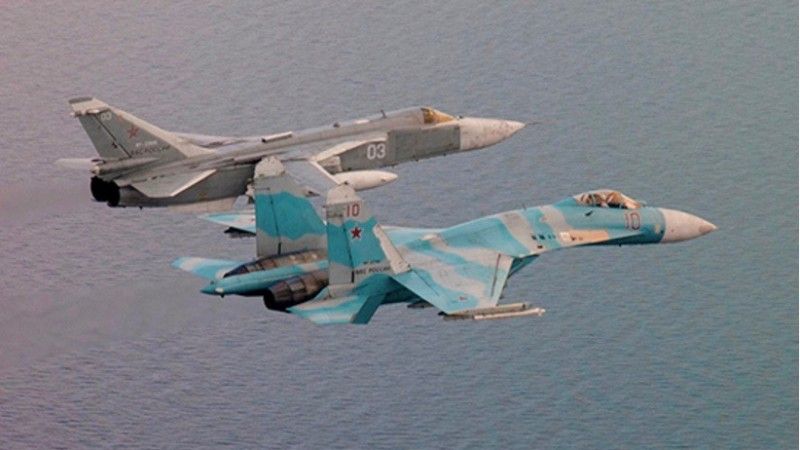
Regardless of when and how the ongoing war ends, Russia will have to retire several types of combat aircraft afterwards. Although many have already proved of little use, this will mean substantial reductions in combat capability — at least on paper.
The history of protracted armed conflicts shows that, once they end, much of the equipment worn out or rendered obsolete by technological advances is scrapped or sold to third countries as part of cost and force cuts. Only the most modern and newest weapons remain in service, while equipment that was fighting on the battlefield just a few years earlier is sent to the scrapyard. US military equipment left over from the Second World War provides a good example. Aircraft such as the P-38 Lightning, Dauntless bombers and the heavy B-17 Flying Fortress and B-24 Liberator bombers were withdrawn from service. They were scrapped or, in some cases, converted into transport aircraft.
Russia will find itself in a similar position after the war, regardless of the conflict’s outcome or when it ends — within a few years at most, although the same would apply even if the war ended tomorrow. Moscow does not have a surplus of combat aircraft comparable to that of the United States after the Second World War. It does, however, have a heavily worn fleet, with many aircraft so old that there is little justification for retaining them now, and there will be none at all after the war. Even today, they are often listed only on paper as supposed evidence of Russian military might. Many will have to be retired, however, and disposing of entire families of aircraft will make the most financial sense.

Russia in the 1990s
There is already a precedent in Russia’s recent history. Following the collapse of the Soviet Union, Moscow decided to retire all single-engined combat aircraft.
Within just a few years, between 1992 and 1998, entire aircraft families were withdrawn from operational service, including all MiG-21 and MiG-23 fighters, MiG-27 ground-attack aircraft, Su-17 fighter-bombers and the navy’s Yak-38 vertical take-off aircraft. Other twin-engined designs also faced the axe, including the infamous Su-15 interceptors and MiG-25 fighters.
Small numbers were reassigned to training duties. The aviation formations inherited from the Soviet superpower were thus substantially reduced. The savings, however, allowed Russia to concentrate on keeping its most modern and promising designs in service: the twin-engined Su-24, Su-25, MiG-29, Su-27 and MiG-31. The Tu-95 and Tu-160 strategic bombers also survived, as did the Tu-22M3 long-range bombers.
3 decades later
Thirty years have passed since then — the period typically planned for a combat aircraft’s entire service life. The aircraft retained in Russia during the 1990s have now exceeded their intended service lives. Successors have also emerged: the Su-30, somewhat by chance following successful exports to India, China and other countries; the Su-35, the planned successor to the Su-27; the Su-34, a replacement for the Su-24 based on the Su-27’s successful aerodynamic configuration; and, finally, the Su-57, which is being steadily introduced into service, albeit with difficulties. Nevertheless, hundreds of older aircraft remain in service, and the war has only accelerated their deterioration.
See also 
Su-24 Fencer frontline bombers
According to figures officially published by reputable sources covering the world’s armed forces, Russia still has around 260 Su-24-family front-line bombers in service, compared with more than 290 listed before the war. These aircraft did not, however, participate in the aggression against Ukraine — at least not from the outset or along the main axes of attack. This probably explains why their confirmed losses currently amount to just 13 aircraft destroyed and five damaged. They have been operated by the Wagner Group, among others, suggesting their secondary status, given the Russian state’s willingness to place them in „private” hands.
It appears that only 100–140 aircraft may actually be in service today, including those operated by the navy. Apart from the episodes involving Wagner, it is the naval aircraft that appear to be used in combat today. Su-24s have been lost over the Black Sea and at bases in Crimea. The wreckage of one was visible in the ruins of Bakhmut in 2023. The Su-24 remains in service only because Russia has been unable to expand its Su-30 and Su-34 fleets sufficiently to replace it.
One indication of its limited utility is that it has not been adapted to carry precision-guided glide bombs fitted with UMPK kits. These are currently carried exclusively by newly built aircraft, primarily the Su-34. Assistance from the Su-24 could ease their workload, but its fleet is apparently in such poor condition that this would make little sense. The same applies to installing newer self-protection systems. Its absence from these relatively safe bombing missions, conducted from behind Russian lines, is the clearest indication that the Su-24 is nearing the end. Interestingly, these aircraft are rolled out at bases in Crimea and elsewhere to serve as decoys for Ukrainian drones. Despite repeated hits, they neither explode nor burn because they contain no fuel or operating fluids. Su-24 production ended in 1993, making the youngest aircraft 33 years old today. The war has only accelerated their ageing, despite the limited use of aircraft belonging to the Black Sea Fleet.
With the Su-34 fleet remaining at roughly 130 aircraft — production offsets losses, or allows only modest fleet growth — the retirement and demise of the Su-24 will reduce Russia’s officially listed aircraft inventory by almost 300.
Su-25 Frogfoot CAS/ground-attack platform

Unlike the Su-24, the Su-25 Grach has been actively employed in the aggression against Ukraine from the outset. Its fleet of 192 aircraft has consequently suffered substantial irrecoverable losses, which we estimate at no fewer than 39 aircraft destroyed, with a further two damaged. Interestingly, these losses resulted from shoot-downs and accidents. Virtually no Su-25s have been lost in Ukrainian missile and drone strikes on airfields. Irrecoverable losses exceeding 20 per cent, with no production to replace them, have been accompanied by wear and tear. We counted 23 Su-25s destroyed in 2022, six in 2023, six in 2024 — two of which may have been lost in earlier years — and four in 2025.
The last known shoot-down of a Su-25 over the front occurred in February 2025, and the last loss in an accident in June 2025. After that, the tally stops and the aircraft disappears from the front line. Instead, a formation of a few aircraft takes the place of a full flypast during the 9 May parades. In theory, the fleet is undergoing modernisation. In the war, however, glide bombs and drones of various classes have replaced the Su-25. This means that aircraft of this class currently have no place on the modern battlefield, or at least that, in positional warfare, their tasks can be performed by considerably less risky means. A decision to retire them or substantially reduce their numbers after the war should come as no surprise.
There is talk of a combat-capable Yak-130M succeeding the Grach. First, however, these aircraft would have to be manufactured, which would be far from straightforward given production of the type to date.
MiG-29 Fulcrum fighters

Photo. mil.ru
More than 200 MiG-29s are still officially listed, including a naval squadron. Despite the potential these aircraft offered in the 1990s, they did not receive funding comparable to that allocated to the Su-27. Nor did export customers come to their rescue, as India did with the Su-27, enabling the development of the Su-30.
In Russia, the aircraft remained neglected for much longer than its larger contemporary, and the technical condition of this underfunded fleet steadily deteriorated. The full extent of the problem became apparent in 2009, following a series of accidents involving these aircraft. An inspection was ordered, revealing that 90 aircraft had structures so worn or corroded that they had to be struck off charge. That was 17 years ago.
Despite the plans, the MiG-29 never acquired a multirole version that secured its future. The MiG-35 was supposed to fulfil that role, but with no interest from export customers, Russia itself ordered only six. Russia’s relatively modern MiG-29s also include carrier-borne variants and a squadron of MiG-29SMTs stationed in Armenia. Russia’s new light or medium fighter — all its other fighters are in the heavy category — will be the Su-75 Checkmate, if it materialises. This single-engined aircraft draws on experience gained with the Su-57. First, however, its development programme must be completed, and then it must be manufactured. Who will pay? There are no foreign customers, and Algeria alone, with potential demand for 50–70 aircraft, will not finance Russia’s programmes. Meanwhile, more than 200 MiG-29s are approaching the end of their service lives in training and test units across Russia.
Russian MiG-29 wartime losses probably comprise two naval aircraft destroyed by drones in Crimea — unless these were merely old airframes being moved around airfields, as is done with the Su-24.

Su-27 fighters

Around 100 Su-27s remain in service, some of which have been modernised. Their numbers are declining as Su-35Ss and Su-57s replace them in the last regiments still operating the type. By Russian standards, this process is proceeding according to plan, with no signs of disaster. Nevertheless, these are still 100 aircraft that must be replaced. Meanwhile, the Su-35 and Su-57 fleets are growing relatively slowly. Russia delivered 14 Su-35s into service in 2025 and 16 aircraft in 2024 — eight Su-35s and eight Su-57s. So far this year, it has delivered 12: six of each type. Replacing 100 aircraft will therefore take a long time, particularly once losses are taken into account.
MiG-31 interceptors

Photo. mil.ru
MiG-31 production ended in 1994, making the youngest aircraft 32 years old. Worse still for Russia, its performance subjects it to considerable wear, and there is no successor beyond concepts and drawings that appear periodically in various publications. Neither the funding nor, probably, the technical capacity is available for a new Russian interceptor, particularly since completion of a development programme would still have to be followed by production. Just over 100 MiG-31s remain in service, or around 130 according to some sources. Somewhere between a dozen and more than 20 have been converted to carry Kh-47M2 Kinzhal aeroballistic missiles. It is difficult, however, to assess how many aircraft in this family remain serviceable today.
Most of their wartime losses are known to have resulted from accidents, engine fires, undercarriage failures and similar incidents. The MiG-31 may remain in service after the war, but only because there is no alternative, and at the cost of cannibalisation and further reductions in fleet size. That is unless Russia changes its doctrine and approach to protecting its airspace, allowing conventional air-superiority fighters to take over the role. Either way, this means another reduction and even fewer resources to cover Russia’s vast territory.
Tu-22M3 long-range bomber

Photo. Department of Defense / Wikimedia Commons
In our assessment, the future of the Tu-22M3 bomber, which is no longer in production, may also be in doubt. Around 60 were available at the start of the war, but at least nine have been destroyed, including three in accidents, several more have been damaged, and the rest of the fleet has suffered wear and tear. The Tu-22M3 cannot carry potent heavy cruise missiles such as the Kh-101, unlike the Tu-95MS and Tu-160. It must approach closer to its targets to employ shorter-range Kh-15, Kh-22 and Kh-32 missiles. It can also carry Kinzhal missiles. In the latter case, however, it is unclear whether Russia is still producing the weapon. Reports this spring suggested that production had been halted because of its low effectiveness, owing to Ukrainian spoofing and its high manufacturing costs. Will these large, failure-prone jets, whose numbers are steadily dwindling, have a place in future wars? This is another question Russia will have to answer after the war.

What is left?
Retiring older aircraft, or grounding them while retaining them on paper, will leave almost exclusively newer types whose introduction into service began after 2008. Withdrawing the older types will allow resources previously devoted to obsolete aircraft to be redirected towards their successors. The fifth generation will be represented by the Su-57, of which 76 are known to have been ordered, although only 20–30 have been delivered. The fourth generation will comprise the Su-30SM/SM2, with around 130 currently in service; the Su-35S, also with around 130; and the Su-34 front-line bomber, likewise numbering around 130. Russia’s tactical aviation fleet „of the future” therefore currently consists of around 400 aircraft. It should also be added that the extent of their wear after four and a half years of intensive combat operations is unknown. With considerable effort, Moscow will probably manage to increase the numbers of these aircraft, which remain in production. Investment in the Su-35S and Su-57 appears particularly warranted. In addition to their existing roles, these aircraft may have to take over those performed by the MiG-31.


