


- WIADOMOŚCI
Armed pontoons to defend Russian ports. Their effectiveness remains questionable

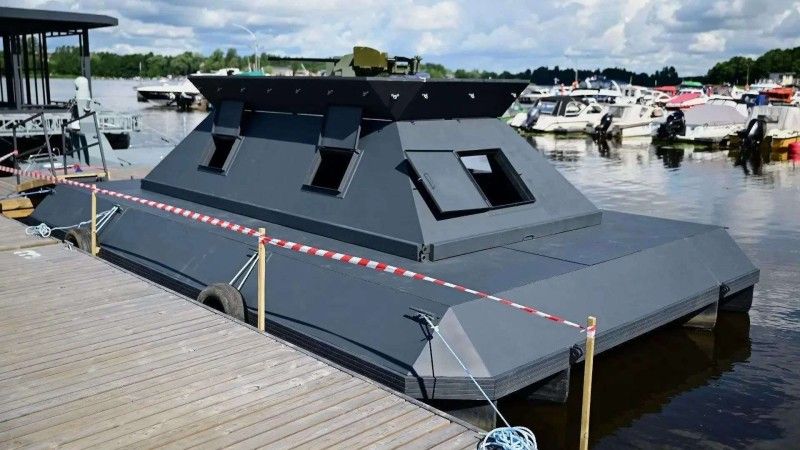
The Russians are boasting about the development of an uncrewed floating platform which, when equipped with the Narwhal combat module, is intended to protect ports and offshore energy infrastructure from various types of drones.
Curiously, the work on this new means of securing maritime infrastructure was not commissioned by the Russian military, but by the Governor of the Leningrad Oblast, Aleksandr Drozdenko. He approached local enterprises regarding the matter, receiving support from the Leningrad Oblast Maritime Council.
Published photographs indicate that at least six conceptual designs were created, only one of which was based on a twin-hull motorboat. The other five solutions resembled rectangular or square pontoons supported by four cylindrical floats, with angular superstructures welded onto them.

Photo. Aleksandr Drozdienko
According to the limited information provided by Aleksandr Drozdenko, only one demonstration platform has been physically built, measuring approximately 4.6 by 2.4 metres and designated as PLOT-47 (or PLOT-40). It was reportedly equipped with the „Narwhal” combat module, which allegedly „successfully struck all targets simulating aerial and maritime drones”. The tests were conducted on Lake Ladoga in the Leningrad Oblast.
The solution proposed by the Russians is likely a defensive rather than an offensive weapon. The hull shape itself suggests that the PLOT-47 platform does not move at high speeds and possesses low seaworthiness. It is also probable that the prototype lacks any propulsion of its own and is intended to be towed into position by other motorboats.

Photo. Aleksandr Drozdienko
The shape of the superstructures more closely resembles the crude armoured cars hastily prepared in Russian factories during the October Revolution than well-thought-out naval vessels. Some commentators have even described the solution as a „small bunker mounted on a pontoon”. This is reinforced by the fact that there is space for a crew inside, albeit without any provision for comfort. The Russians believe that „in the case of manning such platforms with crews working 12-hour shifts, there is no need for extensive social or living facilities”.
PLOT-47 and PLOT-40 are therefore suitable only for the short-term creation of forward firing positions on the water, which could respond to approaching threats at a significant distance from the protected infrastructure. This initiative by the Leningrad Governor can thus be seen merely as a certain act of desperation. Drozdenko has begun to realise that he cannot rely on the Russian Navy and its vessels to protect his own maritime infrastructure. Consequently, he decided to create a fleet of his own platforms to eliminate the threat posed by Ukrainian drones.

Photo. Rostiech
However, the effectiveness of such a solution is likely very low, particularly regarding unmanned aerial vehicles. The Narwhal module is based on the KORD 12.7×108 mm machine gun, which, even when supported by an optoelectronic head, lacks the precision to engage fast and manoeuvring aerial drones. If this solution has not proven fully effective on stable land platforms (including the Typhoon-U and Typhoon-K vehicles), it will certainly not perform well on swaying floating platforms.
Nevertheless, the project itself demonstrates how the approach to protecting ports and coastal infrastructure is changing. Given the current threat, protection cannot rely solely on assets deployed on the infrastructure itself, but also on platforms pushed far forward to serve as early warning systems for approaching threats.

Photo. Russss/Wikipedia
Conceptually, this resembles the Maunsell Forts erected at sea, many kilometres from the British coast, during the Second World War. Their crews reportedly shot down dozens of German aircraft and V-1 flying bombs, and sank one German vessel. However, what was tested on Lake Ladoga is certainly not such an effective solution.


