











- WIADOMOŚCI
- KOMENTARZ
Bulgaria turns to France. 57 CAESAR howitzers for nearly €686 million

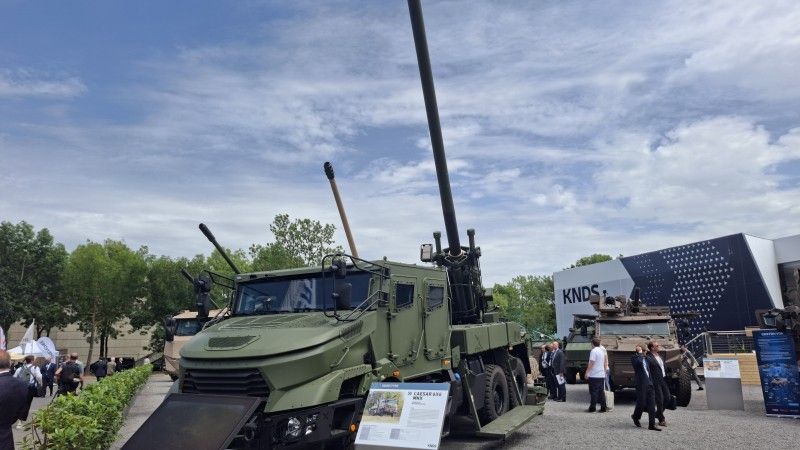
Bulgaria plans to acquire 57 French CAESAR 155 mm self-propelled howitzers for nearly €686 million. The Bulgarian parliament has approved the investment project, which is expected to be financed primarily through the European SAFE instrument. This is another success for the French defence industry and another NATO country moving away from Soviet artillery towards modern European-made systems.
On 19 November 2026, the Bulgarian parliament approved the acquisition project for 57 CAESAR self-propelled howitzers. The proposal received 158 votes in favour, with none against and 19 abstentions. Deliveries are expected to be completed by 31 December 2030.

The programme includes not only the howitzers themselves but also 155 mm ammunition, support equipment, command systems and communications equipment. The new weapons are intended to equip three artillery battalions.
For Bulgaria, this represents a fundamental change. Its land forces still operate Soviet-era 122 mm Gvozdika self-propelled howitzers and 152 mm D-20 towed guns. CAESAR will increase their firing range to more than 40 km, improve counter-battery capabilities and enable the transition to NATO-standard ammunition.
France secures another market
Bulgaria is participating in a joint European CAESAR procurement programme coordinated by France. Croatia, Estonia, Slovenia and Portugal have also joined the initiative.
Importantly, Sofia intends to use the SAFE instrument, under which Bulgaria has been allocated access to more than €3.26 billion in loans for defence investment. The final contract for the 57 howitzers has yet to be signed.
France is steadily expanding its position in the European artillery market. Croatia has ordered 18 CAESAR Mk II systems, Lithuania has committed to another 30, and Slovenia is also investing in the platform. Bulgaria is now set to join the growing group of users.

Meanwhile, Paris is increasing ammunition production. On 20 November, the French Directorate General of Armaments announced an order for another 50,000 artillery shells of 155 mm calibre from KNDS. The production capacity of the French defence industry is also being expanded.
Europe is abandoning Soviet artillery
Bulgaria’s decision demonstrates that artillery modernisation in Europe is not limited to countries bordering Russia. NATO members on the Alliance’s south-eastern flank are also investing in new artillery systems and improving interoperability with their allies.
Interestingly, just a few years ago, European countries frequently purchased military equipment individually, with little coordination. Joint procurement programmes and European financing for the defence industry are now becoming increasingly important.

France is doing more than selling additional CAESAR howitzers. It is building a network of European users around its own defence industry, connected through ammunition, training, spare parts and technical cooperation.
Nevertheless, ammunition stockpiles remain a major challenge. Purchasing dozens of modern howitzers is insufficient unless a country also possesses adequate ammunition reserves, reconnaissance capabilities and maintenance facilities.
The war in Ukraine has demonstrated that artillery effectiveness depends not only on range and precision but also on the ability to sustain prolonged combat operations. The French understand this well. And they are becoming increasingly effective at using these lessons to strengthen their own defence industry.