












- ANALIZA
- WIADOMOŚCI
F-35A is not enough. Infrastructure as the bottleneck of nuclear sharing

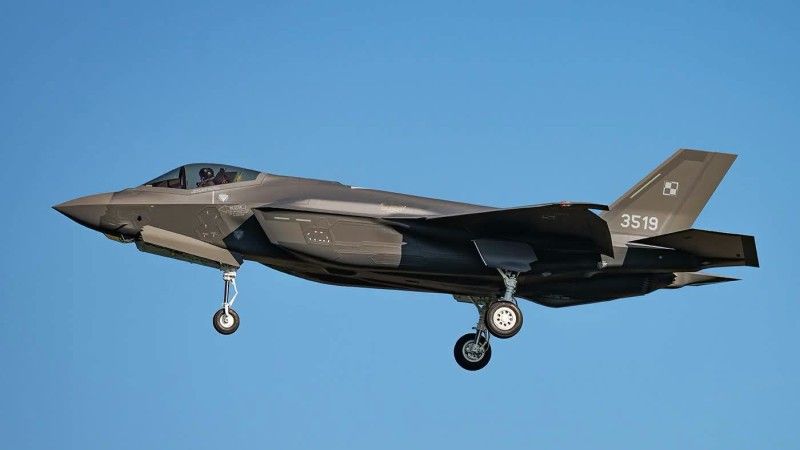
Photo. Fot. Paolo Rollino Photography
F-35A squadrons are not in themselves a guarantee of participation in NS, because although in Poland we also have the previous DCA (Dual-Capable Aircraft) model, the F-16, Polish participation in NS is still shrouded in fog. This is because in Poland, politics has outpaced planning.
What we already have
Let’s start with what we already have. Since May, the first Polish F-35As have been stationed at the 32nd Tactical Air Base in Łask. Eight of the 32 ordered had arrived by October, and the type itself has been certified to carry B61-12 bombs since 2023. Then there is politics: on 27 August, Deputy Defence Minister Paweł Zalewski announced that the government had secured the possibility of joining the DCA programme, which he called a first step towards nuclear sharing, and a month earlier, the head of the National Security Bureau (BBN), back from Washington, spoke of great openness on the American side.
The Husarz is not the only Polish candidate, by the way. The B61-12 has also been integrated with the F-16, including the C/D version, and it was precisely these aircraft that carried out the nuclear mission in Belgium and the Netherlands for years. We have 47 Block 52+ jets, which are being upgraded to the F-16V standard. The thing is, the type’s compatibility with the bomb does not make it a carrier yet, because you need the right equipment and the certification of the aircraft, the crews and the whole unit. So it turns out we potentially have two carriers and ground infrastructure for neither of them.
See also 

This is where the problem with how we talk about the issue arises. In the public debate, it goes like this: there is an aircraft, there is consent, the rest is a formality. But that is not true. The aircraft, although expensive, is actually the easiest part of the whole puzzle, because you buy it in a standard configuration, and adapting it comes down to wiring, software and certification. Much harder is what has to be built on the ground and what cannot be bought off the shelf.
What is a nuclear base made of?
To understand what we are missing, it is enough to look at the countries that have been flying this mission for years. Belgium, Germany, the Netherlands, Italy and Turkey host around a hundred American bombs at their bases, and none of them sits in an ordinary warehouse. The weapons rest in underground vaults of the WS3 system (Weapons Storage and Security System), built into the floors of hardened aircraft shelters. This means the bomb does not leave the protected facility until the moment it is loaded onto the aircraft. There are no such vaults in Poland, nor in the Baltic states.
The vault is only the beginning of the list. Custody of the weapons lies exclusively with the Americans, and at host-nation bases, this is the job of the Munitions Support Squadrons (MUNSS), usually 125–150 personnel strong. They are responsible for receiving, storing, maintaining and protecting the bombs until an authorised order to release them is received. Such a unit will not fit into a container by the fence, because it needs its own facilities, a separate security zone, secure communications with the American and allied command systems, and facilities for the technical maintenance of the weapons. The host has plenty to do as well: security forces, trained and certified crews, weapons personnel and recurring inspections; whoever fails an inspection has the capability suspended.

Someone will say that Łask already has American certification. That is true, because in March the base received certification of its infrastructure for F-35 operations, covering hangars, technical facilities and security systems. It is a significant achievement, but it concerns protecting the aircraft’s secrets, not nuclear weapons. These are two separate sets of requirements and one cannot replace the other.
How long it takes and how much it costs
How long it takes to build such infrastructure is best seen in examples from Western Europe. The first is RAF Lakenheath in Britain, from which American bombs were withdrawn in the first decade of this century. The base had 33 vaults from the 1990s, which were mothballed but still existed. The decision to restore the mission was most likely taken in 2021; the first trace appeared in 2022 in the budget documents of the NATO Security Investment Programme (NSIP), and by February 2025, 22 of the 33 shelters had been modernised. So even where the infrastructure was in place and the base is used by the US Air Force, the reactivation alone took several years.
The second example is Büchel in Germany, which has hosted American weapons for decades. Adapting the base to the F-35 alone was supposed to cost 1.2 billion euros, and according to the German Defence Ministry, it will swallow around 2 billion, with the infrastructure due to be ready in 2027. Berlin, for its part, said from the start that complex American security requirements were among the sources of risk.

The conclusion for us is an uncomfortable one. If countries that have vaults, personnel, procedures and decades of practice need years and billions just to keep the capability, then what about Poland, which would be starting from scratch? For comparison, NATO’s last programme to modernise storage sites in Europe took thirteen years and cost 384 million dollars, and we are talking about facilities that were already standing.
A dispersal base is not a shortcut
What we hear about most often is an intermediate solution. William Alberque, a former senior NATO official, considers it more likely than permanent storage, and the idea is to certify the Polish F-35s and designate selected bases as Dispersed Operating Bases. The weapons would only reach them in a crisis or on the eve of war, and in peacetime there would be no warheads in Poland. This fits the line sketched out by Deputy Minister Zalewski, which is participation in the mission without a permanent stockpile.
The trouble is that a dispersal base without prepared infrastructure remains an entry in a planning document. To receive weapons within hours, you need to have in advance a place for their temporary storage that meets American standards, and on top of that, positions for the custodial personnel, communications, security forces and rehearsed procedures for receiving the shipment, loading and releasing the weapon. All of this has to pass certification in peacetime, because a crisis is not the moment for a first inspection.

Then there is survivability. Łask and Świdwin lie within range of Russian ballistic and cruise missiles stationed in the Kaliningrad Oblast and in Belarus, and flight time is counted in minutes. A base to which nuclear weapons are moved in a crisis becomes a first-priority target. Whether it will deter anyone at all therefore depends on things that seem far removed from the subject: layered air and missile defence, hardened shelters, rapid runway repair and the ability to disperse aircraft to other airfields. Without this, an adversary may conclude that the whole capability can be switched off with a single conventional strike. Instead of stabilising the situation, it invites pre-emptive action.
So what follows from this?
First, it is not Warsaw that sets the pace. Weapons storage infrastructure is funded by NATO through the NSIP, the standards are set by the United States, and the allies have to agree to expand the network of bases. We can lobby and push, but we will not build this on our own.
Second, a lot can be done with our own resources and there is no need to wait for anyone. These include air defence of the bases, shelters, physical protection, training of crews and ground personnel, and wider participation in the Steadfast Noon exercises. These are investments that will pay off regardless of what happens with nuclear sharing, because they raise the resilience of the air force in every scenario.
Third, it is worth changing how we measure progress. Whether things have really started moving is not shown by more declarations or more Husarz jets on the apron in Łask. It will be shown by line items in American and NATO budget documents, tenders for construction work at specific bases and the arrival in Poland of American personnel specialising in nuclear weapons handling. Until that happens, Polish participation in NS remains a story with no action behind it, and the Husarz jets in Łask are simply very good aircraft without a nuclear mission.


