












- ANALIZA
- WIADOMOŚCI
Greenland changes Denmark’s airlift problem. That is why Airbus has a chance

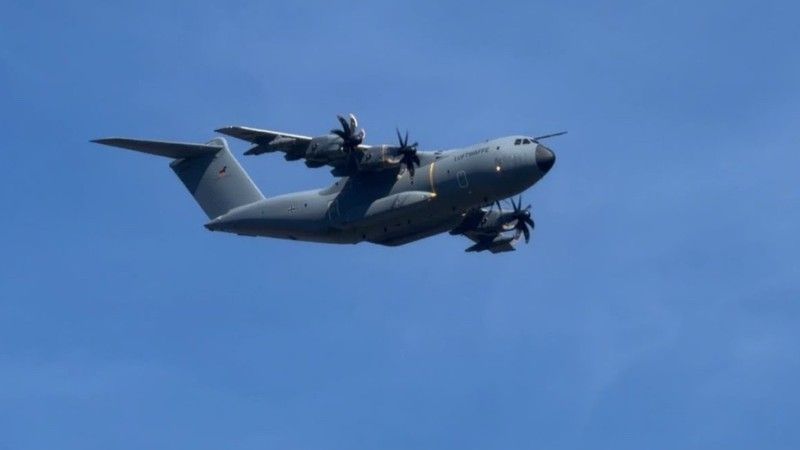
Photo. Mateusz Broncel
Denmark has not formally chosen the A400M, but Greenland is changing the logic of its future military transport fleet. Copenhagen still operates four C-130J aircraft, and replacing them with another medium transport aircraft would be the safer option. Yet the Arctic and North Atlantic are forcing Denmark to ask a different question: not only how to replace the Hercules, but whether it needs a larger aircraft able to carry heavier and bulkier loads into remote northern locations.
According to La Tribune, Denmark is seriously considering the acquisition of four to five A400M aircraft. This should still be treated carefully. The Danish government has not announced a final decision, a shortlist or a formal selection of Airbus. A parliamentary question submitted in September asked about the timetable, operational requirements, NATO requirements and possible manufacturers for a future replacement of the C-130J fleet. An official answer has not yet been published. This means that the A400M is a serious prospect, but not yet a Danish government decision.
The timing, however, matters. On 7 October, Airbus Defence and Space signed a co-operation agreement with the Danish industrial cluster CenSec. The communication referred directly to the A400M and A330 MRTT programmes.
This does not decide the competition, but it shows that Airbus is already trying to build an industrial argument in Denmark. The offer is not only about the aircraft. It is also about involving Danish companies and research centres in European defence aviation programmes. The operational argument comes from Greenland. In 2025, the French Air and Space Force tested the A400M on snow- and ice-covered runways at Station Nord and Mestersvig. In 2026, it went further, landing directly on the Arctic ice cap in northern Greenland.
These trials are not just a marketing demonstration. Denmark’s Arctic problem is precisely about reaching remote locations where weather, distance and infrastructure limit what can be delivered and how quickly. Greenland is not a normal transport environment. It requires range, payload, cargo volume and the ability to operate in difficult conditions. The A400M gives Denmark a different class of cargo. The Danish C-130J-30 can carry roughly 19 tonnes, while the A400M can carry up to 37 tonnes. But the more important issue is not only weight. It is volume.

The larger cargo hold of the A400M allows it to transport equipment that a Hercules may simply not accommodate. That matters for Greenland: helicopters, engineering vehicles, radar components, base equipment and larger logistic loads can be more important than the headline payload figure alone. One test is particularly relevant. Denmark and France have already practised loading a Danish MH-60R Seahawk into a French A400M. The operation required technical adjustments, but it worked and produced a formal loading procedure.
For a country responsible for Greenland and the North Atlantic, this is not a small detail. Being able to move a naval helicopter by air changes how quickly Denmark can reinforce remote areas, support maritime operations and respond to a crisis in the High North.
The wider political context is also moving in Airbus’s favour. Denmark, Greenland and the United States agreed in September to expand defence arrangements around Greenland, including new defence areas in Narsarsuaq and Mestersvig. Denmark has also announced major Arctic and North Atlantic investment packages.
This does not mean that the A400M is required by the new arrangements with the United States. It does mean that Denmark’s future airlift requirement is becoming more Arctic, more military and more demanding. A larger transport aircraft becomes easier to justify when the state is expanding military infrastructure in the very area where that aircraft has already been tested. There is also a NATO and Polish angle. In July 2026, NATO launched work towards a multinational A400M fleet with Belgium, Croatia, France, Poland, Spain, Türkiye and the United Kingdom. Denmark is not part of that initial group.
This is interesting because Denmark already participates in multinational A330 MRTT arrangements. If Copenhagen buys its own A400Ms, it would take a different path: shared strategic tanker access through NATO, but national tactical-heavy airlift for Greenland and the North Atlantic. The strongest argument for Airbus is therefore not that Denmark is suddenly becoming “French” in defence procurement. That would be too simple. Denmark is diversifying its European defence suppliers while facing a harder Arctic requirement.
The C-130J remains a proven aircraft, and Lockheed Martin will argue continuity, lower transition risk and existing Danish experience. Embraer’s C-390 could also be a modern medium-airlift option. The A400M, however, offers something else: a step into a heavier class of transport. The Danish decision should therefore be read through Greenland, not only through the age of the C-130J fleet. Greenland increasingly requires military equipment, infrastructure, mobility and the ability to move larger loads to remote locations.

At the same time, the United States is expanding the defence framework around the island, while Denmark is investing in Arctic and North Atlantic capabilities. France has also been very active in this space: the A400M has been tested on snow- and ice-covered runways in Greenland, landed on the Arctic ice cap and was used in training connected with the transport of a Danish Seahawk helicopter.
This is why the A400M is not just an Airbus sales pitch. It fits a changing operational environment in which Greenland is becoming more important for NATO, the United States, Denmark and European military presence in the High North. The question is no longer only which aircraft replaces the Hercules. It is whether Denmark wants an airlift capability sized for the Greenland problem it now faces.


