- WIADOMOŚCI
- ANALIZA
Helsinki set the course. Iceland shows JEF is becoming a northern security instrument

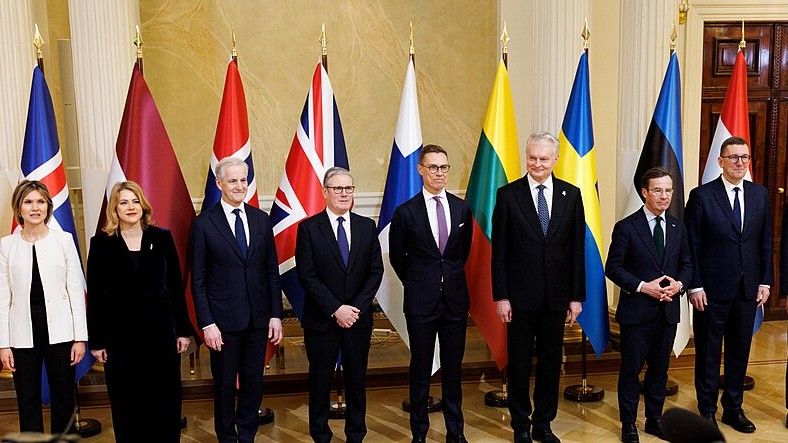
Photo. Lauren Hurley / No 10 Downing Street / Wikimedia Commons
The JEF defence ministerial in Iceland was not just another regional meeting. It showed that the decisions taken by JEF leaders in Helsinki in March 2026 are now moving into military practice: closer cooperation with Ukraine, stronger activity below the threshold of Article V, and a clearer understanding that the Baltic Sea, the High North and the North Atlantic must be treated as one connected security space.
The Joint Expeditionary Force remains a UK-led framework, bringing together Denmark, Estonia, Finland, Iceland, Latvia, Lithuania, the Netherlands, Norway, Sweden and the United Kingdom. Yet its role is no longer limited to exercises and political signalling among like-minded northern European states. After Russia’s full-scale invasion of Ukraine and the growing pattern of sabotage, cyber operations and pressure against critical infrastructure, JEF is increasingly becoming a practical tool for the grey zone between national response and NATO’s collective defence mechanism.
This is why Helsinki matters. The March 2026 JEF Leaders’ Summit in Finland gave the format a clearer political direction. It placed Ukraine, the Baltic region, the High North and the North Atlantic inside one security conversation. The meeting in Iceland should be read as the next step in that process. Keflavík did not create a new agenda; it showed that the Helsinki agenda is being implemented.
Ukraine’s participation in Lion Protector is the best example. For the first time, Ukrainian units took part in JEF’s flagship exercise, with Ukrainian mine countermeasure vessels operating alongside JEF forces. This is more than a symbolic gesture. Ukraine is not only a country receiving support. It is also bringing operational experience from modern war into the training and planning of northern European states. That matters for maritime security, mine warfare, drones, infrastructure protection and the way future crises in the region may unfold.
Canada is the second major element. Ottawa was not merely present in Iceland as a polite guest. It has applied to join the JEF, and ministers began work towards a recommendation for leaders on Canadian membership. If accepted, this would change the character of the framework. JEF would no longer be only a northern European format. It would gain a direct North American dimension, linking the Baltic Sea, the European Arctic, Iceland, the GIUK gap, the North Atlantic and the Canadian Arctic.

Finland sits at the centre of this shift. Before 2023, Helsinki was a close NATO partner. Today, it is one of the states shaping how the northern flank is organised. Finland links the Baltic region with the High North, hosts new allied structures, and is becoming a political and military hub for northern security. The March summit in Helsinki was therefore not simply a diplomatic event. It reflected Finland’s new position inside NATO and inside the wider regional architecture.
The most important value of JEF remains its ability to operate below the threshold of Article V. This is exactly where Russia has been testing Western states: sabotage, pressure against undersea infrastructure, disinformation, cyber activity, air and maritime incidents. These are serious enough to require a collective response, but not always clear enough to trigger NATO’s full machinery. JEF can act faster, regionally and with fewer political constraints, while still complementing NATO rather than replacing it.
Lion Protector 26 also points in that direction. The exercise is being conducted across Iceland and Norway, synchronised with the UK Carrier Strike Group and focused on the North Atlantic and High North. The growing attention to critical infrastructure, maritime access and response options shows that JEF is preparing for concrete regional scenarios, not just demonstrating interoperability for its own sake.
The industrial dimension should not be overlooked. Since the NATO Summit in Ankara, JEF national armaments directors have already met twice, and defence ministers now expect concrete proposals before their next meeting. This is important because a regional security framework cannot rely only on exercises. It needs equipment, stockpiles, production links and supply chains that can support activity in a crisis.
The Iceland meeting therefore confirms a wider change. Northern Europe is no longer a set of separate theatres. The Baltic Sea, Finland, the High North, Iceland and the North Atlantic are becoming parts of one operational map. Helsinki gave this approach political direction and Keflavík showed that JEF is starting to turn it into practice.