- WIADOMOŚCI
- ANALIZA
A revolution in Russian military logistics? Moscow wants to avoid a repeat of 2022

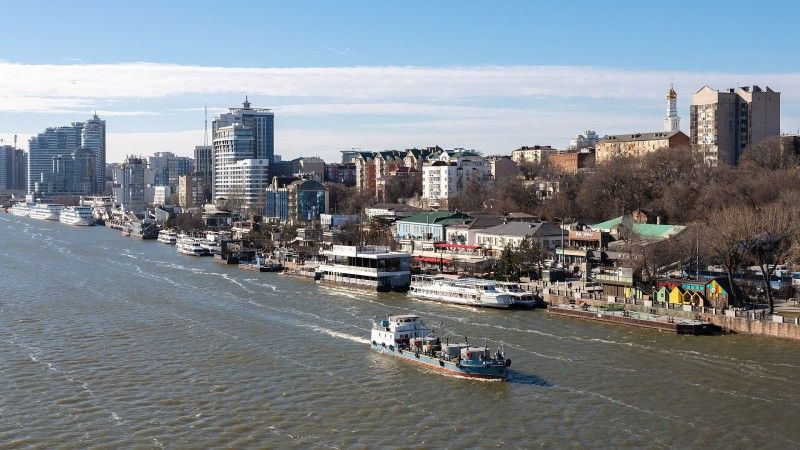
Photo. Vyacheslav Argenberg / Wikimedia Commons
One of Russia’s most important central government institutions is the Ministry of Defence. It is an extensive organisation with a complicated structure that can be difficult for outside observers to understand. Recently, however, several important and particularly interesting changes have taken place within the ministry.
The Ministry of Defence of the Russian Federation is headed by the Minister of Defence, who is assisted by twelve (!) deputy ministers. These include two First Deputy Ministers, one State Secretary, one deputy who simultaneously serves as Head of the Main Military-Political Directorate, and another who heads the Ministry of Defence’s administrative apparatus. The minister and his deputies may be serving professional military personnel or officials of the Federal State Civil Service, meaning civilian government officials. Their status depends on the decisions of the Russian President, who directly supervises the Ministry of Defence.
The largest component of the ministry is the General Staff of the Armed Forces of the Russian Federation. It is headed by the Chief of the General Staff, who also holds the position of First Deputy Minister of Defence.

The structure of Russia's Ministry of Defence and the division of positions between civilians and military personnel
In recent years, the second First Deputy Minister of Defence has been a civilian official. In Russia, alongside military ranks and those used in various security institutions, there is an entire system of ranks for civilian government officials. A similar system, although with different rank titles, exists within civilian prosecution services and judicial institutions, including courts.
Following a tradition dating back to the Russian Empire, senior civilian government officials are entitled to wear various types of uniforms. Within the Ministry of Defence, these are standard military-style uniforms. The most distinctive feature distinguishing a Russian general from a civilian official of an equivalent rank is the colour of their insignia. Military personnel wear gold insignia, while civilian officials wear silver.
The ministry itself is enormous. Its authorised staffing establishment, excluding protection and support personnel, comprises 13,400 positions. Of these, 8,470 are reserved for military personnel and 4,930 for civilians. This explains why the minister has twelve deputies, as they collectively have to coordinate the work of several thousand people.
Various organisational units report directly to the minister and his individual deputies. These include main directorates, directorates, departments and services, headed by both military officers and civilian government officials.
Subordination of military units and the stable role of Russia's General Staff
In addition to the ministry’s organisational units, military formations, military institutions and other federal organisations are subordinate to the minister, his deputies and the heads of the aforementioned departments. However, these organisations are not formally part of the ministry itself.
For example, the General Staff includes the Directorate of the Chief of Electronic Warfare Troops. As a central authority, it supervises all matters relating to electronic warfare across the Russian Armed Forces.
The 15th Separate Electronic Warfare Brigade is also directly subordinate to this directorate. Other similar brigades, numbered 16, 17, 18 and 19, report to the commanders of their respective military districts, while the head of the directorate exercises only specialist oversight over their activities.
The General Staff has the most stable organisational structure within the Ministry of Defence. Its responsibilities are relatively clearly defined, which means that structural changes occur infrequently. When such changes are introduced, they generally reflect developments on the battlefield. One example was the establishment of the new Directorate of the Chief of Unmanned Systems Forces in 2025.
Information censorship and General Solodchuk's assumption of responsibility for logistics
In recent years, the subordination of various organisational units within the Ministry of Defence to individual deputy ministers has undergone several changes.
Unfortunately, understanding the reasoning behind decisions made by the ministry’s leadership is extremely difficult. Russian wartime censorship further complicates this task. The ministry’s website is blocked for users outside Russia and for internet crawlers.

Even when access is obtained, however, it becomes apparent that not all deputy ministers have clearly defined responsibilities or publicly available lists of subordinate departments.
Until relatively recently, considerably more information was available. The main omissions concerned the subordination of particularly sensitive organisations, such as the 12th Main Directorate of the Ministry of Defence, responsible for storing and distributing nuclear warheads, and the 9th Directorate, responsible for maintaining permanent command posts, most of which are located deep underground.
The concealment of the Ministry of Defence’s precise organisational structure appears to be primarily connected with the extensive changes initiated in 2026, particularly those concerning military logistics in its broadest sense.
Previously, two deputy ministers were responsible for these matters. Following a Kremlin decision, most of their responsibilities were transferred to a newly appointed Deputy Minister of Defence, Colonel General Valery Solodchuk.

Under the decision of the Minister of Defence, Solodchuk will be responsible for the overall organisation of rear support for the armed forces, in other words, military logistics.
Deputy Defence Minister Colonel General Alexander Sanchik, who was previously responsible for logistical support, will now oversee the procurement of weapons, military and specialised equipment, as well as the technical support of the armed forces.
Meanwhile, Deputy Defence Minister Alexei Krivoruchko, who previously supervised military-technical support, will now be responsible for overseeing the development of advanced weapons, military equipment and specialised systems.
Until these changes were introduced, the division of responsibilities was as follows.
Deputy Defence Minister Colonel General Alexander Sanchik supervised, among others:
- The Logistics Support Headquarters;
- The Department of Resource Support;
- The Department of Transport Support;
- The Department of Maintenance and Utilities Support;
- The Main Automobile and Armoured Directorate;
- The Main Missile and Artillery Directorate;
- The Main Directorate of the Chief of Railway Troops;
- The Metrology Directorate;
- The Logistics Support Inspectorate.

Deputy Defence Minister Alexei Krivoruchko, meanwhile, supervised, among others:
- The Main Armaments Directorate of the Armed Forces;
- The Department for State Defence Order Support;
- The Public Procurement Department;
- The Procurement Directorate for the Improvement of the Technical Foundations of the Armed Forces Command and Control System;
- The Directorate for Advanced Research of the Armed Services and Special Projects;
- The Directorate of Military Representative Offices.
It remains unclear how these organisational units have been divided in detail between the three deputy ministers under the new arrangements.
One thing, however, is certain: most of these responsibilities have been transferred to the newly appointed Deputy Minister, Colonel General Valery Solodchuk.
Before his appointment, Solodchuk commanded the Central Military District and the Centre Grouping of Forces, which was formed by that district and has been engaged in combat operations in Ukraine.

The changes are widely interpreted as a response to extensive criticism of the organisation and performance of Russian military logistics during the war.
Since 2022, a substantial proportion of Russia’s failures on the battlefield have resulted from shortcomings in its logistical system. General Solodchuk has been tasked with addressing these weaknesses.
As is often the case in Russia, the reforms have begun at the highest level of command. However, it is highly likely that they will eventually extend to lower levels of the military command structure.
The precise nature of these further changes will probably become clear in the near future. After all, logistics is everything in war.