












- WIADOMOŚCI
Russia warns NATO about Kaliningrad. Threatening to use 'the entire arsenal'

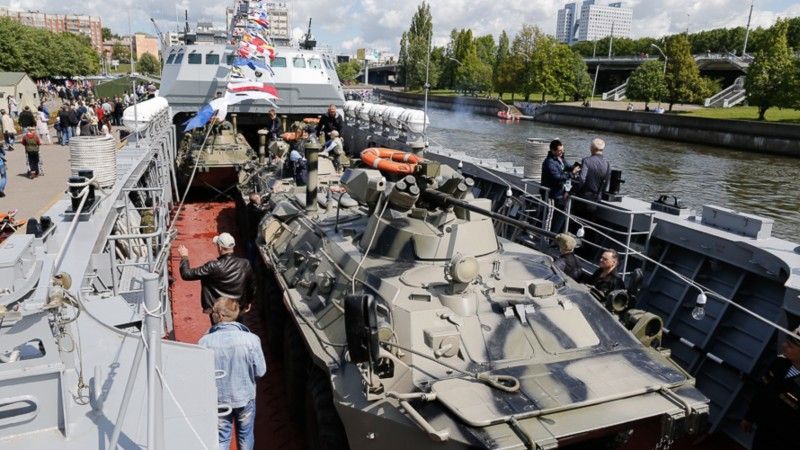
Russia is once again escalating its rhetoric towards NATO in connection with the situation surrounding Kaliningrad. The Russian Embassy in Belgium released a statement on 28 September, accusing Alliance member states of conducting increasingly aggressive military activities in the Baltic region and preparing scenarios intended to lead to the isolation of the Russian exclave.
Moscow primarily points to the increased NATO presence in the Baltic, military exercises, and Operation Baltic Sentry, launched in January 2025 to protect subsea infrastructure. However, the Russians claim that these actions could be used to prepare for a future blockade of Kaliningrad.
Kaliningrad is a Russian exclave situated between Poland and Lithuania. The region holds great military significance. Russia has deployed Iskander missile systems, nuclear weapons, air defences, and other assets there, allowing it to control a significant portion of the airspace over the Baltic. From NATO’s perspective, its location near the Suwałki Gap—the land bridge connecting Poland with Lithuania and the other Baltic states—is also a major concern. In the event of a potential conflict, Kaliningrad would thus be one of the most critical points in the entire theatre of operations.
Moscow portrays NATO actions as preparations for war
The Russian Embassy claims that NATO is conducting exercises in which offensive scenarios against Russia are being modelled. Moscow also criticises Western warnings regarding the possibility of a Russian attack on the Baltic states in the coming years.
In recent years, NATO countries have indeed been preparing much more seriously for the possibility of a conflict with Russia. However, this does not stem solely from a desire to increase pressure on Moscow. Primarily, it is a reaction to Russia’s own actions. The full-scale war against Ukraine has shown that the Kremlin is ready to use military force to achieve its goals, while Russian troops and aviation have repeatedly conducted activities that increase the risk of incidents near NATO countries.
The Alliance is strengthening the eastern flank, increasing its military presence, expanding infrastructure, and preparing plans for a situation where Russian pressure could also be directed against a NATO member state. The Baltic states, Poland, and the Baltic Sea are of particular importance here. NATO must also take into account the Russian capabilities concentrated in Kaliningrad.
In 2026, the most significant undertakings were Steadfast Dart, involving approximately 10,000 troops, as well as Steadfast Deterrence, BALTOPS in the Baltic, and Arctic Sentry in the north. Simultaneously, Baltic Sentry and Eastern Sentry are operational, and NATO is developing further initiatives related to the protection of the eastern flank and countering drones.
In this way, a narrative is created that is very convenient for the Kremlin: Russia points to NATO’s reaction while simultaneously ignoring what triggered that reaction. Every increase in the number of troops, ships, or exercises can be presented as evidence of preparations for an offensive, even if NATO declares that its focus is on deterrence and the defence of its own territory.

The harshest warning concerns Kaliningrad
In its statement, however, the embassy goes further and details what it believes to be evidence of NATO’s preparations for confrontation. The Russians write of an “unprecedented increase in military activity” by the Alliance along Russia’s western borders. They claim that NATO states no longer limit themselves to strengthening defence but are also allegedly practising offensive operations during exercises.
Moscow places a particularly strong emphasis on activities regarding the Baltic. According to the Russian Embassy, NATO is creating new threats to the Russian Baltic Fleet and analysing specific scenarios leading to the “disconnection” of Kaliningrad from Russia. The Russians claim that variants for the political and military isolation of Russian ports in the country’s northwest are being developed in parallel.
The embassy also draws attention to the increasingly sharp rhetoric from Western politicians and military officials. In its assessment, NATO states are deliberately raising the level of confrontation by publicly speaking about the possibility of striking military targets located in Kaliningrad and organising further exercises near Russian borders.
Moscow is particularly critical of warnings regarding a potential Russian attack on the Baltic states. According to the embassy, claims that Russia could attack one of the Baltic countries by 2029, or even sooner, are part of a Western information campaign intended to justify further militarisation of the region.

In doing so, the Russians are attempting to invert the West’s arguments. In the statement, they emphasise that Russia’s highest authorities have repeatedly declared no intention of initiating military action against NATO. Moscow also points to its proposals regarding written security guarantees and argues that Alliance states are ignoring these declarations.
The sharpest passage, however, appears in the description of a potential attempt to isolate Kaliningrad. The embassy warns that such a scenario would mean a rapid escalation and a “direct armed conflict” with Russia. Moscow stresses that it possesses the means to respond to potential aggression and is ready to use “its entire arsenal” to defend its own territory if NATO states attempt to cut off Kaliningrad from the rest of the Russian Federation.


