












- WIADOMOŚCI
Von der Leyen on security: The EU will defend every inch

European Commission President Ursula von der Leyen has delivered this year’s State of the European Union address. What does the State of the Union 2026 tell us about the Community’s approach to security issues?
Wednesday’s speech by the head of the European Commission began with a reference to Charles Dickens’s book „A Tale of Two Cities”, which tells the story of characters whose lives bridge London and Paris during the French Revolution. „It was the best of times, it was the worst of times,” wrote Dickens, and von der Leyen referred to these words, stating that the state of the Union „is today the best in history, yet its fate is more uncertain than ever before”.
The German politician’s address focused largely on economic issues. There was no shortage of discussion regarding China (the EU’s daily trade deficit with Beijing amounts to one billion euros [approx. £840 million]) and the need to become independent of Chinese critical raw materials. The EC President also spoke about administrative barriers blocking the further development of the Community, announcing an acceleration of reforms related to the „One Europe, One Market” programme.
New formats and cooperation with NATO
While economic issues are highly significant, we will focus exclusively on the security themes raised by the EU politician. In the initial phase of the speech touching upon this area, Ursula von der Leyen stated that over the last five years, the Old Continent has increased defence spending by almost 80 per cent. It is worth making a small annotation here to show that this strong result is largely due to the countries of NATO’s eastern flank, including Poland.
Let us now look at the specific solutions that, according to Ursula von der Leyen, are intended to improve security in the European Union. The head of the EC announced the creation of a mechanism for responding to hybrid activities – the Emergency Security Protocol. It is intended to be the equivalent of NATO’s Article 4, triggering joint consultations on specific threats. Furthermore, a new format is to be created to enable meetings of member state leaders. The European Security Council is intended to involve not only the leaders of EU countries but also representatives of states such as Norway, the United Kingdom, Ukraine, and Canada. The rapprochement of the latter with the Union is becoming increasingly visible, exemplified by a declaration expressing the readiness of EU institutions to begin work on making Canada the first associate member of the EU.
The above indications do not mean taking actions in opposition to the North Atlantic Alliance. Cooperation with NATO is to be key to ensuring the Union’s security, and the European Instrument for Strategic Enablers project is to fully take into account the cooperation between both organisations. What is it supposed to involve? It concerns the creation of a new European instrument for strategic assets. Speaking about relations with NATO, von der Leyen even used a phrase frequently appearing in the Alliance’s rhetoric: „Europe will defend every metre of its territory” – paraphrasing words spoken, for instance, in 2022 by the then US President Joe Biden.
Cooperation with Ukraine
In the context of security, one cannot escape the topic of Ukraine. It also played a significant role in the European Commission President’s speech. „The war in Ukraine has shown us how important strategic enablers are. These are key support measures and factors that increase the effectiveness of the armed forces, upon which every credible defence relies. From air and missile defence to strategic transport and air-to-air refuelling. From outer space to cyberspace,” said von der Leyen.
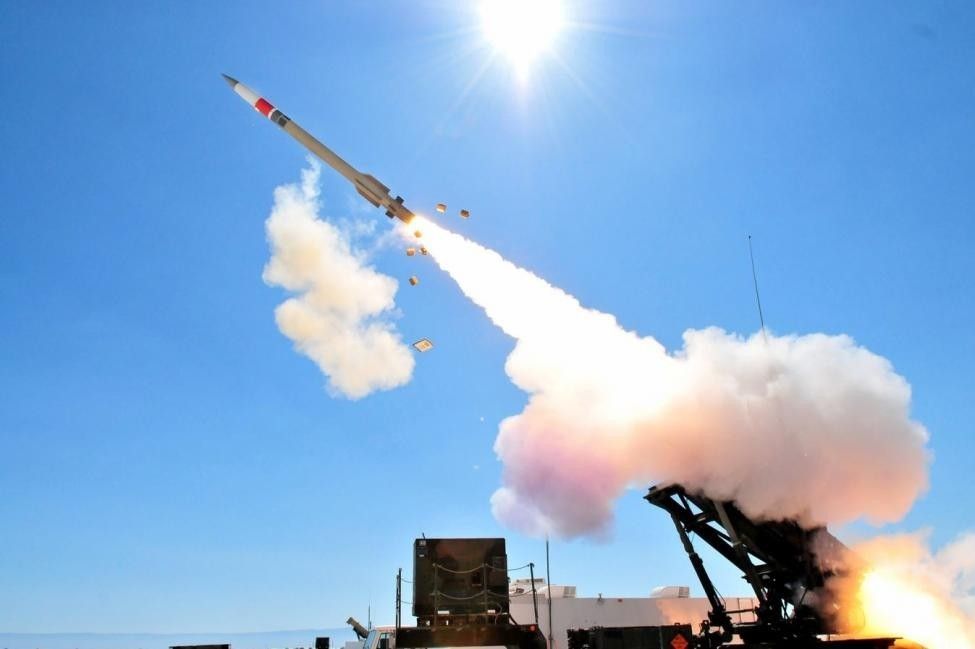
The politician declared continued support for the government in Kyiv. This refers to assistance in both the energy and humanitarian sectors. There were also references to the continued desire to support Ukrainian anti-aircraft defence (not only through the purchase of American Patriot missiles). The desire to achieve greater independence from US effectors is prompting the Union to seek its own, cheaper systems. According to von der Leyen, an example of such European-Ukrainian cooperation is to be, among others, Project Freya (work on which is being conducted by the Ukrainian company Fire Point along with Germany, France, the United Kingdom, Sweden, and Norway).
The head of the European Commission also referred to the sanctions imposed on the Russian Federation. In her opinion, in the near future, European Union states should place greater emphasis on tightening existing sanctions packages.


