












- ANALIZA
- WIADOMOŚCI
Russia’s veto exposed the UN’s weakest point

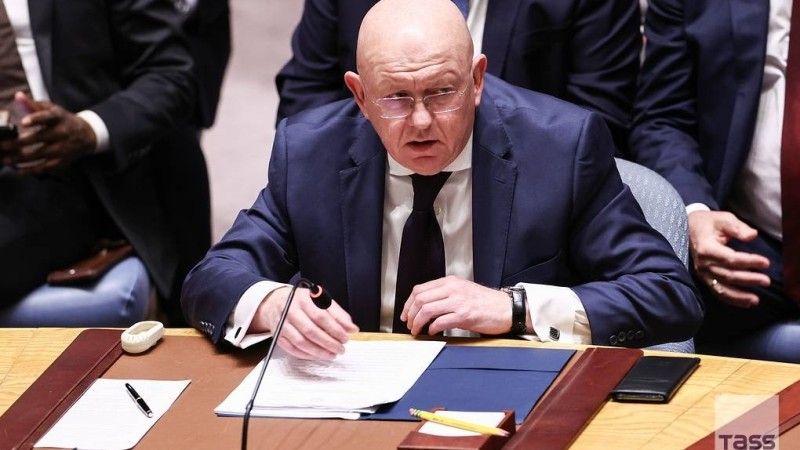
Photo. X/TASS Agency
Russia’s invasion of Ukraine exposed one of the deepest contradictions within the United Nations system: a permanent member of the Security Council can launch a war against another state and at the same time retain the right to block decisions concerning its own actions. This institutional paralysis has become one of the strongest arguments for reforming the UN, yet the war has also shown that the organisation remains indispensable in humanitarian assistance, evacuation operations and efforts to reduce the global consequences of the conflict.
Since the beginning of the full-scale invasion, the debate over the effectiveness of international institutions has focused particularly strongly on the United Nations, which was created after the Second World War to maintain international peace and security. The war in Ukraine demonstrated, however, that the organisation faces a structural problem when one of the permanent members of the Security Council becomes the aggressor, because the same state that is accused of violating the principles of the UN Charter retains significant influence over the organisation’s most powerful decision-making body.
Russia’s position in the Security Council is central to this problem because its veto allows Moscow to block resolutions that directly concern its own actions. There is no simple legal mechanism that would allow the international community to remove Russia from the Security Council or deprive it of its permanent membership without fundamental changes to the institutional architecture of the United Nations. This has created a situation in which the state responsible for launching the war can participate in decisions regarding the international response to that same war.
The contradiction has intensified calls for a reform of the UN system, particularly of the Security Council, its composition and the rules governing the use of the veto. Critics argue that the current model reflects the balance of power created in 1945 rather than the political realities of the twenty-first century, while the war in Ukraine has demonstrated how easily the Council can become paralysed when the interests of one of its permanent members are directly involved. At the same time, any serious reform would require agreement among states that currently benefit from the existing system, which makes fundamental institutional change extremely difficult.
However, evaluating the United Nations exclusively through the failure of the Security Council would provide an incomplete assessment of its role during the war. Russia’s aggression created one of the largest humanitarian crises in Europe since the Second World War, forcing millions of Ukrainians to leave the country and millions more to become internally displaced. In response, UN agencies expanded their presence, launched large-scale humanitarian programmes and mobilised billions of dollars to support people affected by the conflict.

The organisation’s activities have included food assistance, shelter, medical support, protection of vulnerable groups and coordination with Ukrainian authorities and other humanitarian actors. This dimension of the UN response has been significantly more effective than its political role, primarily because humanitarian agencies do not depend on the same decision-making mechanisms as the Security Council. The difference between these two levels of activity is essential to understanding why the organisation can appear simultaneously ineffective at the political level and indispensable at the humanitarian one.
Even in the humanitarian sphere, however, the United Nations has encountered serious limitations, particularly in territories occupied by Russia. Moscow has repeatedly restricted access for international humanitarian organisations, making it difficult to deliver assistance to populations living outside the control of the Ukrainian government. The problem became particularly visible after the destruction of the Kakhovka Dam in June 2023, when requests for access to affected areas under Russian occupation were rejected, generating criticism from Kyiv and highlighting the dependence of humanitarian operations on the consent of the occupying power.
Despite these restrictions, the UN achieved several important results that demonstrated the continued value of international mediation. Together with the International Committee of the Red Cross, it participated in efforts to organise the evacuation of civilians from the Azovstal steelworks in Mariupol, while its involvement in negotiations concerning Ukrainian agricultural exports contributed to the functioning of the Black Sea Grain Initiative. The agreement allowed tens of millions of tonnes of agricultural products to leave Ukrainian ports and reduced some of the pressure on global food markets.
These achievements illustrate the fundamental paradox of the United Nations during the war. The organisation was unable to prevent the invasion and has been incapable of forcing Russia to end its aggression, but at the same time its agencies have provided humanitarian assistance on a scale that few other institutions could replicate. The problem therefore lies less in the absence of activity than in the gap between the ambitions of the UN system and the political constraints imposed by the structure of the Security Council.
The war in Ukraine has also revived the broader debate over whether the existing collective security system can function when a major power openly violates its basic principles. The Security Council was designed around the assumption that the most powerful states would assume particular responsibility for maintaining international stability, yet the conflict has demonstrated what happens when one of those states itself becomes the source of instability. This is not a temporary procedural problem, but a structural weakness embedded in the organisation’s design.
For that reason, proposals for reform are likely to remain part of the international debate even after the war ends. Some argue for limiting the use of the veto in cases involving mass atrocities or direct aggression, while others propose changes to the composition of the Security Council or a stronger role for the General Assembly. Yet any reform that significantly reduces the privileges of permanent members will encounter resistance from precisely those countries whose approval would be necessary to implement it.

The war has therefore not made the United Nations irrelevant, but it has exposed the limits of what the organisation can achieve in a confrontation involving a permanent member of the Security Council. Its humanitarian capacity remains substantial and its role in mediation can still produce tangible results, but its ability to enforce peace is constrained by the political structure created at the end of the Second World War. The central question is therefore not simply whether the UN works, but whether it can be reformed sufficiently to remain credible in a world in which great-power rivalry once again shapes international security.


