












- ANALIZA
- WIADOMOŚCI
FBI Director planned Moscow visit. Why is he heading there?

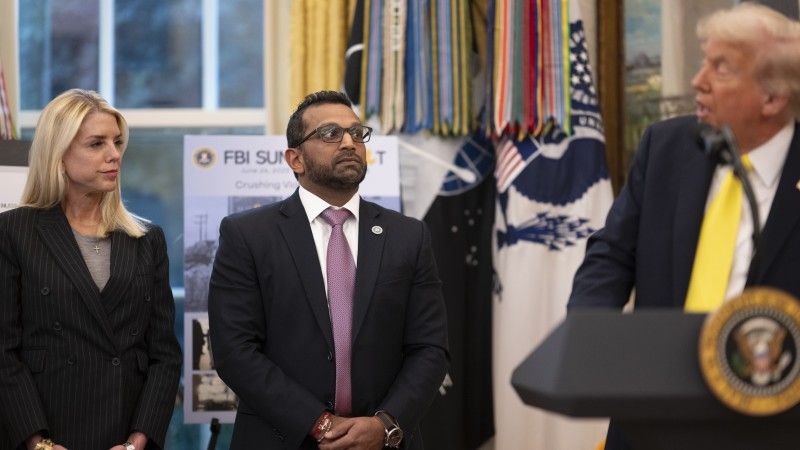
Photo. The White House/whitehouse.gov/gallery/president-donald-trump-participates-in-a-press-conference-in-the-oval-office/
Reports that FBI Director Kash Patel may visit Russia have prompted criticism in the United States and questions about the actual purpose of the trip. Some Russian media outlets, meanwhile, are attempting to portray it as a sign that Moscow and Washington continue to maintain working-level contacts. The problem is that the FBI has officially confirmed neither the visit itself nor its agenda. Reports about Patel’s plans are based on anonymous sources, and the resulting information vacuum has rapidly been filled with political speculation.
A single primary source and no official confirmation
Among the publications analysed, the principal source of the information was Politico, which cited a US official and another person familiar with the preparations. According to these sources, Patel is expected to visit Russia in mid-October 2026, with Moscow and St Petersburg reportedly included in the itinerary.
According to Politico’s sources, Russia’s Federal Security Service, the FSB, would probably host the visit. However, this has not been officially confirmed by either the US or Russian side. It is also unknown whom Patel would meet or what issues would be included on the agenda.
The White House referred questions concerning the trip to the FBI. Neither the FBI nor the Department of Justice responded.
Reuters merely reported Politico’s claims, citing its findings without providing independent confirmation of the travel plans. This means that many of the subsequent publications do not constitute separate sources of information but merely repeat the original report.
The Kremlin’s response was similarly ambiguous. Dmitry Peskov neither confirmed nor denied the report, stating that visits of this kind usually take place behind closed doors.
At this stage, therefore, this should not be described as an officially announced visit, but rather as a travel plan reportedly under preparation and described by the media on the basis of anonymous sources.
FSB's possible role - the main source of controversy
Discussions between a US official and Russian representatives would not necessarily be extraordinary in themselves. Even states engaged in an acute conflict maintain limited communication channels on matters involving terrorism, detained citizens, cybercrime and other transnational threats.
The last known serving FBI director to visit Russia was Robert Mueller in 2013.
The political circumstances have changed fundamentally since that visit. Russia is waging a full-scale war against Ukraine, while relations between Washington and Moscow remain severely strained by the war, sanctions and Russian operations targeting Western states.
It should also be emphasised that the FSB is not an ordinary law-enforcement institution. It is Russia’s domestic security service and the successor to parts of the Soviet KGB. The possibility that it could host the FBI director therefore raises questions extending well beyond routine law-enforcement cooperation.
The Independent has highlighted both the FSB’s probable role and the absence of a disclosed agenda. It also noted that critics link their concerns to Patel’s previous statements and political associations.
It is also significant that the FBI director heads an institution responsible, among other things, for protecting the United States against foreign espionage, cyberattacks and influence operations. His meeting with representatives of the Russian security service would therefore require a clearly defined mandate and appropriate counterintelligence safeguards. It remains unknown, however, whether the planned trip concerns specific operational matters or broader political contacts.

Timing ahead of the election heightens suspicion
The visit would reportedly take place in mid-October, only a few weeks before the November congressional elections. The timing alone does not prove any connection between the trip and the election campaign. It is, however, politically sensitive because of the history of Russian interference in US elections and Patel’s personal involvement in disputes concerning the investigations into the matter.
The official “Report on the Investigation into Russian Interference in the 2016 Presidential Election” found that the Russian government interfered in the election in a sweeping and systematic manner. At the same time, the investigation did not establish that members of Donald Trump’s campaign had entered into a criminal agreement with the Russian government or coordinated the interference operation with it. These are two separate findings and should not be conflated.
The failure to establish criminal coordination between the Trump campaign and the Russian government does not therefore mean that no Russian interference operation took place. The report confirmed its existence but did not establish a criminal agreement between the campaign and Moscow.
See also 

Patel's past burdening the visit
Reactions to the announced trip also stem from the political past of the current FBI director. Kash Patel has for years been one of the most prominent Republican critics of investigations into Russian interference and contacts between Russia and individuals in Trump’s circle.
He rose to prominence as a staff member of the House Intelligence Committee, participating in Republican efforts to undermine the credibility of FBI investigations. He subsequently described the investigation on numerous occasions as a politically motivated hoax created by Trump’s opponents. The Washington Examiner describes him as one of the most outspoken critics of the FBI investigation into Russian interference in the 2016 election.
Additional questions were raised by the earlier disclosure that Patel had received a payment of USD 25,000 from Global Tree Pictures, a company headed by Russian-American producer Igor Lopatonok.
The Washington Post found that the company had paid Patel for participating in a production portraying him and other former members of the first Trump administration as victims of a conspiracy. The newspaper also described Lopatonok’s earlier projects, which promoted anti-Western views and narratives consistent with Kremlin messaging.
The payment itself does not prove that Patel is under Russian influence. It is, however, an aspect of his background that increases political suspicion surrounding the trip, particularly while its agenda remains unknown.

Democratic criticism and a lone voice from the MAGA circles
The strongest reactions have come from Trump’s opponents. Occupy Democrats portrayed the trip as Patel moving closer to the security apparatus of a state whose activities the FBI is tasked with protecting the United States against.
Democratic Senator Andy Kim of New Jersey also voiced criticism. He compared Patel’s planned trip to Russia with the Trump administration’s policy towards Canada and argued that Washington was treating adversaries as friends and friends as adversaries.
The New Republic presented the opposition as transcending party lines. Such a description, however, requires caution. In the material cited, the critical voice from the political right is represented primarily by Trump-aligned activist Laura Loomer. No evidence was presented of broad, organised opposition among the Republican Party leadership.
Loomer raised the issue of the planned trip in the context of a possible expansion of US sanctions against Russia and Moscow’s cooperation with Iran. Her criticism therefore rests on different grounds from that of the Democrats. It concerns primarily not Russian electoral interference, but the potential inconsistency of the Trump administration’s security policy.
There are, however, no grounds for using Loomer’s single critical statement to claim that there is broad opposition within the MAGA movement or across the American right.
The conservative Washington Examiner adopted a more measured tone. The outlet does not portray the mere possibility of a visit as an act of capitulation to the Kremlin. It nevertheless highlights the undisclosed agenda, the war against Ukraine, US military assistance to Kyiv, sanctions against Russia and controversies surrounding Patel’s use of publicly funded travel. It also recalls his long-running campaign against the investigation into Russian interference and the payment connected with a production by the company associated with Lopatonok.
Against this background, the question arises as to whether Patel will be able to draw a clear distinction between his responsibilities as FBI director and his previous political activities and close ties to Trump’s circle.

Russian commentary: from Russiagate to Iran and China
Some Russian media outlets are attempting to interpret the possible visit as evidence of the existence of working-level, non-public channels between Moscow and Washington. There is, however, no single, coherent Russian interpretation. Individual commentators have advanced differing and unconfirmed hypotheses.
Pavel Dubravski, quoted by Focus Mail, proposed three possible explanations for the trip. The first was that Patel might participate in talks concerning the Russian-Ukrainian war. Dubravski himself regarded this scenario as unlikely, noting that the FBI director is responsible for counterintelligence and domestic security rather than diplomacy.
The second possibility was that Patel might be interested in materials concerning the investigation referred to by Trump and his supporters as “Russiagate.” The third hypothesis involved a possible search for information about the Biden administration’s relations with Volodymyr Zelensky and the Ukrainian authorities.
Dubravski also acknowledged the possibility of security-related discussions, but stressed that any such trip should be regarded as a working visit rather than an indication of a comprehensive change in Russian-American relations.
These are, however, merely the commentator’s speculations. There is no information indicating that any of the subjects mentioned would actually appear on the agenda.
Oleg Khlobustov presented other hypotheses. In remarks reported by Gazeta.ru, he suggested that the trip could be connected with an attempt by Washington to influence Russian-Chinese relations. Khlobustov also speculated that the United States might be interested in securing at least passive Russian assistance in connection with the conflict in the Middle East and its policy towards Iran.
These claims are likewise not based on a disclosed agenda for the visit. They represent the opinions of a Russian commentator rather than information originating from the FBI, the White House, the Kremlin or the FSB.
See also

Announcement itself can be propaganda-exploited
Irrespective of the trip’s actual purpose, the mere report that the FBI director may visit Russia has potential propaganda value for Moscow.
The Moscow Times cited a specific example of a similar event being exploited for propaganda purposes: Russian state media portrayed the participation of a representative of Trump’s circle in the St Petersburg International Economic Forum as evidence of a diplomatic shift towards Russia.
Were Patel to be officially received by the FSB, Russian media could use the image to argue that, despite the war, sanctions and allegations concerning Russian influence operations, Washington once again regards the Russian security services as a partner for dialogue.
This does not mean that the visit itself would constitute a concession to the Kremlin. It means only that the absence of a transparent explanation of its purpose makes it easier for Moscow to assign the trip its own political meaning.
Contacts between security services do not necessarily constitute a concession
Discussions with the FSB should not automatically be regarded as political capitulation. States engaged in conflict sometimes maintain limited contacts on specific operational matters. Refusing all communication can make it more difficult to address problems involving terrorism, detained citizens, cybercrime or international security. The key questions, however, concern who conducts the talks, under what mandate and for what purpose.
Should Patel’s trip concern specific operational matters and be coordinated with the appropriate institutions of the US administration, it could form part of normal threat management.
If, however, the FBI director were to establish an informal political channel between the Trump administration and the Russian security services, questions would arise regarding the limits of his authority and the circumvention of traditional diplomatic channels.
From an analytical perspective, a senior official’s visit to a state conducting extensive intelligence activity against the United States would involve heightened counterintelligence risks. In such an environment, electronic devices, meeting venues and informal contacts could create opportunities to obtain information, monitor the delegation or attempt to exert pressure. This does not mean that any such measures have already been taken against a potential Patel delegation.

Lack of answers as the principal problem remains
At this stage, the most justified criticism concerns not the intention to speak with Russian representatives in itself, but the lack of transparency. It is unknown who invited Patel, who approved the trip, which institutions are involved in preparing the agenda or which issues would be discussed. It is not even known whether the trip will take place in accordance with the media plan.
As a result, Trump’s opponents see the possibility of another political gesture towards the Kremlin. Laura Loomer interprets the trip through the prism of Russia’s relations with Iran, while Russian commentators speculate about Russiagate, Ukraine, China and the Middle East.
None of these interpretations has been confirmed.
Reports of Patel’s trip became a political problem even before any official announcement was issued. This resulted from a combination of several factors: the FSB is reportedly the probable host, the agenda remains unknown, the timing falls ahead of the congressional elections, and the FBI director has for years been involved in disputes concerning Russian interference and the credibility of investigations conducted by US agencies.
The visit may ultimately prove to be a technical meeting concerning specific security issues. It could also become part of a broader channel of communication between the Trump administration and Moscow.
Until the FBI presents the purpose and scope of the discussions, it is impossible to determine which of these interpretations is correct. What can be said is that the continuing uncertainty makes it easier for the Kremlin to portray the planned trip as evidence that Russia’s isolation is weakening and that direct contacts with the most important US security institutions are being restored.


