- ANALIZA
- WIADOMOŚCI
Friction between India and Russia: Everything under control

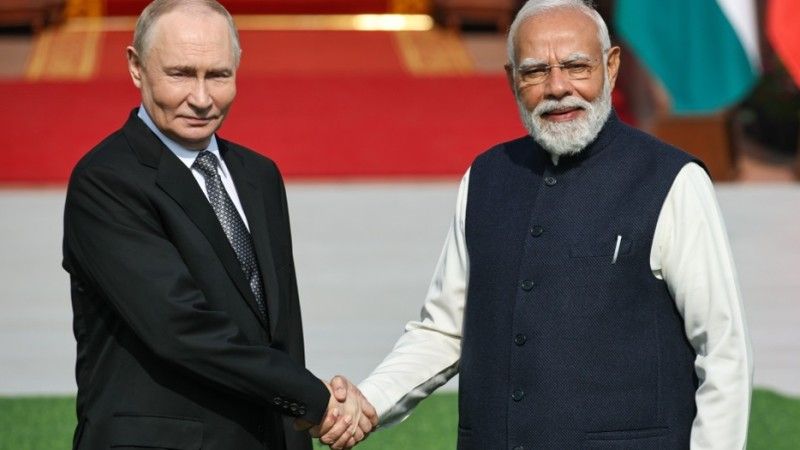
Four Indian sailors were killed in a Russian attack on a commercial vessel in the Black Sea. India summoned the Russian Chargé d’Affaires. However, the incident will not undermine the strong India-Russia relationship.
In recent weeks, India has been gripped by widespread student protests over the scandal involving the leak of question papers for the national medical entrance examination, which ultimately led to the exam being cancelled. In Delhi, a permanent sit-in protest has been established, with one activist threatening a hunger strike. Public anger is running high. The authorities are attempting to defuse the tension, but a quick resolution does not appear imminent. At one point, several metro stations in the city centre were even closed.
It was precisely during this period of domestic turmoil that serious diplomatic friction arose between India and Russia – though media coverage of the incident was naturally overshadowed by the student protests.
On the evening of 19 July, Russian forces attacked the vessel „Golden Leo”, which was sailing under the flag of Guinea-Bissau. The ship was in the Black Sea, departing from the port of Odesa and carrying corn. It was clearly a civilian commercial vessel with no connection to military activities. The ship was seriously damaged, and the attack, carried out with three missiles, killed 10 of the 17 crew members. Among the dead were four Indian citizens.
This was the first such incident since March 2022, when a single Indian student was killed during the Russian shelling of Kharkiv while attempting to evacuate as part of ”Operation Ganga” – the Indian government’s successful effort to evacuate over 20,000 of its citizens (mostly students) from Ukraine. Since then, there had been no Indian civilian casualties in the Russia-Ukraine war. The „Golden Leo” incident was therefore exceptional in the context of India-Russia relations.

For context, on 11 June, three Indian sailors had been killed in similar circumstances – though in a different theatre of conflict, near Oman, with the United States as the attacking party. India responded firmly at the time, summoning the US Chargé d’Affaires in Delhi and issuing a strong protest. „These attacks must cease and end. We also call for dialogue and diplomacy so that we can have an early return to peace and stability in the region,” the spokesperson for India’s Ministry of External Affairs stated. The Indian government did not demand compensation, but the Indian Seafarers« Union sought it, and the families of the deceased requested government support.
When Russia carried out an almost identical act a month later, India had to respond in a similar manner – despite its frequently demonstrated sympathy towards Russia. The Ministry of External Affairs summoned the Russian Chargé d’Affaires and issued a strong protest. In its statement, the MEA noted that „such attacks undermine the safety, security, and stability of international maritime commerce.” In response, Russia stated that it remained in contact with the Indian side but had no intention of abandoning its chosen strategy and would continue strikes against targets such as the „Golden Leo”. According to Moscow, these vessels were transporting weapons for Ukraine and were serving military rather than civilian purposes. Russian officials also claimed they had „explained their position to India.” On 22 July, India’s External Affairs Minister S. Jaishankar met his Russian counterpart Sergey Lavrov on the sidelines of the ASEAN summit in Manila, conveyed India’s „strong concern” over the incident, and then discussed further deepening of bilateral cooperation.

It is worth noting that India has long pursued a policy of paying particular attention to the safety of its citizens during armed conflicts involving third parties. „Operation Ganga” was not the only such evacuation in recent years. New Delhi routinely evacuates its nationals from conflict zones and consistently urges warring parties to exercise caution regarding Indian citizens. This established policy, combined with the fact that an almost identical incident involving the United States had occurred just a month earlier, prompted India’s sharp reaction to the tragic event caused by Russian forces.
There is, however, no possibility that this matter will overshadow India’s core strategic interests – namely, defence cooperation and the purchase of discounted Russian oil. Both are of critical importance to New Delhi. In recent years, both sides have attempted to expand cooperation into new areas, but with limited success. Apart from arms and oil, Russian products hold relatively little appeal for the Indian market. Indian consumers and businesses strongly prefer American, Chinese, and European goods. Nevertheless, the two key pillars – defence and energy – are significant enough to ensure that bilateral relations will remain solid despite the Black Sea incident.

Even if such incidents were to recur, it is difficult to imagine them having any real impact on the relationship between New Delhi and Moscow. At the same time, this does not mean India will not maintain strong ties with the West. For India, this is not a zero-sum choice. New Delhi is actively developing cooperation with Russia, the European Union, and the United States. A Free Trade Agreement with the EU is expected to enter into force next year, while trade negotiations with the United States are also progressing.